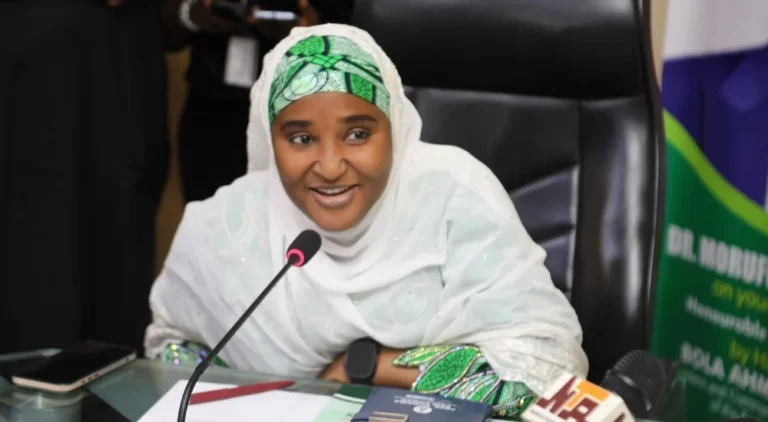

There is palpable anxiety and unrest in the Peoples Democratic Party (PDP) over plans by five of its governors to defect in the coming days.
Information gathered revealed that two of the governors are serving their second terms, while others are serving their first terms, according to information obtained by the Daily Sun.
Join our WhatsApp community
The PDP ruled 13 states following the national elections in 2023, including the states of Edo, Delta, Bayelsa, Rivers, Akwa Ibom, Enugu, Osun, and Oyo.

Other states that have governors from the opposition party include Adamawa, Taraba, Zamfara, Plateau, and Bauchi. In Edo State’s most recent off-season governorship election, however, the All Progressives Congress (APC) defeated the PDP.
The PDP now has just 10 states after Delta State Governor Sheriff Oborevberi and his Akwa Ibom counterpart Umo Eno, together with members of their Houses of Assembly and other party leaders, recently defected to the APC.
According to reports, the ruling APC is stepping up its efforts to woo five of the PDP’s surviving governors to defect from the opposition.

A member of the PDP National Working Committee (NWC) confirmed to news correspondents that the APC is making concerted efforts to win over some of PDP governors, especially those from the South. This is said to be a part of President Bola Tinubu’s strategy for the next general elections.
Join our WhatsApp community
The NWC member claimed that the APC wants to control all of the Southern states in order to support President Tinubu’s second chances, but he asked to remain anonymous due to the delicate nature of the matter.
However, Bala Mohammed, the governor of Bauchi State, has maintained that the PDP’s ongoing problems and defections were being planned from outside.

The Bauchi governor, who spoke at a meeting of the PDP NEC, yesterday, said: “We have been engrossed in controversies and challenges, not created by us, but created for us, and we have been navigating, unlike the other parties, irrespective of the manifestations and the perceptions there.
“The news of people leaving the party are all cosmetic. They are all created to diminish us.”
Meanwhile, Senator Samuel Anyanwu’s reinstatement as national secretary was confirmed by the PDP National Executive Committee (NEC) yesterday.
Senator Adolphus Wabara, the BoT, praised the NWC members for their commitment to cooperating for the party’s benefit. He asked the party leaders to prevent such cracks from occurring in the future.

He said, “We shall survive. The god of politics is in this party. Allah politics is in this party. For anybody, any other party, to succeed, we have to release our God to bless them. But our God knows that PDP is the beacon of hope for this country.”
Members of the party’s Board of Trustees (BoT) were supposed to convene at the NEC Hall by 10am, but there was a commotion when the security personnel, who had taken control of the main entry into the party secretariat, blocked their admittance. Tension at the Wadata Plaza increased when some PDP secretariat employees objected to the BoT members’ inability to enter the meeting space.
Join our WhatsApp community
Umar Tsuari, the former national secretary of the PDP, informed reporters that no meetings were permitted at the Wadata Plaza and that the security personnel were acting on directives from the top.
As a result, the BoT was forced to move its meeting to the Central Business District (CBD) of Abuja, specifically to the Shehu Musa Yar’Adua Centre.
Join Our Social Media Channels:
WhatsApp: NaijaEyes
Facebook: NaijaEyes
Twitter: NaijaEyes
Instagram: NaijaEyes
TikTok: NaijaEyes

, the fund will provide credit-risk protection to participating financial institutions, helping them lend to businesses that might otherwise struggle to meet conventional lending requirements. The model is designed to support up to $1 billion in outstanding credit capacity. The initiative will bring together lenders, business-support organisations, investors and other financing partners to create a structured route for eligible businesses to obtain commercial loans. Unlike a conventional loan programme that directly disburses money to applicants, the fund will share part of the lending risk with participating financial institutions. Banks will still assess applications, approve loans and manage repayments. ## How the $200 Million SME Fund Will Work The financing initiative targets businesses that have moved beyond the early stages of development and are ready to borrow to support further growth but face difficulties securing adequate credit. Under the proposed arrangement, eligible businesses can initially access loans in local currency equivalent to $250,000, subject to approval by participating lenders. The initiative aims to make loans of up to $1 million available when fully funded. The fund will work with venture capital firms, business accelerators and other SME ecosystem partners to identify and recommend potential borrowers. These organisations can help demonstrate a business's track record and readiness for debt financing. The fund will then apply its eligibility criteria, guarantee requirements and portfolio-risk assessments. Its assessment process will also use artificial intelligence-powered underwriting and due diligence. Participating financial institutions will retain responsibility for independently evaluating borrowers, deciding whether to approve applications, disbursing funds and monitoring repayments. According to [BusinessDay](https://businessday.ng/technology/article/cascador-sterling-target-sme-collateral-barriers-with-200m-credit-backstop/), the model is intended to reduce the collateral and guarantee burden on businesses with proven commercial traction. Cascador chief executive officer Trish Thomas said Nigerian entrepreneurs often struggle because the capital available to them does not match their business needs or stage of development. She explained that sharing risk with lenders could help more established businesses obtain the financing needed to scale and generate employment. Sterling Bank Group Executive Obinna Ukachukwu said the partnership combines additional credit protection with referrals from venture funds and studios familiar with the businesses they support. This approach, he noted, could give lenders greater confidence to offer larger loans with longer repayment periods. ## Why the Initiative Matters to Nigerian SMEs Access to affordable and appropriate financing remains a significant obstacle for businesses seeking to expand in Nigeria. Many enterprises require capital to purchase equipment, improve production, enter new markets and recruit workers, but conventional lending conditions can make borrowing difficult. Cascador's white paper, *The Multiplier Model*, highlights the wider challenge. According to the organisation, only 22 per cent of businesses in Sub-Saharan Africa have a bank loan or line of credit, compared with a global average of 36 per cent. The new fund seeks to bridge this gap by encouraging commercial lenders to finance businesses that have demonstrated demand for their products or services but cannot easily secure suitable debt. For entrepreneurs, the potential benefits include access to larger loans, longer financing periods and reduced pressure to provide extensive collateral or guarantees. However, the arrangement does not guarantee approval, and businesses will still need to satisfy the relevant eligibility requirements and lender assessments. The fund is also expected to attract contributions from philanthropic organisations, impact investors and development finance institutions to support its risk-sharing structure. ## Back Story: Sterling Bank and Cascador Expand an Existing Partnership The announcement builds on an earlier financing partnership between Sterling Bank and Cascador. In May 2025, the organisations introduced a $2 million Catalytic Fund to provide growth financing to businesses emerging from Cascador's entrepreneur development programme. As reported by [PUNCH Newspapers](https://punchng.com/cascador-sterling-bank-unveil-2m-fund-for-nigerian-smes/), the earlier initiative combined debt financing with business support, flexible repayment arrangements and reduced collateral requirements. The new $200 million fund represents a broader approach, designed to bring additional ecosystem partners into the financing process rather than rely solely on businesses connected to Cascador. Cascador said it had supported 80 ventures since 2019, with those businesses collectively raising more than $150 million in capital. For Nigeria's SME sector, the success of the expanded initiative will depend on how effectively it mobilises funding, attracts participating lenders and makes financing accessible to qualified businesses. If implemented successfully, the model could help more Nigerian enterprises secure the capital needed to grow, strengthen local industries and create sustainable employment.](https://naijaeyesblog.com/wp-content/uploads/2026/10/Sterling-Cascador-768x432.avif)