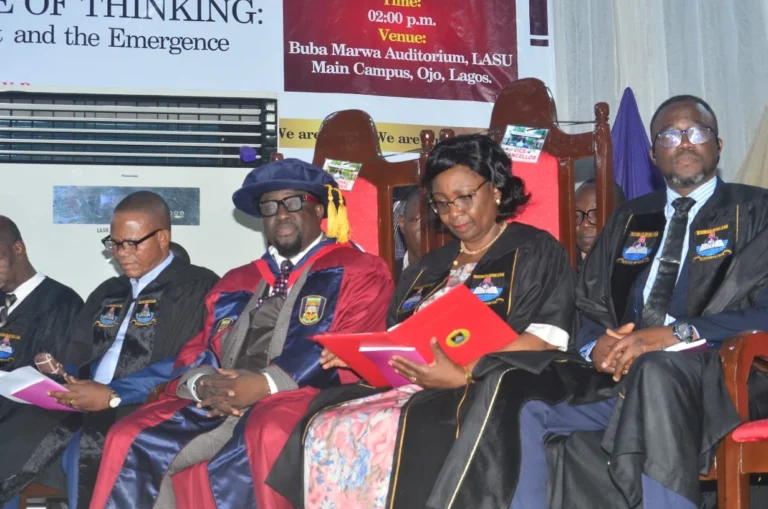
In Cape Town on 11 November 2025, the stage was set for a pivotal moment in Africa’s digital journey. At the annual AfricaCom 2025, Dr. Song Xiaodi — President of the Small Cell Product Line at Huawei Technologies Co., Ltd. — delivered a keynote entitled “Seize Three Opportunities to Build a Digital Africa”. His message: Africa stands on the cusp of transformation, and now is the time for action.
Dr. Song stressed that the global digital economy is accelerating rapidly, and Africa’s share is set for extraordinary growth. He pointed out that over 170 countries already have established digital strategies, while Africa is demonstrating what he called “great ambition” in this domain.
For Nigeria — and the wider continent — the implications are enormous. With its youthful demographics, rising mobile penetration and expanding tech-savvy population, the continent is poised for a leap. But it needs the right infrastructure, user-experience push and green foundation to fully unlock that potential.

Ubiquitous Connectivity: The Foundation for Change
The first major opportunity identified by Dr. Song centres on ubiquitous connectivity. Simply put: networks alone are not enough. What matters is reaching every corner — villages, farms, classrooms — and enabling them to plug into the digital world. huawei
You can picture it: a child in a rural Nigerian town joining a live session in an urban university; a small-scale farmer using mobile internet to sell produce direct to market; a teacher engaging remote pupils via video. Dr. Song illustrated this by referencing a region in Papua, Indonesia, where connectivity opened new horizons for remote communities. huawei
For Nigeria, the challenge is familiar: bridging the divide between urban hotspots and off-grid communities. But the prize is big. Reliable connectivity lays the groundwork not just for access, but for innovation. It becomes the platform on which digital services, commerce, learning and more are built.
Elevating the User Experience in 5G and Beyond
The second opportunity is about moving past “just connectivity” into the era of experience. Dr. Song urged operators and stakeholders across Africa to upgrade networks and services so that next-generation technologies — 4K/8K video, 3D, immersive reality — become part of everyday life.
He cited the case of a South-East Asian operator that achieved a 15 % uplift in ARPU (Average Revenue Per User) by deploying strong 5G infrastructure combined with strategic pricing and service design. That example is particularly relevant to Nigerian operators: better tech + better experience = additional value.
In essence, once the network infrastructure is in place, the next step is to make it meaningful. To deliver services that users care about, that business models can monetise, and that contribute to a thriving digital economy. For Nigeria, that means tailoring experiences to local needs, not simply replicating models designed elsewhere.
Green Development: Sustainability as a Core Pillar
The third opportunity Dr Song highlighted is perhaps the most forward-looking: the link between digitalisation and sustainability. He emphasised that going green isn’t a hurdle — it is a necessary and beneficial complement to digital growth.
One telling example: in Mali, Huawei has implemented a green energy solution that powers remote network base stations entirely with renewable energy. The result: ~10 tons of carbon emissions cut annually and operational cost savings of about €20,000 for local operators.
Why this matters for Nigeria: our climate, our geography, the diversity of infrastructure means that digital roll-out must be sustainable if it’s to last. Renewable-powered networks, efficient energy usage, and planning for environmental resilience will distinguish the future-proof projects from short-term wins.
A Call to Action: Partnering for a Digital, 5G & Green Africa
Pulling these threads together, Dr. Song concluded with a message of commitment. He noted that Africa is in the midst of its transition from 3G to 4G and already into 5G — and that despite global economic uncertainty, the one stable anchor is technological innovation.
Huawei reaffirmed its support for African operators to expand connectivity, create added value and accelerate digital transformation. The aspiration is to unlock what he termed “Africa’s digital productivity” by building a future that is digital, 5G-enabled and green.
For Nigeria, what this means is clear: don’t wait. This isn’t a passive future; it’s a moment of momentum. Network providers, government agencies, tech firms, educational institutions and entrepreneurs all have a role. The three opportunities — connectivity, experience, sustainability — form a kind of roadmap. But the vehicle will be partnerships, investment, localised innovation and execution.

Why This Matters for Nigeria
While the speech by Dr. Song is framed in continental terms, its relevance for Nigeria cannot be overstated. Consider:
- With Africa’s digital economy projected to grow six-fold by 2050, Nigeria stands to capture a significant slice, given its size and young population.
- Connectivity still remains a challenge in many Nigerian rural regions — meaning the first opportunity is both urgent and impactful.
- Elevating user experience via 5G and advanced services opens doors for new revenue streams: streaming, VR/AR, digital commerce, remote work, education.
- Embracing green development means digitalisation won’t be at odds with environmental goals — vital for Nigeria’s long-term strategy.
Conclusion
As someone who has followed the digital transformation landscape across Africa, I’m struck by how this moment feels different. It’s not simply about rolling out networks or ticking boxes. It’s about seizing a window where Africa can craft its own digital narrative — with inclusion, innovation and sustainability at its core.
What stood out from Dr. Song’s address is that the three opportunities are interlinked: you can’t have meaningful user experiences without connectivity; you can’t sustain scale without green foundations; you can’t unlock the digital economy without all of the above working in harmony.
For Nigeria, the question isn’t “if” but “how fast, how well and how inclusively.” Will the country map out strategies aligning with these opportunities? Will operators and institutions reflect local realities in their deployment? Will sustainability be seen not as a cost, but as a strategic asset?
The time is now. The opportunity is there. And with the right alignment of vision, policy and execution, Nigeria — and Africa at large — can truly build a “Digital Africa” that delivers for its people, its economy and its future.
Join Our Social Media Channels:
WhatsApp: NaijaEyes
Facebook: NaijaEyes
Twitter: NaijaEyes
Instagram: NaijaEyes
TikTok: NaijaEyes