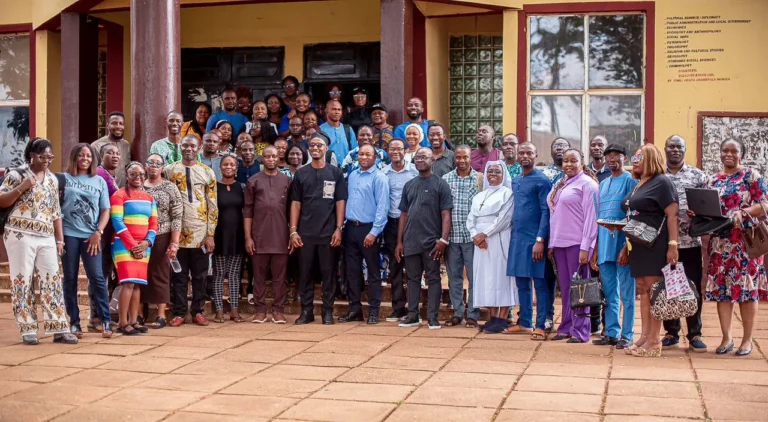
At a high‑profile workshop in Abuja, the Ministers of Education and of Communications, Innovation and Digital Economy declared a fresh national commitment: to build a unified, interoperable, and inclusive digital education system that will transform learning across Nigeria. The event, held under the banner of the Nigeria National EdTech Strategy Mid‑Term Co‑creation Workshop, brought together stakeholders from government, donors, and development partners such as Mastercard Foundation and World Bank Group. The ministers described the initiative as more than policy talk: it is meant to be a clear, coordinated push away from the fragmented efforts of the past.
This unified push signals the beginning of a bold shift — from a patchwork of isolated digital‑learning programmes to a national ecosystem where classrooms, teachers, infrastructure, and data work together for lasting impact.

From dusty chalkboards to digital classrooms
According to the Minister of Education, Dr. Tunji Alausa, Nigeria can no longer accept outdated teaching methods while preparing young people for a digital global economy. “Doing nothing, or doing what we did before, is a total failure,” he said. Aware of the urgency, he revealed that hundreds of smart schools and digital teaching platforms are already being deployed across the country. Within four months, every classroom in federal government‑owned secondary schools is to receive a smart board with full internet access.
Recognising the economic realities many teachers face, the government is working on zero-rated data access. This will allow teachers to access online training platforms at no cost. Also, starting January, teachers who complete verified online professional development courses will begin receiving structured compensation. Efforts are being made not just to install hardware, but to build resilient systems that ensure smart boards and digital tools remain functional and effective for lasting benefit.
Beyond infrastructure, the strategy includes launching real-time online subject instruction for junior secondary students. These lessons, delivered by master teachers, will be accessible to both public and private schools nationwide — widening access and leveraging scarce teaching capacity more efficiently.

Building a full digital education ecosystem
The minister of communications, innovation and digital economy, Dr Bosun Tijani, emphasised that a modern education system must rest on more than devices. He drew parallels with Nigeria’s financial sector ,whose interoperable infrastructure enables money transfers across banks in seconds. “Education needs the same approach,” he said. According to Dr Tijani, an effective digital education system must include content creators, educators, telecom providers, device manufacturers, maintenance technicians, regulators and investors. Without such an ecosystem, technology risks being wasteful spending rather than a meaningful investment.
In recognition of the nation’s digital divide, Dr Tijani announced planned infrastructure investments, including the installation of 4,000 telecommunications towers, aiming to connect more than 30 million Nigerians currently without internet access. These towers will be linked to a nationwide fibre‑optic backbone to lower data costs and improve connectivity nationwide. Whether in inner‑city slums, remote villages, or internally displaced persons camps, the goal is for every child to gain access to digital learning content.
The government is also exploring ways to make smart devices more affordable. Talks are ongoing around local manufacturing options that leverage Nigeria’s lithium deposits for battery production. The idea is to sustainably reduce device costs and support the local industry.
To bring order to previously fragmented efforts, the government will roll out the Nigeria Education Data Infrastructure (NEDI). This unified data system will enable cross‑platform communication, integrated learning records, and streamlined national‑level planning and monitoring. This is a critical step toward ensuring accountability and measuring progress. As Dr Alausa remarked, “Education must speak with one voice.”
Preparing Nigeria for a $1 trillion future economy
The ministers argued that Nigeria’s ambition to become a $1 trillion economy cannot succeed without modernising its education system. Transforming schooling into a skills-driven, technology-powered engine is no longer optional: it is essential. Dr Tijani warned that any teacher who fails to understand basic tools like artificial intelligence is already falling behind.
The outcome of the workshop is expected to be a concrete blueprint outlining steps to achieve EdTech interoperability, robust teacher training, nationwide digital inclusion, and real-time content delivery. The ministers pledged that the strategy will not be another lofty document gathering dust. Instead, it will lead to measurable and irreversible transformation across the country.
For a country with millions of young people, the stakes are high. If implemented effectively, this national EdTech vision could reshape Nigeria’s classrooms, expand access, improve learning quality, and equip a new generation with the skills needed for the 21st‑century economy.
Join Our Social Media Channels:
WhatsApp: NaijaEyes
Facebook: NaijaEyes
Twitter: NaijaEyes
Instagram: NaijaEyes
TikTok: NaijaEyes