Nigeria’s communications regulator and leading telecom operators are calling for urgent, unified action to build Africa’s artificial intelligence infrastructure. Their warning: if the continent does not act now to build local capacity, it risks being left behind in the new global economy dominated by AI.
A Shared Warning on Africa’s AI Future
During a high-level virtual forum convened by Africa Hyperscalers, regulators, cloud providers, hyperscalers, data centre operators, and tech industry leaders came together to assess what it would take for Africa to be competitive in an AI-driven world. (punchng.com)
The meeting opened with a keynote address from the head of the Nigerian Communications Commission (NCC), Aminu Maida. He argued that AI must now be recognised as fundamental national infrastructure, as important as roads, power supply and ports in determining a country’s competitiveness. He said countries that build robust digital foundations now will tap into “new productivity, new jobs, new opportunities,” while those that do not will be resigned to consuming technology developed elsewhere. (punchng.com)
Dr Maida identified what he termed the continent’s “compute divide, algorithmic divide and data divide” as urgent obstacles. He said local governance of data and development of African AI models are essential to avoid being left behind.
The Infrastructure Gaps: What Needs to Be Built
According to the forum, Africa currently lacks adequate infrastructure to support modern AI workloads. What is required are strong investments in several interconnected areas: high-capacity data centre facilities, cloud infrastructure, high-speed connectivity, stable power supply, skilled talent and effective policy and governance frameworks.
Presently, the continent hosts just over 210 data centres, nearly half of them concentrated in four key markets, including Nigeria. In Nigeria itself, there are roughly 21 active data centres, most located in Lagos, giving the country a total capacity of only 56.1 megawatts as of 2025. Experts at the forum argued that to meet growing demand, Nigeria will need to increase its data centre capacity nearly fourfold by 2030.
Speakers from across the industry emphasised that data centres intended for AI must meet stringent requirements: high availability, advanced cooling (liquid cooling), resilient networks and dependable power supply. Without reliable connectivity and stable energy, it will be impossible to “talk about AI” in any serious way.
On the power question, one industry executive noted Africa may need decentralised power policies, data centres may soon have to “bring their own power,” drawing from new gas corridors or other local energy solutions.
Telecom Sector Eyes Practical AI Use Cases, But Collaboration Is Key
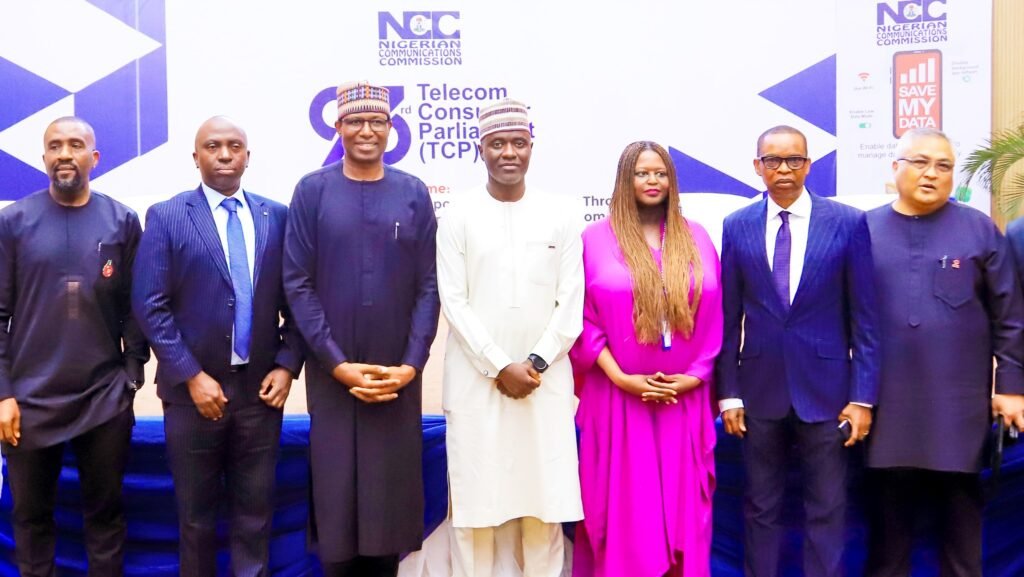
Far from being a futuristic dream, AI is already becoming relevant to telecom operations. Association of Telecommunications Companies of Nigeria (ATCON) president Tony Emoekpere said telecom firms in Nigeria are increasingly using AI for predictive maintenance, customer service improvements, network efficiency and operational analytics.
Still, Emoekpere warned that these benefits will remain limited if telecom firms act in isolation. He argued that only coordinated efforts across the sector, and collaboration with regulators, cloud providers, investors and government, will unlock the full potential of AI.
A panel of experts echoed the same view. Executives from major telecom operators, data centre firms and regulatory bodies highlighted that only a cross-industry ecosystem can deliver scalable, sustainable AI infrastructure. No single entity can build it alone.
The Path Forward: What Nigeria and Africa Must Do
The consensus from the forum was clear: Africa’s digital future depends on a deliberate, coordinated push for AI infrastructure development. That means:
- Massive expansion of data centre capacity, built to global standards for reliability, cooling, connectivity and energy.
- Investment in cloud infrastructure and high-speed connectivity.
- Strengthening power supply, or building decentralised energy solutions to support data centre operations.
- Cultivating local talent through training, partnerships between industry and universities, and practical skills development.
- Enacting policy and governance frameworks that ensure data sovereignty, interoperability, security and adaptive regulation.

According to Dr Maida, the regulatory authorities are committed to enabling this transformation through open access frameworks, support for cloud adoption, data centre development, cybersecurity oversight, and regulation adapted to the demands of AI.
What emerges is a picture of renewed hope: Africa might yet catch up in the global AI race, if stakeholders fully embrace collaboration, investment, and long-term planning.
In Nigeria, as elsewhere in Africa, the choice seems clear. Invest in the foundations now, or accept a future in which the continent consumes technology designed in distant lands. The recent call from NCC and major telecom operators could well mark the start of a determined push for local AI readiness.
Join Our Social Media Channels:
WhatsApp: NaijaEyes
Facebook: NaijaEyes
Twitter: NaijaEyes
Instagram: NaijaEyes
TikTok: NaijaEyes