Dubai has just taken a major step forward in 5G-Advanced (5G-A) connectivity with a new partnership between du, a leading telecom provider in the United Arab Emirates, and global technology company Huawei. This collaboration marks the debut of a 25Gbps E-band microwave link integrated into a live 5G-A network, bringing fibre-like capacity to wireless transport in areas where laying fibre is costly or difficult, according to Huawei.
From dense city centres to rural edges, operators like du face growing pressure to support rapidly rising data traffic and deliver reliable, high-speed connectivity. With this deployment, the company is ready to meet these challenges head-on while laying a foundation for future generations of mobile broadband.
A Big Day for UAE Connectivity
On the ground in Dubai, du has signed a three-year innovation agreement with Huawei following the successful launch of the world’s first commercial 25Gbps E-band microwave link at a 5G-A site. The deal goes beyond traditional equipment supply. It lays out a framework for ongoing research and co-development, with a focus on enhancing network performance and meeting the insatiable demand for wireless data services.
This deployment resolves one of the most pressing challenges in next-generation mobile networks. Legacy wireless transport links often lack the capacity to handle 5G-A’s significant bandwidth needs, especially where optical fibre is scarce or deployment costs are prohibitive. The new solution closes that gap with unprecedented speed and reliability.
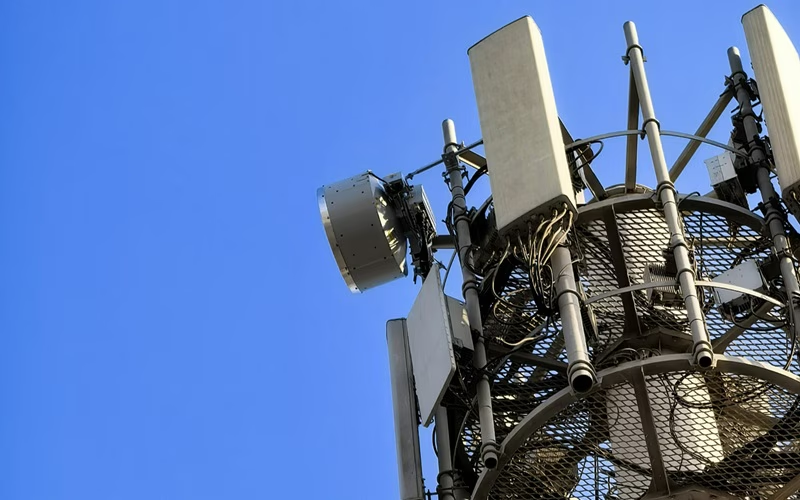
At the heart of this innovation is Huawei’s state-of-the-art E-band microwave technology. Operating at frequencies around 80GHz, E-band links can carry large amounts of data over long distances without needing fibre. With peak capacity now reaching 25Gbps over a single radio link, the performance rivals that of many optical solutions.
What This Means for Mobile and Digital Services
For consumers and businesses in the UAE, the practical benefits of this rollout will be significant. du’s upgraded network can now support high-capacity applications that require rapid throughput, low latency, and dependable performance. These services include advanced 5G applications, real-time cloud computing, and sprawling Internet of Things ecosystems that underpin everything from smart cities to industrial automation.
The new microwave transport also enhances network resilience. Wireless solutions can be deployed faster than fibre and adapted to a range of environments. That means rural communities, business districts, and event venues can all benefit from improved connectivity without lengthy construction or disruption.
du’s Chief Technology Officer, Saleem Alblooshi, captured the moment by highlighting the strategic importance of the deployment. He emphasised that combining fibre-equivalent capacity with wireless flexibility allows du to address varied connectivity needs, from bustling downtown areas to remote regions that have historically lagged in digital access.
Huawei’s role in the partnership was underscored by James Zeng, President of Huawei’s Microwave Product Line. He explained that large-capacity E-band transport is a key direction for ongoing innovation in wireless networks. Technologies like the intelligent beam tracking antenna and high-power 2T2R modules help mitigate issues that usually challenge high-frequency links, such as antenna sway or signal alignment problems.

How the Technology Works and Why It Matters
Microwave transport has been a cornerstone of mobile network backhaul for decades, especially in regions where fibre is limited or too expensive to install. In traditional 5G networks, microwave links typically offer up to 10Gbps per site, which was sufficient in earlier phases of deployment. However, the jump to 5G-Advanced brings a dramatic increase in required capacity, driven by data-intensive services and more connected devices.
E-band microwave technology operates in the 80GHz frequency range, which allows significantly greater data throughput compared to conventional microwave bands. Advanced signal processing, antenna design, and modulation techniques have helped push this technology to deliver up to 25Gbps in live networks, a performance level once only achievable with fibre.
The power of E-band also lies in its flexibility. Because it is wireless, deployment times are far shorter than laying cable. This agility can make a big difference in markets where rapid expansion of connectivity infrastructure is critical. Operators can respond more quickly to spikes in demand, technological shifts, or coverage gaps without waiting months for fibre installation.
Huawei’s implementation also includes intelligent mechanisms such as advanced beam tracking. These functions help maintain link quality even when environmental conditions challenge stability, such as wind or slight shifts in antenna alignment. By combining high transmit power with responsive signal control, the solution keeps performance consistent across different scenarios.
Impacts on Future Networks
Beyond immediate benefits, the UAE project sets a precedent for how carriers can evolve their networks toward future technologies. Achieving 25Gbps backhaul capacity in a commercial 5G-A network means operators can support new use cases that 5G alone could not sustain. These range from immersive virtual reality and augmented reality experiences to automated industrial systems and next-generation cloud services.
As mobile networks continue to evolve toward 6G and beyond, robust transport infrastructure will be an indispensable foundation. Wireless microwave solutions like those deployed by du and Huawei offer a complementary path to fibre, especially where optical access remains limited or impractical.
Industry observers have noted that microwave transport will continue to play a vital role even as more fibre is deployed worldwide. The combination of high capacity, low latency, and flexibility makes E-band links a powerful tool for both current networks and future expansions.
A Step Forward for Regional Telecom Innovation
The success of this deployment also demonstrates the growing technical prowess of operators and vendors in the Middle East and North Africa region. In recent years, partnerships between global technology companies and regional carriers have brought forward several digital infrastructure milestones. Earlier examples include commercial 25Gbps E-band links launched by Huawei and Vodafone in Egypt, which helped position the country as a regional hub for ultra-high-speed connectivity and digital services.
For the UAE, du’s announcement reinforces its ambition to lead in digital transformation. Enhanced connectivity plays directly into national strategies for economic diversification, smart city implementation, and digital inclusion. Reliable and high-speed mobile networks support everything from education and healthcare to tourism and financial services.
From the perspective of global telecom innovation, deployments like this one point to a future where wireless and fibre technologies work together to create resilient, high-performance networks. Carriers will have more options to design hybrid infrastructures that balance cost, speed, and geographical reach.

Conclusion
The integration of a 25Gbps E-band microwave link into a live 5G-Advanced network in the UAE represents a defining moment in mobile network evolution. By combining Huawei’s advanced wireless transport technology with du’s forward-looking network strategy, this partnership delivers fibre-equivalent capacity with the deployment flexibility that modern operators need.
Consumers and businesses across the UAE can expect faster, more reliable internet services, while the regional telecom sector gains a blueprint for future network upgrades. This project confirms that high-capacity microwave transport will remain essential as networks push into deeper advanced milestones and support ever-expanding digital demands.
Join Our Social Media Channels:
WhatsApp: NaijaEyes
Facebook: NaijaEyes
Twitter: NaijaEyes
Instagram: NaijaEyes
TikTok: NaijaEyes