Gold Shatters Records: The $4,383.76 Surge Explained
The “Midas touch” has returned to the global markets with a vengeance. On Monday, December 22, 2025, spot gold prices defied gravity, scaling a new all-time peak of $4,383.76 per ounce.
This isn’t just a minor fluctuate; it’s a historic breakout that has pushed the yellow metal past its previous October record of $4,381.52. As an economic analyst specializing in precious metals, I can tell you that we are witnessing a “perfect storm” of monetary easing, labor market cracks, and geopolitical friction.
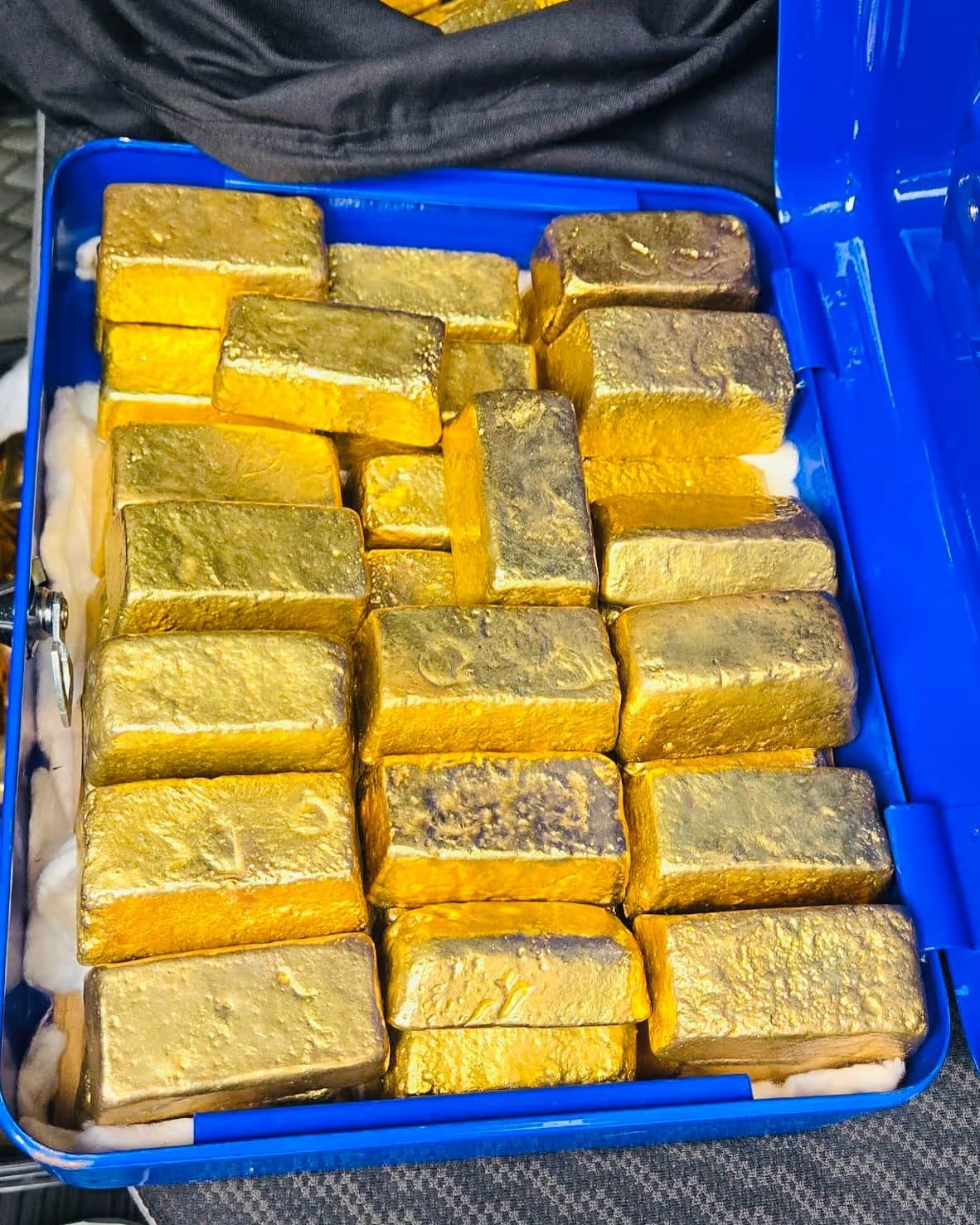
Table of Contents
The $4,383 Breakout: What Just Happened?
The “Triple Threat” Driving the Rally
Gold vs. The Fed: The Opportunity Cost Theory
Beyond 2025: Is $5,000 Gold the New Reality?
Expert Advice: Should You Buy the Peak?
The $4,383 Breakout: What Just Happened?
In early Monday trade, gold futures and spot prices surged as investors digested a “dovish” cocktail of economic news. This latest rally represents a staggering 67% year-to-date gain, cementing gold as the top-performing major asset class of 2025.
While the previous October high of $4,381.52 acted as a psychological ceiling for weeks, the current momentum suggests that the market has fundamentally reset its “price floor” higher—with $4,000 now appearing to be the new $2,000.
The “Triple Threat” Driving the Rally
The surge to $4,383 was not accidental. It was fueled by three primary economic catalysts that converged over the weekend:
🇺🇸 Cracks in the Labor Market: Recent data showed the U.S. unemployment rate unexpectedly ticked up to 4.6%, signaling that the high-interest-rate environment of the past two years is finally cooling the “engine” of the U.S. economy.
📉 Easing Inflation: Core Consumer Price Index (CPI) figures released last week showed inflation rising at its slowest rate since early 2021. This gives the Federal Reserve “green light” to continue cutting rates without fear of reigniting price spirals.
🛢️ Geopolitical Tensions: A U.S. blockade of Venezuelan oil tankers and ongoing friction in Eastern Europe have re-energized gold’s role as a “safe-haven” asset.
Gold vs. The Fed: The Opportunity Cost Theory
To understand why gold is rising, you have to understand its relationship with interest rates. Gold is a non-yielding asset, meaning it doesn’t pay a monthly dividend or interest like a bond or a savings account.
When the Federal Reserve cuts rates (as they did three times in late 2025), the “opportunity cost” of holding gold drops. If a bank account only pays 2%, the “penalty” for holding gold is low. When the market expects even more cuts in 2026, investors rush to gold to protect their wealth from a weakening U.S. Dollar.

Beyond 2025: Is $5,000 Gold the New Reality?
The consensus among major financial institutions is increasingly bullish. While gold’s 67% return in 2025 is unlikely to repeat exactly, the trajectory remains upward.
Bank of America & HSBC: Both have set a $5,000 target for 2026, citing continued Fed easing and massive central bank buying.
Goldman Sachs: Recently lifted its target to $4,900, noting that private sector investment into gold ETFs is just starting to accelerate.
Central Banks: For the first time since 1996, gold now accounts for a larger share of global central bank reserves than U.S. Treasuries—a massive structural shift in how nations store value.
Expert Advice: Should You Buy the Peak?
As an expert, I always caution against “chasing the green candle.” While the long-term outlook is bright, gold is currently in “overbought” territory.
The Strategy: Look for “healthy pullbacks.” Significant support levels are currently sitting at $4,290 and the psychological $4,000 mark. If the price dips to these levels, it may provide a more stable entry point for those looking to hedge against 2026’s economic uncertainty.
Join Our Social Media Channels:
WhatsApp: NaijaEyes
Facebook: NaijaEyes
Twitter: NaijaEyes
Instagram: NaijaEyes
TikTok: NaijaEyes