
US immigration lawyers are increasingly helping OnlyFans models, content creators, and social media influencers from Nigeria and other countries secure O-1 visas, citing their “extraordinary ability” under U.S. immigration law.
The trend follows President Donald Trump’s recent criticism of visa restrictions on Nigeria.
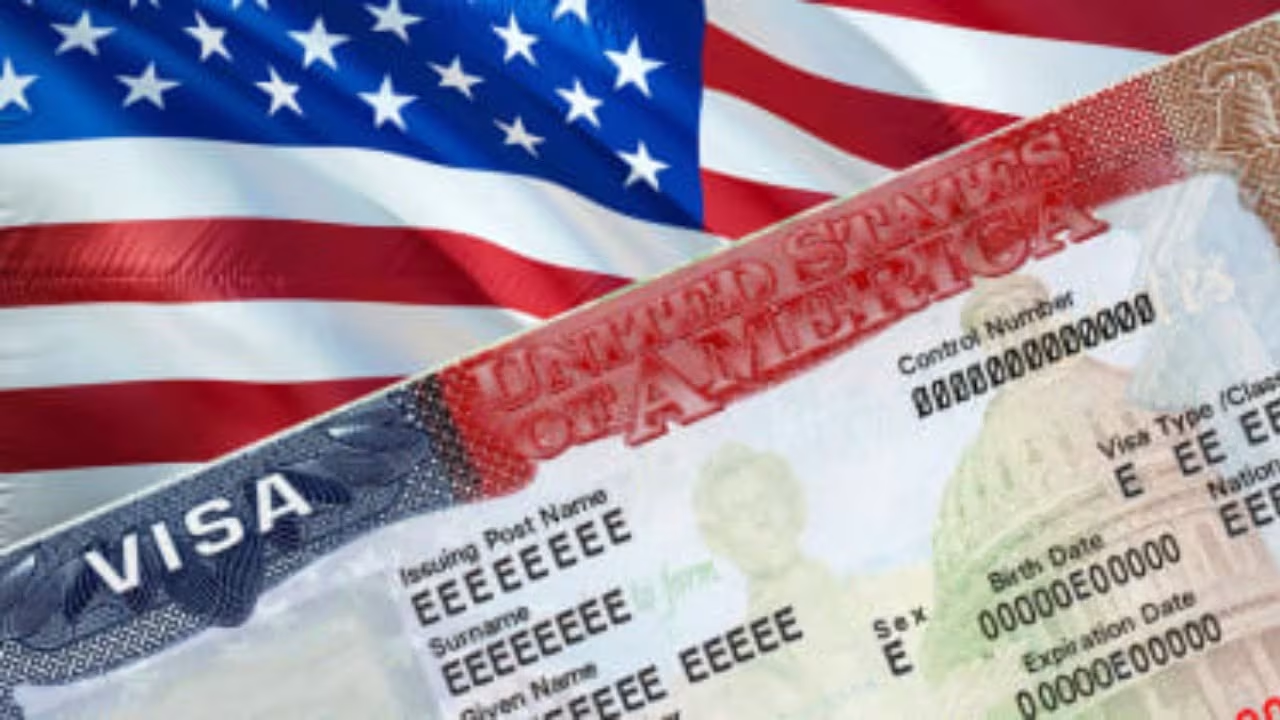
The O-1 visa, which is divided into O-1A and O-1B categories, is reserved for individuals with exceptional talent. O-1A covers fields such as science, education, business, and athletics, while O-1B is designated for the arts and creative industries.
Immigration lawyers have successfully argued that digital creators, influencers and adult content performers fall within the O-1B classification.
Amid restrictions affecting B-1, B-2, B-1/B-2, F, M and J visa applicants, some Nigerian influencers and content creators are exploring the O-1 route as an alternative pathway into the United States.
O-1 visas cannot be applied for directly by individuals; petitions must be filed through a U.S. employer or agent, typically with the assistance of immigration lawyers. Successful applicants may also bring dependents under the O-3 category.
Speaking to the Financial Times, prominent immigration lawyer Michael Wildes said a large proportion of his recent clients were social media personalities, whom he described as “scroll kings and queens.”
He noted that metrics such as likes, views and subscriber counts make it easier to demonstrate eligibility, as these figures can be used to quantify influence and commercial success.
According to immigration experts, brand endorsements, ambassadorial roles and influencer marketing deals may be presented as evidence of professional recognition.

Other qualifying factors include leading roles in productions, significant earnings, expert recognition and international exposure through published or featured works.
Fiona McEntee, another U.S. immigration lawyer, told the Financial Times that appearances at events such as store launches could qualify as “starring in a distinguished production” under O-1B criteria.
However, concerns have been raised that the growing use of the O-1B category by influencers and adult content creators could disadvantage applicants in science, education and other O-1A fields, where proving “extraordinary ability” often requires more complex documentation and subjective assessments.
Despite these concerns, immigration lawyers argue that approvals under the O-1B category remain relatively straightforward, particularly for applicants with substantial online followings and demonstrable commercial success.
Join Our Social Media Channels: