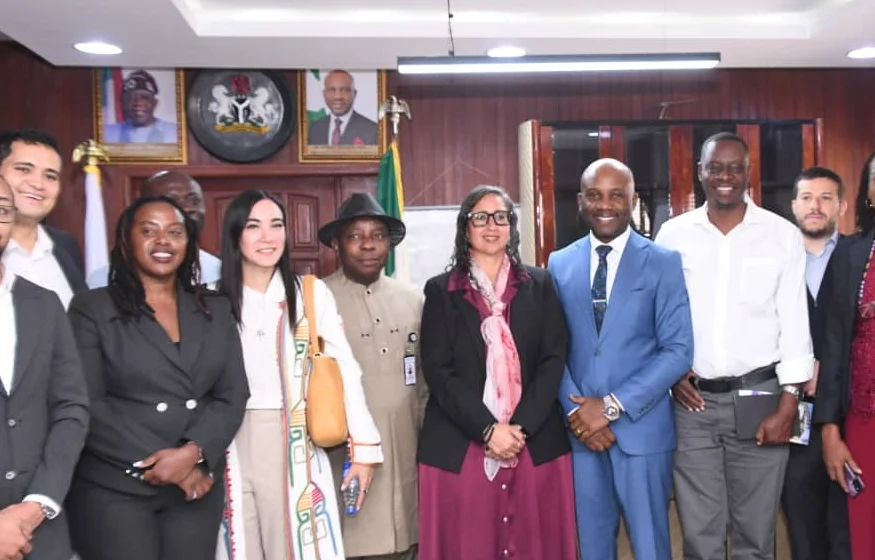
In a significant policy push this year, the Federal Government of Nigeria has placed science, technology and innovation at the centre of its economic transformation agenda. Speaking in Abuja, the Minister of Innovation, Science and Technology, Dr Kingsley Udeh, outlined an ambitious vision to strengthen the country’s scientific capacity and elevate Nigeria’s role as a science and innovation hub across Africa. His remarks came while hosting members of the Massachusetts Institute of Technology Kuo Sharper Center Foundry Fellows, a group of global innovation leaders visiting the nation.
Dr Udeh described the government’s approach to science, technology and innovation as a strategic priority aimed at closing the persistent gap between research and market-ready solutions. According to him, Nigeria boasts abundant creative talent and intellectual output, but translating these into products and services that drive business, jobs and national competitiveness has often fallen short. The new direction seeks to tackle this challenge head-on.
Udeh emphasised that the Federal Government’s commitment is rooted in the National Science, Technology and Innovation Policy, which articulates an unambiguous ambition to make the country one of the world’s leading scientific powers. Creating a thriving scientific ecosystem in Nigeria, he said, will depend on shifting from traditional supply-driven research approaches to a demand-led innovation environment that is responsive to industry needs and global trends.
Transforming Research into Market Solutions
A key component of the Federal Government’s strategy is the development of a national policy that will guide the commercialisation of research and innovation outputs. This policy, Udeh explained, reflects a deliberate move to embed commercial viability into the science and innovation ecosystem so that inventions and discoveries are more likely to create commercial value and societal impact.
Central to this strategy is the establishment of what the ministry terms an “Innovation Monetary Policy,” structured around a Gross Domestic Expenditure on Research and Development (R&D) framework. This mechanism will, for the first time, enable systematic measurement of Nigeria’s R&D investment, which currently stands at an estimated 0.16 percent of gross domestic product based on World Bank figures. The plan is not only to track how much Nigeria spends on research, but also to build momentum towards meeting broader continental targets for investment in innovation.
To support innovators and researchers, the ministry is preparing to launch a dedicated Commercialisation Fund. This fund will provide staged financial backing from early proof-of-concept phases right through to full deployment and scaling of innovations. The intention is to ensure that promising ideas do not falter at critical stages due to lack of capital, and that businesses can grow more sustainably.
Revitalising Nigeria’s network of technology incubation centres and innovation hubs forms another pillar of the strategy. These centres are intended to act as fertile grounds where startups and researchers can access the resources, mentorship and infrastructure needed to accelerate growth and compete in both domestic and global markets.
Leadership and Institutional Support for Innovation
Dr Udeh made it clear that the Ministry of Innovation, Science and Technology will take on a broad leadership role within the country’s scientific landscape. This includes providing institutional support that ensures innovators, entrepreneurs and scientists are not left to navigate structural challenges alone. He assured that alongside financial backing, entrepreneurs would gain access to partnerships, national and international networks, and market linkages that can amplify their potential.
The minister also appealed to the visiting MIT Foundry Fellows to collaborate with Nigerian innovators. He encouraged technology transfer initiatives, co-development arrangements, and investment opportunities that could deepen Nigeria’s integration into global innovation ecosystems. Udeh’s appeal highlighted the importance the government places on international cooperation as a complement to domestic capacity building within the STI sector.

Global Engagement and Local Impact
Earlier in the engagement, the Executive Director of the MIT Kuo Center Foundry Fellows, Dina Sherif, underscored the purpose of the visit as an opportunity for the fellows to engage directly with Nigeria’s entrepreneurial and innovation landscape. The visit was intended to provide firsthand insight into how local actors manage growth, confront volatility and address structural constraints in a dynamic business environment. The exchange of ideas and practices, she noted, could yield mutual benefits for Nigerian innovators and the global innovation community alike.
This interaction comes at a time when Nigeria is actively redefining its role in the global science and technology landscape and seeking partnerships that can facilitate knowledge exchange and investment. It also aligns with broader discussions across government circles about enhancing STI contributions to economic diversification. For example, previous government statements have emphasised the importance of STI in driving industrial transformation and competitiveness, and envisaged measurable allocations of national resources toward these objectives.
Building a science-driven economy is seen as foundational to achieving sustainable growth and creating quality jobs for Nigeria’s young and burgeoning population. Science and innovation are expected to play a critical role in sectors ranging from agriculture to manufacturing, digital trade, health and energy, contributing to national progress and positioning Nigeria as a competitive player on the African and global stages.
Conclusion
The Federal Government’s renewed focus on strategic science, technology and innovation growth reflects a broader commitment to redefining Nigeria’s economic future. By strengthening the commercialisation of research, institutionalising R&D measurement, providing targeted funding, and fostering both local and international partnerships, the government aims to unlock the nation’s scientific potential. This approach signifies a shift towards an innovation-driven economy that harnesses the creativity of Nigerian researchers and entrepreneurs to generate sustainable solutions and propel national development.
The coming months will be pivotal as policy frameworks are finalised and implementation begins, with stakeholders across sectors watching closely to see how these ambitions translate into measurable outcomes for the country.
Join Our Social Media Channels:
WhatsApp: NaijaEyes
Facebook: NaijaEyes
Twitter: NaijaEyes
Instagram: NaijaEyes
TikTok: NaijaEyes