
Huawei has unveiled a major advancement in mobile network technology with its FDD triple low-band Massive MIMO solution, a development positioned to reshape how operators expand coverage and capacity across both 4G and 5G networks. The announcement highlights a growing industry focus on making better use of low-band spectrum, which remains critical for wide-area connectivity, especially in emerging markets like Nigeria.
At a time when mobile data demand continues to surge across Africa and globally, Huawei’s latest innovation aims to address one of the most persistent challenges facing telecom operators: how to deliver faster speeds, broader coverage, and improved user experience without dramatically increasing infrastructure costs.
The company’s FDD triple low-band Massive MIMO builds on its earlier tri-band deployments but shifts attention to lower frequency bands, which are known for deeper penetration and wider reach. These characteristics make them especially valuable in rural areas and densely populated urban environments where consistent connectivity is still uneven.
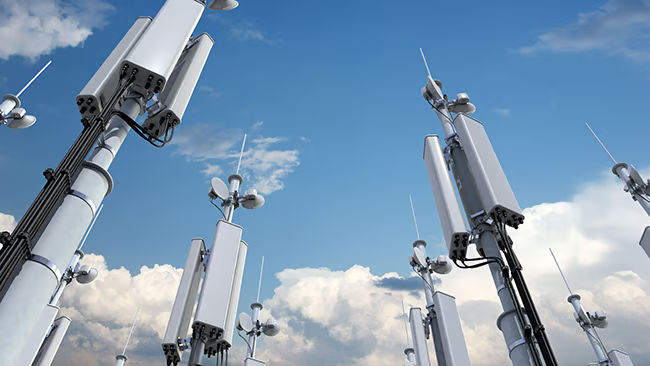
Rising data demand pushes innovation in network capacity
Across Africa, including Nigeria, mobile data consumption has been rising sharply due to increased smartphone adoption, video streaming, fintech services, and remote work. Huawei notes that 4G traffic alone has been growing by about 50 percent annually in some regions, placing enormous pressure on existing infrastructure.
Traditional network solutions such as 4T4R systems are increasingly struggling to keep up with this demand. In response, Massive MIMO technology has emerged as a key solution by enabling multiple antennas to transmit and receive data simultaneously, thereby boosting spectral efficiency and overall network performance.
Huawei’s earlier tri-band Massive MIMO already demonstrated strong results, including the ability to handle up to 90 percent more 4G traffic during peak periods and significantly improve user speeds. These gains laid the foundation for further innovation, leading to the development of the triple low band solution.
By focusing on low-band spectrum, Huawei is addressing a different but equally important dimension of network performance: coverage. Low frequencies travel farther and penetrate buildings more effectively than higher bands, making them ideal for ensuring stable connectivity in both cities and remote communities.
How the new technology improves coverage and efficiency
The FDD triple low-band Massive MIMO solution integrates multiple low-frequency bands into a single, compact system. This allows operators to maximise the use of fragmented spectrum resources while simplifying deployment.
One of the key innovations lies in Huawei’s ability to combine multiple bands into a unified antenna system without increasing the size or complexity of the equipment. Earlier versions of its technology already demonstrated that multiple bands could share the same antenna array and power system, improving efficiency and reducing hardware requirements.
This integrated approach delivers several benefits. First, it improves coverage by leveraging low-band frequencies that can reach wider geographic areas. Second, it enhances capacity by enabling more simultaneous connections and higher data throughput. Third, it reduces operational costs for telecom operators by minimising the need for additional infrastructure.
Field deployments of Huawei’s Massive MIMO solutions in African markets have shown notable performance improvements. In Senegal, for example, large-scale deployments achieved multiple-fold increases in both downlink and uplink capacity, helping to ease congestion during high-demand events.
In Nigeria, collaboration between Huawei and MTN has already demonstrated the potential of tri-band Massive MIMO, with significant increases in network capacity and user experience during peak usage periods.
Implications for Nigeria and emerging markets
For countries like Nigeria, where digital transformation is accelerating, but infrastructure gaps remain, the introduction of FDD triple low-band Massive MIMO could be particularly impactful.
Low-band spectrum is often more widely available and less expensive than higher-frequency bands, making it a practical option for expanding connectivity in underserved areas. By improving both reach and efficiency, Huawei’s solution could help operators extend reliable internet access to millions of people who are currently underserved.
This has broader economic implications. Improved connectivity supports digital banking, online education, e-commerce, and remote work, all of which are becoming essential components of modern economies. For Nigeria’s growing tech ecosystem, better network performance could unlock new opportunities for startups and digital services.
At the same time, the technology also supports the gradual transition to 5G. While 5G is often associated with high-frequency bands, low-band spectrum plays a crucial role in providing baseline coverage. Huawei’s solution enables operators to enhance existing 4G networks while preparing for more advanced 5G deployments.

The road ahead for Massive MIMO and mobile networks
Huawei’s FDD triple low-band Massive MIMO represents part of a broader evolution in wireless technology, where efficiency and integration are becoming just as important as raw speed.
Massive MIMO itself has already proven to be a transformative innovation, significantly improving spectral efficiency and enabling networks to handle more users and higher data volumes. The next phase of development is focused on making these gains more accessible and cost-effective for operators worldwide.
Looking ahead, the integration of multiple frequency bands, intelligent beamforming, and AI-driven network optimisation is expected to further enhance performance. Huawei has been actively investing in these areas, positioning its solutions as part of a larger ecosystem that supports both current and future connectivity needs.
For telecom operators, the challenge will be balancing investment costs with the need to deliver better services. Technologies like FDD triple low-band Massive MIMO offer a pathway to achieve this balance by maximising the value of existing spectrum and infrastructure.
As mobile networks continue to evolve, innovations that improve both coverage and capacity will play a critical role in bridging the digital divide. Huawei’s latest announcement signals a continued push in that direction, with implications that extend well beyond technology into economic and social development.
Join Our Social Media Channels:
WhatsApp: NaijaEyes
Facebook: NaijaEyes
Twitter: NaijaEyes
Instagram: NaijaEyes
TikTok: NaijaEyes