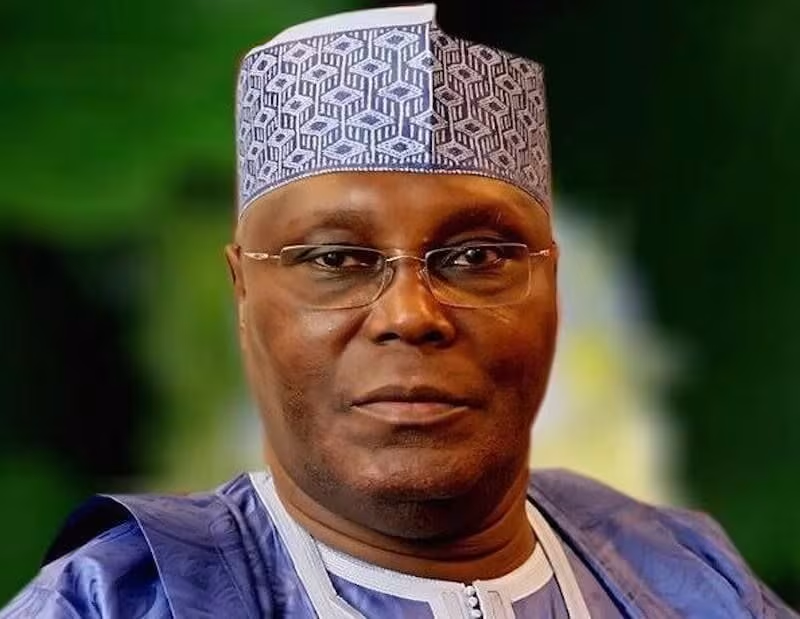

With the African Democratic Congress (ADC) primary election concluded, political attention has now shifted to who will emerge as the running mate to the party’s presidential candidate, Atiku Abubakar, ahead of the 2027 election.
Atiku had previously selected the current Nigeria Democratic Congress (NDC) presidential candidate, Peter Obi, as his running mate in the 2019 election, while former Delta State governor, Ifeanyi Okowa, served as his vice-presidential candidate in the 2023 polls.
A few weeks ago, Atiku secured the ADC presidential ticket after polling the highest number of votes at the party’s primary election.
Amid growing speculation over his possible running mate, reports suggest the former Vice President may be considering candidates from the South-East, with names such as Director-General of the World Trade Organization (WTO), Ngozi Okonjo-Iweala, and former Speaker of the House of Representatives, Emeka Ihedioha, being mentioned.
However, Director of Politics at Arise News, Sumner Sambo, disclosed that Okonjo-Iweala had reportedly distanced herself from the speculation, stating that she was unwilling to leave her current role as WTO Director-General for Nigerian politics.
Okonjo-Iweala became the first woman and first African to lead the WTO after assuming office on March 1, 2021. She reportedly began her second term in September 2023, with her tenure expected to run until 2029.
According to Sambo, she had already communicated her position directly to Atiku’s camp.
“Okonjo-Iweala is not willing to leave a lucrative position as WTO Director-General to consider such a move. She made that clear to them, which is understandable because she only resumed her second term recently,” he said.
Another prominent name linked to the vice-presidential speculation is former Imo State governor and ex-Speaker of the House of Representatives, Emeka Ihedioha, who is believed to be among those being considered by Atiku.
Beyond the South-East, there are also indications that Atiku may be considering the South-South region.
One of the names being mentioned is former Minister of Transportation and two-term Rivers State governor, Rotimi Amaechi, who was also a presidential aspirant.
Reports indicate that Atiku recently held a closed-door meeting with Amaechi, although details of the discussion were not disclosed. The meeting has since fueled speculation that it may be connected to the vice-presidential slot.
Meanwhile, an APC chieftain, Sogbeye Eli, argued that choosing a running mate from the South-East may not significantly boost Atiku’s chances because of Peter Obi’s strong influence in the region.
“Atiku has little room to gain votes through a vice-presidential candidate from either the South-East or South-West,” Eli stated during an interview.
In another development, ADC chieftain and former presidential candidate, Dele Momodu, stirred reactions online after sharing a campaign-style flyer portraying himself as Atiku’s running mate.
Alongside the flyer, Momodu wrote: “The Attraction of Atiku Abubakar/Dele Momodu ticket” and “The right choice for a greater Nigeria.”
Reacting to the ongoing speculation, Atiku’s Special Assistant on Public Communication, Phrank Shaibu, stated that the ADC candidate would choose his running mate based on competence and capacity rather than symbolism.
Speaking in an interview, Shaibu said the decision would be guided by what best serves the national interest and helps address Nigeria’s challenges.
He stressed that the role of Vice President should not be treated as that of a “spare tyre,” adding that the country needs a capable governing team.
“When the time comes, Nigerians should expect a choice based on competence, experience, and national interest,” he said.
Contributing to the debate, lawyer Maduabuchi Idam argued that selecting a running mate from the South-East could be Atiku’s strongest political strategy.
According to him, such a move could promote national cohesion, political balance, and help Atiku challenge Peter Obi’s influence in the region ahead of the 2027 election.
He noted that excluding the South-East from the ticket could lead to criticism and weaken support from voters in the region.