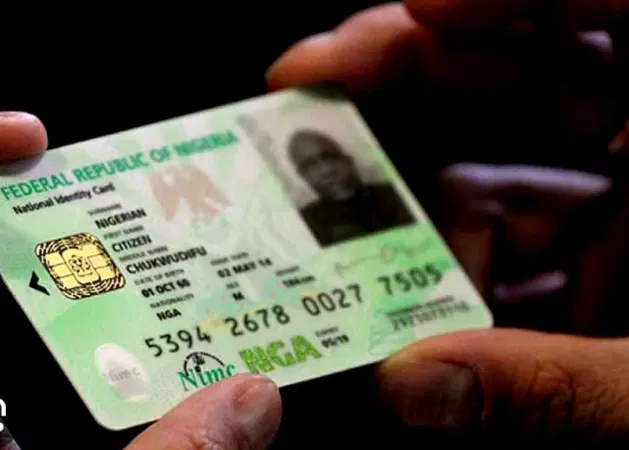

President Bola Tinubu has ordered the National Identity Management Commission(NIMC) to register all Nigerians in the national identity database by the end of 2026, according to the commission’s Director-General and Chief Executive Officer, Abisoye Coker-Odusote.
Speaking on Channels Television’s Sunday Politics, Coker-Odusote explained that this mandate is part of the Federal Government’s vision to build a comprehensive national identification system aimed at improving planning, governance, and public service delivery.
She said, “The President has given us till the end of this year to make sure that we capture every single Nigerian”
Explaining further, she notged that NIMC is collaborating with partners under the World Bank-funded Identification for Development (ID4D) project to accelerate registration across the country.
“What we have done is we have partnered through the World Bank ID4D project with front-end partners. They are part of the digital identity ecosystem. These are private citizens that we’ve enabled and given jobs to enrol citizens on our behalf,” she explained.
Coker-Odusote alsp disclosed that the exercise would also help determine Nigeria’s actual population, noting that current estimates range between 200 million and 250 million people.
“It is estimated that we’re 200 million. When we’re done enrolling, we will then know the actual numbers that we have. Some estimates say 230 million, while a few people say 250 million.
“Your identity is basically the foundation for effective governance and service delivery. How can you plan if you don’t know the total number of persons that you have? We have been mandated by Mr President to go down to the community levels to enrol every single Nigerian,” she said.

Multiple registration
Addressing concerns regarding multiple registrations, the NIMC head stated that the commission’s biometric verification system prevents individuals from obtaining multiple identities.
She explained that while the previous system only detected duplicate enrolments after records were submitted, the current system uses biometric verification to identify and invalidate duplicates instantly.
“The legacy system had no way of verifying at the front end whether you had already been captured. Once the record comes into the system, it flags it as a duplicate or that the person already exists in the database.
“You would only have one identity generated for you. The other record goes into a deduplication bucket where it is invalidated,” she said.
Rea Also: NIMC-Over 120 Million Nigerians Enrolled as Digital Identity Revolution Reaches Major Milestone
Backstory…
Since the introduction of the National Identification Number (NIN), authorities have repeatedly extended registration deadlines while linking the identity number to essential services such as SIM card registration, passport applications, banking, tax administration and social intervention programmes.
Millions of Nigerians rushed to enrol during the NIN-SIM linkage exercise, but the process exposed challenges including overcrowded enrolment centres, inadequate registration infrastructure and the difficulty of reaching people in remote communities.