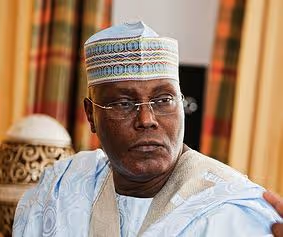

Presidential candidate of the African Democratic Congress, ADC, Atiku Abubakar, has called on the United States Federal Bureau of Investigation, FBI, to protect its investigators, confidential sources and sensitive investigative procedures while releasing any records concerning President Bola Tinubu that can legally be made public.
Atiku made the appeal in a statement issued on Saturday by his Senior Special Assistant on Public Communication, Phrank Shaibu, in reaction to the FBI’s request to provide confidential explanations for withholding certain records connected to investigations involving Tinubu.
The FBI had approached a US District Court for the District of Columbia, seeking approval to submit declarations ex parte and in camera, which would allow the agency to present its explanations privately to the court.
In an application dated August 20, the agency argued that publicly revealing all its reasons for withholding some documents could expose sensitive information and potentially put lives at risk.
However, Atiku disagreed that such concerns should result in the blanket withholding of records that are legally eligible for public disclosure. He maintained that the FBI could protect genuinely sensitive material while making available documents that the law permits the public to access.
The former vice president urged the agency to protect its personnel, confidential informants and legitimate investigative methods, while redacting information that must remain secret under US law.
He, however, warned against using concerns about sensitive information as a reason to prevent lawful public scrutiny of records relating to Tinubu.
“The FBI says disclosure could endanger lives, but Nigerians are already suffering and dying as a result of the hardship caused by the Tinubu administration’s economic policies,” Atiku said.
“The FBI says disclosure could endanger lives. Which lives? Nigerians are already dying,” he said.
Atiku linked the country’s economic hardship to the removal of the fuel subsidy, arguing that the policy has contributed to rising transportation costs, food prices and pressure on businesses and employment.
He explained that increased fuel costs affect transportation and production, with the effects eventually being felt by ordinary families through higher prices and reduced economic opportunities.
“Fuel affects transportation. Transportation affects food prices. Energy affects production. Production affects jobs. All of them determine whether an ordinary Nigerian family can survive until the end of the month,” Atiku said.
On the disputed FBI records, Atiku stressed that he was not asking the agency to reveal the identities of undercover officers, expose confidential sources or disclose sensitive investigative methods.
Instead, he said the FBI should make public any information that can legally be released while properly removing protected details from the documents.
“This is not an attempt to interfere in Nigeria’s politics. It is a humanitarian and democratic appeal because Nigerians have the right to access information that can legitimately be made public about those who exercise enormous power over their lives,” Atiku said.
Atiku maintained that Nigerians have a right to know relevant information concerning the background and character of individuals who hold significant power in the country.
He therefore urged the FBI to clearly distinguish between information that genuinely requires protection and records that can legally be released without compromising investigators, sources or ongoing investigative processes.
BACKSTORY:
The latest development is part of a long-running Freedom of Information Act (FOIA) case in the United States concerning FBI records linked to past investigations involving President Bola Tinubu. The FBI recently asked a US District Court in Washington, DC, for permission to privately explain why it believes certain portions of the requested records should remain confidential.
The agency argued that publicly disclosing its full reasons could reveal sensitive law-enforcement methods, expose confidential sources or potentially endanger individuals. Atiku Abubakar, however, insisted that while genuinely sensitive information should be protected or redacted, records that can legally be released should not be unnecessarily withheld from public scrutiny.
The issue has now become part of the wider political debate ahead of Nigeria’s 2027 presidential election, with Atiku arguing that Nigerians have a legitimate interest in information that can lawfully be disclosed about those holding significant public office.