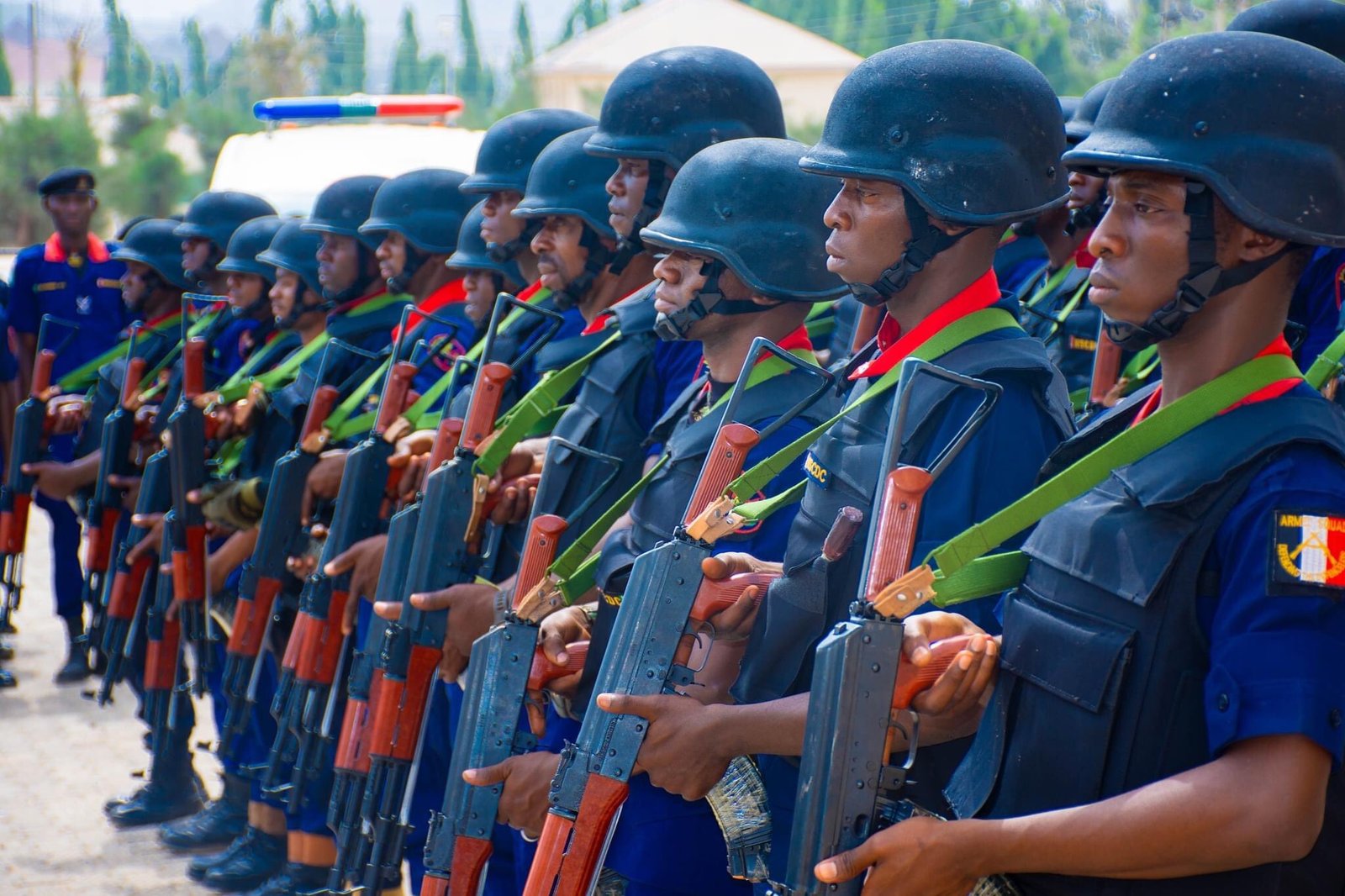

The Nigeria Security and Civil Defence Corps (NSCDC), FCT Command, has deployed 3,000 personnel across the Federal Capital Territory as part of heightened security measures for Nigeria’s 66th Independence Anniversary celebrations.
According to the Command, FCT Commandant Dr Olusola Odumosu authorised the deployment to strengthen security, maintain law and order, and protect lives and property before, during and after the anniversary events.
The Command said it had mobilised personnel from several specialised units for the operation in a statement issued on Tuesday and signed by the FCT Civil Defence Public Relations Officer, DSC Monica Ojobi.
The units involved include the Arms Squad, Female Strike Force, Crack Squad, Agro Rangers, Chemical, Biological, Radiological and Nuclear Explosives (CBRNE) Unit and Counter-Terrorism Unit.
The FCT Police Command has announced that its strategic security operations will focus on high-risk locations and vulnerable areas across the nation’s capital.
Targeted sites include Critical National Assets and Infrastructure (CNAI), alongside public facilities such as shopping malls, markets, motor parks, amusement centers, and recreational parks.
To prevent criminal activity and forestall potential security breaches during the upcoming festive period, the Command disclosed that plainclothes operatives have been deployed for covert surveillance and intelligence gathering, with heightened monitoring directed at uncompleted buildings and designated criminal hotspots throughout the territory.
Backstory…
Nigeria will mark its 66th Independence Day on October 1, 2026, six and a half decades after the country gained independence from British colonial rule in 1960.
The anniversary has since become an annual moment for the country to look back at its political, economic and social journey.
Nigeria’s post-independence history has included periods of civilian and military rule, a civil war, economic transformations driven largely by oil, and several attempts at political and economic reform.
Just recently, President Tinubu, in a pre independence message ahead of the anniversary, also urged Nigerians not to lose hope, adding that the country is on the path to greatness and that mistakes and missed opportunities will be addressed.
Read Also: Nigeria at 66- The Cost of Six Decades of Missed Opportunities