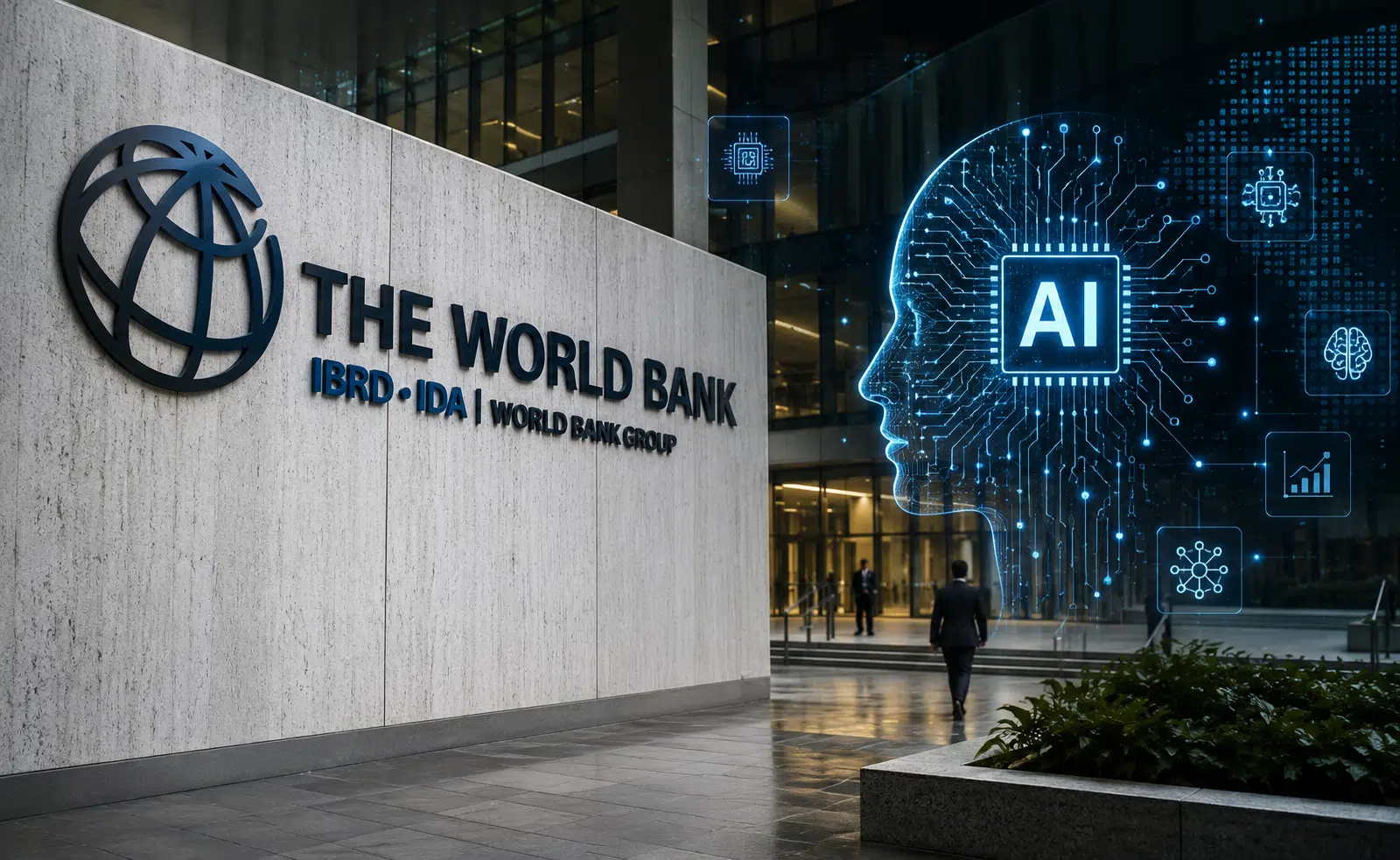

The World Bank is asking African countries to think differently about the artificial intelligence race. Rather than spending scarce public resources trying to build frontier AI systems immediately, the bank says Africa could get faster and more practical results from smaller AI applications designed around existing realities.
The message came in the World Bank’s latest Africa Economic Update, released on October 6, 2026. The report says most African countries are still at an early stage of AI adoption, although Kenya, Nigeria and South Africa are among the countries where activity is more visible. The bank says the bigger opportunity is affordable, locally adapted AI that can operate with limited bandwidth.
The World Bank projects economic growth in Sub-Saharan Africa to rise from 4.1 per cent in 2025 to 4.3 per cent in 2026. But it also warns that growth alone will not create enough jobs for a rapidly expanding workforce. AI therefore enters the conversation as a productivity tool, not simply a symbol of technological ambition.
Why smaller AI makes sense for Africa
The idea behind “Small AI” is straightforward. Instead of using a large general-purpose model for everything, developers can build or adapt smaller systems for specific jobs. Such tools may run on smartphones, basic computers or local hardware, and some can continue working when internet connectivity is weak or intermittent.
The World Bank has highlighted examples from agriculture, health and education in its Small AI, big impact report. In Kenya, the Nuru app can help farmers identify crop diseases from images and can work without continuous internet access. In Ghana, an AI-powered mathematics tutor called Rori uses WhatsApp and basic phones to provide personalised learning. The bank said students using the service for an hour a day over eight months gained an additional year of learning at about $5 per student.
These examples show what practical African AI adoption could look like. A useful system does not always need billions of parameters or an expensive data centre. The key may simply be solving a defined problem with a tool that fits the user’s network, device and budget.
The World Bank has also emphasised that small AI can deliver services through familiar platforms such as WhatsApp, SMS and other low-connectivity channels. In a recent World Bank expert discussion, officials pointed to small AI as a way of reaching people who rely on basic devices and unreliable internet connections.
Also Read: Why AI Skills Are Becoming Essential Across Every Profession
Nigeria and the wider African opportunity
For Nigeria, this approach could be particularly relevant. The country has one of Africa’s largest technology ecosystems, but businesses, schools, hospitals and government agencies still operate in an environment where electricity costs, data prices, device affordability and connectivity affect digital services.
The World Bank says African governments will need reliable electricity, affordable connectivity, digital skills, quality data and computing infrastructure if AI is to deliver broad economic benefits. It also stresses local context. An AI system trained mainly on foreign data may not perform well with local languages, institutions or cultural realities.
That concern is being explored by the World Bank’s Development Impact AI Lab. Its work on context-specific AI for low-resource languages includes a model built for Nigerian social media that reportedly performed better on its specific task than generic frontier models.
This points to a more realistic African AI strategy. Countries do not have to choose between doing nothing and competing immediately with the world’s biggest technology companies. They can adopt available tools, adapt them to local needs, build the infrastructure and skills around them, and gradually advance towards more sophisticated systems.
Back story: Africa’s AI race has an infrastructure problem
The World Bank’s position builds on its World Development Report 2026, The Promise of Artificial Intelligence, which argues that developing economies can gain from AI if they close gaps in connectivity, electricity, skills, data and computing capacity. The report says 16.2 per cent of jobs in developing economies could see meaningful productivity gains from AI, while 4.5 per cent are at risk of automation.
This helps explain the bank’s practical approach. In many African communities, the immediate question is not whether people can access the most powerful AI model in the world. It is whether a farmer can receive useful weather advice, a student can access personalised tutoring, or a health worker can get reliable decision support without a strong internet connection.
For Africa, the AI opportunity may be less about building the biggest machine and more about building the right one. Smaller systems that are cheaper, locally relevant and capable of working on low-bandwidth networks could give millions of people a more realistic entry point into the AI economy.
Also Read: World Bank Raises Africa’s 2026 Growth Forecast to 4.3%, Urges Governments to Invest in AI