
Minister of Works Dave Umahi has announced that President Bola Tinubu directed the rerouting of the Lagos–Calabar Coastal Highway along the existing East-West Road corridor through Ondo and Edo states.
According to Umahi, the presidential directive aims to eliminate the need for an entirely new alignment along that specific segment, minimizing land acquisition challenges and reducing construction overhead.
“Divert, do not do any new alignments. Pass the coastal highway through the existing East-West road,” the minister quoted Tinubu as saying.
Umahi added that persistent hydrological and environmental challenges along the East-West Road, particularly within the Ughelli axis in Delta State, heavily influenced the decision.
According to the minister, recent flooding exposed the corridor’s vulnerability, as its initial design and construction failed to anticipate the full impact of severe climate events.
He noted that Delta State Governor Sheriff Oborevwori has already taken proactive measures to mitigate flood damage, while the Federal Government prepares to elevate critical sections of the highway.
The minister revealed that the Federal Ministry of Works will raise affected segments of the East-West Road by approximately two meters above both current heights and projected flood levels.
Furthermore, Umahi defended the alignment modification along the Ondo State axis of the coastal highway, maintaining that the initial route presented severe structural and marine engineering challenges.
“I am aware of petitions against me saying I diverted the Ondo section. I welcome that,” he said.
“But the important thing is whether you are doing the right thing or the wrong thing. We have no regret for decisions taken in Ondo.”
Umahi clarified that the federal government had redesigned the route to avoid the difficult terrain and is undertaking extensive filling works.
Read Also: New Traffic Rules Set to Protect the Lagos-Calabar Coastal Highway
Wider Coastal Highway Project
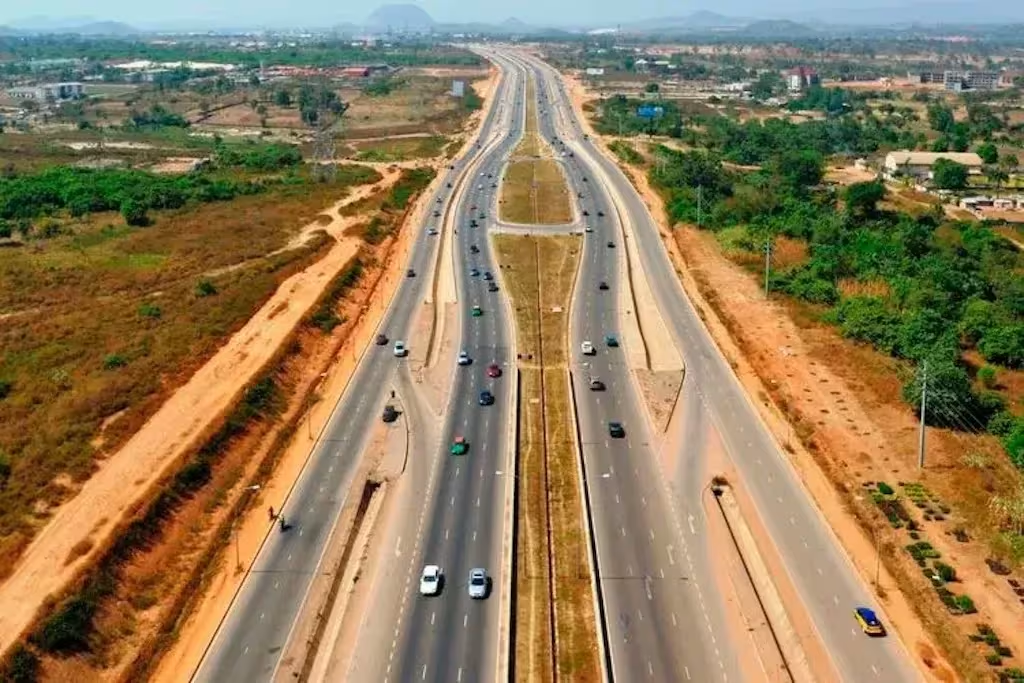
Providing an update on the broader Lagos–Calabar Coastal Highway project, Minister of Works Dave Umahi confirmed that Section 1—a 47.47-kilometer stretch originating from Victoria Island, Lagos—is fully completed and ready for official commissioning.
He stated that dual-carriageway paving on Section 2, spanning 55 kilometers to the Lagos–Ogun state border, is scheduled for completion next month.
To alleviate traffic congestion near major industrial hubs, Umahi noted that the ministry modified several flyovers, overpasses, and underpasses along the corridor, particularly around the Dangote Refinery and Lekki Deep Seaport.
At the eastern terminus in Calabar, the minister reported that over 30 percent of the construction work across the 65-kilometer Sections 3A and 3B has been executed.
The minister added that a 129-kilometer dual road from the Edo-Delta boundary to the Delta-Bayelsa boundary is undergoing route surveys and procurement, with construction anticipated to start in November. He mentioned further Niger Delta developments, like as the 9.7-kilometer Eket bypass and the 15-kilometer Eleme junction-to-Onne route.
Backstory…
The Lagos–Calabar Coastal Highway is a proposed 700-kilometre road project designed to connect Victoria Island in Lagos with Calabar in Cross River State, passing through several coastal states.
The Federal Government has presented the project as a way to improve movement along Nigeria’s southern corridor, connect economic centres and ports, and create an alternative route for long-distance traffic.
Read Also: Lagos-Calabar Coastal Highway Renamed After Tinubu