


The artificial intelligence (AI) data centre investment boom is facing fresh challenges as rising interest rates, falling technology stocks and increasing financing costs force developers to reconsider ambitious expansion plans.
The global race to build infrastructure for AI services has attracted billions of dollars from technology companies, private equity firms and institutional investors. However, the latest market turbulence is raising questions about whether some developers can generate sufficient returns to justify their spending.
According to a Reuters report published on October 15, 2026, companies involved in building AI infrastructure are delaying fundraising plans or facing pressure to secure capital on less favourable terms.
Among the affected businesses are AirTrunk, Firmus and SB Energy, whose planned stock market listings have been paused or withdrawn amid concerns about valuations, execution risks and financing conditions.
The development comes as investors become more cautious about businesses that depend heavily on borrowing to construct data centres, purchase advanced computing equipment and secure electricity supplies.
Although demand for AI computing remains strong, companies must now demonstrate that their investments can deliver sustainable financial returns.
Higher Interest Rates Increase AI Data Centre Costs
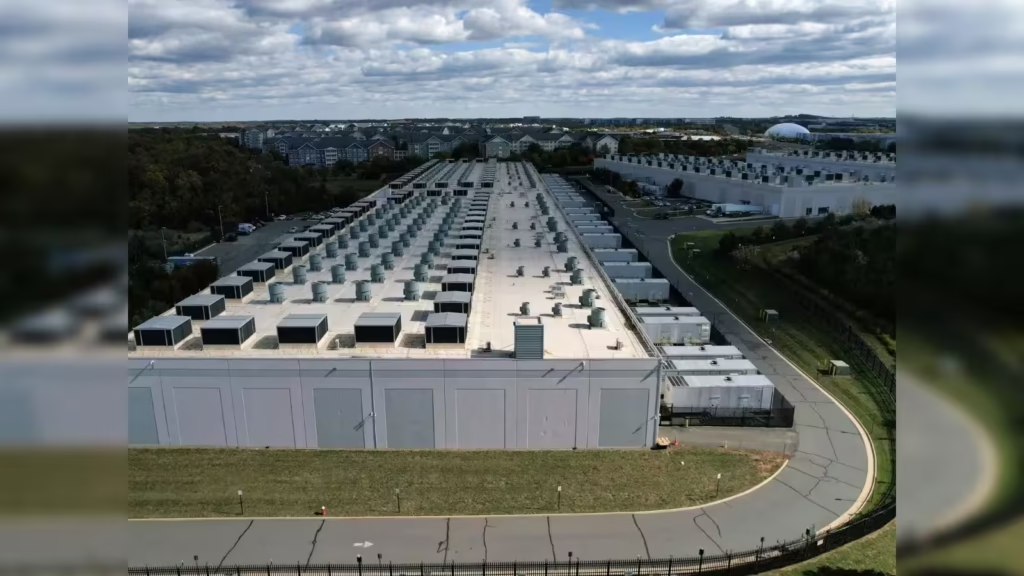
AI data centres require substantial investment in land, buildings, high-performance servers, cooling systems and electricity infrastructure. Developers often rely on loans, bonds and external investors to cover these expenses.
When interest rates rise, borrowing becomes more expensive. Companies may face higher interest payments, increased refinancing costs and greater pressure to generate revenue quickly enough to support their projects.
Reuters reported that rising US Treasury yields have intensified scrutiny of AI infrastructure companies, particularly those carrying substantial debt or relying on optimistic revenue projections.
Firmus, an AI infrastructure company backed by Nvidia, had planned a $5 billion initial public offering in Australia. However, concerns surrounding its financial projections and debt burden have complicated its fundraising ambitions.
The pressure extends to other parts of the technology industry. Investors are increasingly questioning whether the rapid expansion of AI infrastructure will produce profits that justify the enormous sums being spent.
Higher electricity prices, expensive computing equipment and delays in connecting facilities to power grids can further weaken project economics.
For developers planning multibillion-dollar investments, even relatively small increases in financing costs can affect profitability and determine whether a project proceeds as scheduled.
Investors Remain Interested but Demand Better Returns
Despite the difficulties, investment activity in the data centre sector has not disappeared. Instead, the market is showing signs of a shift towards companies with stronger finances and more predictable revenue.
According to Reuters, mergers and acquisitions involving Asian data centres reached $21.3 billion in 2026 as of October 13, compared with $10 billion throughout 2025.
Debt financing also reached $22.3 billion during the period, while equity fundraising fell by 4.6 per cent year on year to $5.4 billion.
These figures suggest that investors are still committing money to AI infrastructure, although raising funds through public share offerings has become more challenging.
Established operators with long-term customer contracts may have an advantage over newer businesses whose growth depends on uncertain forecasts.
The change could encourage companies to prioritise financial discipline, secure customers before construction and assess the commercial viability of projects more carefully.
Back Story: AI Expansion Faces Financial and Energy Constraints
The latest developments highlight a broader challenge facing the AI industry. Technology companies are spending heavily on computing infrastructure, but the financial benefits of that investment may take years to materialise.
A September 2026 report by The Information also identified growing financing difficulties, with some developers having to offer investors more attractive terms to secure funding.
Energy availability presents another major concern. Large data centres require reliable electricity, while grid upgrades, environmental requirements and construction delays can increase costs.
For Nigeria and other African economies hoping to attract digital infrastructure investment, the situation offers an important lesson. Data centres can support cloud computing, AI services and digital economic growth, but investors also need reliable power, suitable regulations and financially sustainable business models.
The immediate challenge for the global industry is to balance rapid expansion with commercial reality. As interest rates and financing costs rise, developers will need to prove that their projects can generate sufficient revenue to repay investors.
The AI data centre boom is not necessarily coming to an end, but the latest market pressure suggests that access to cheap capital can no longer be taken for granted.



, the fund will provide credit-risk protection to participating financial institutions, helping them lend to businesses that might otherwise struggle to meet conventional lending requirements. The model is designed to support up to $1 billion in outstanding credit capacity. The initiative will bring together lenders, business-support organisations, investors and other financing partners to create a structured route for eligible businesses to obtain commercial loans. Unlike a conventional loan programme that directly disburses money to applicants, the fund will share part of the lending risk with participating financial institutions. Banks will still assess applications, approve loans and manage repayments. ## How the $200 Million SME Fund Will Work The financing initiative targets businesses that have moved beyond the early stages of development and are ready to borrow to support further growth but face difficulties securing adequate credit. Under the proposed arrangement, eligible businesses can initially access loans in local currency equivalent to $250,000, subject to approval by participating lenders. The initiative aims to make loans of up to $1 million available when fully funded. The fund will work with venture capital firms, business accelerators and other SME ecosystem partners to identify and recommend potential borrowers. These organisations can help demonstrate a business's track record and readiness for debt financing. The fund will then apply its eligibility criteria, guarantee requirements and portfolio-risk assessments. Its assessment process will also use artificial intelligence-powered underwriting and due diligence. Participating financial institutions will retain responsibility for independently evaluating borrowers, deciding whether to approve applications, disbursing funds and monitoring repayments. According to [BusinessDay](https://businessday.ng/technology/article/cascador-sterling-target-sme-collateral-barriers-with-200m-credit-backstop/), the model is intended to reduce the collateral and guarantee burden on businesses with proven commercial traction. Cascador chief executive officer Trish Thomas said Nigerian entrepreneurs often struggle because the capital available to them does not match their business needs or stage of development. She explained that sharing risk with lenders could help more established businesses obtain the financing needed to scale and generate employment. Sterling Bank Group Executive Obinna Ukachukwu said the partnership combines additional credit protection with referrals from venture funds and studios familiar with the businesses they support. This approach, he noted, could give lenders greater confidence to offer larger loans with longer repayment periods. ## Why the Initiative Matters to Nigerian SMEs Access to affordable and appropriate financing remains a significant obstacle for businesses seeking to expand in Nigeria. Many enterprises require capital to purchase equipment, improve production, enter new markets and recruit workers, but conventional lending conditions can make borrowing difficult. Cascador's white paper, *The Multiplier Model*, highlights the wider challenge. According to the organisation, only 22 per cent of businesses in Sub-Saharan Africa have a bank loan or line of credit, compared with a global average of 36 per cent. The new fund seeks to bridge this gap by encouraging commercial lenders to finance businesses that have demonstrated demand for their products or services but cannot easily secure suitable debt. For entrepreneurs, the potential benefits include access to larger loans, longer financing periods and reduced pressure to provide extensive collateral or guarantees. However, the arrangement does not guarantee approval, and businesses will still need to satisfy the relevant eligibility requirements and lender assessments. The fund is also expected to attract contributions from philanthropic organisations, impact investors and development finance institutions to support its risk-sharing structure. ## Back Story: Sterling Bank and Cascador Expand an Existing Partnership The announcement builds on an earlier financing partnership between Sterling Bank and Cascador. In May 2025, the organisations introduced a $2 million Catalytic Fund to provide growth financing to businesses emerging from Cascador's entrepreneur development programme. As reported by [PUNCH Newspapers](https://punchng.com/cascador-sterling-bank-unveil-2m-fund-for-nigerian-smes/), the earlier initiative combined debt financing with business support, flexible repayment arrangements and reduced collateral requirements. The new $200 million fund represents a broader approach, designed to bring additional ecosystem partners into the financing process rather than rely solely on businesses connected to Cascador. Cascador said it had supported 80 ventures since 2019, with those businesses collectively raising more than $150 million in capital. For Nigeria's SME sector, the success of the expanded initiative will depend on how effectively it mobilises funding, attracts participating lenders and makes financing accessible to qualified businesses. If implemented successfully, the model could help more Nigerian enterprises secure the capital needed to grow, strengthen local industries and create sustainable employment.](https://naijaeyesblog.com/wp-content/uploads/2026/10/Sterling-Cascador-768x432.avif)