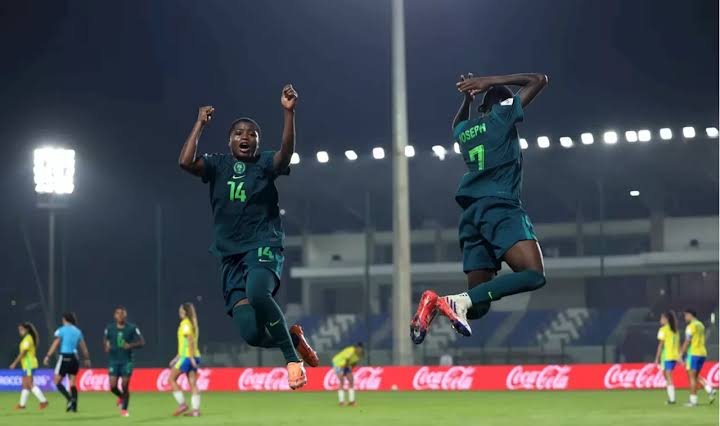

Nigeria’s first FIFA U-17 Women’s World Cup title is a landmark for African football. The most revealing part of the Flamingos’ campaign was how they reached it. Akeem Ishola Busari’s side lost its opening match, regrouped and won six straight games, finishing with a 2-1 victory over Japan in Rabat on November 7.
FIFA confirmed Nigeria became the first team to lose its opening match and still win the competition. The achievement is more than the story of a coach appointed seven months earlier. It shows how a young team responded to a setback and adapted to different opponents.
The turnaround began with a conversation
Nigeria’s 2-1 defeat to Poland on October 17 exposed problems a new team sheet alone could not solve. Busari said his technical staff spoke with players individually and collectively about attitude, cohesion and the team’s playing approach.
He said they chose discussion and counselling rather than bullying. The Flamingos responded with a 2-0 win over Puerto Rico and a 3-1 victory over defending champions North Korea. They then beat Mexico, Venezuela and Brazil in the knockout rounds.
The opening defeat became a point of correction, not a defining result.
Selection and tactics mattered
FIFA reported that Awawu Bashiru and Oluebube Umejiaku, both initially used from the bench, became decisive figures. Bashiru scored twice against Brazil in the semi-final and opened the scoring against Japan. Umejiaku scored Nigeria’s second goal in the final.
Busari told FIFA that selection depended on character, mindset, attitude and merit, not reputation. He wanted players to earn opportunities and contributions to come from beyond the first-choice names.
His tactics also shifted by opponent. After the final, he said Nigeria sought to reduce Japan’s speed, press selectively and send longer passes into spaces where the Japanese were less comfortable. ACLSports reported his description of a mix of mid-block and high pressing, with players competing for second balls.
Also Read: Flamingos Make History as Nigeria Defeats Japan to Win U-17 Women’s World Cup
The numbers behind the approach
FIFA’s tournament statistics show Nigeria attempted 113 shots, the competition’s second-highest total, including 35 against Brazil. The team recorded 43 per cent possession control. The figures suggest the Flamingos created chances without needing to dominate the ball.
The final required another kind of control. Bashiru scored in the 39th minute, Umejiaku doubled the lead in the 47th, and Fuki Ito pulled one back in the 80th. Nigeria then defended under pressure. Busari said the closing stages required fewer touches, disciplined positioning and management of tired players. U-17 Women’s World Cup Morocco 2026+3
Back Story: From Ibadan to a continental first
The NFF appointed Busari on April 2, 2026, when he coached Pacesetter Queens in Ibadan. He replaced Bankole Olowookere, who led the Flamingos to bronze at the 2022 tournament in India. Busari first had to qualify Nigeria, which beat Benin Republic 8-5 on aggregate in July.
Busari’s April qualifying camp began with 36 invitees. The August preparation list had 26 players, before the NFF announced the final 21 in October. Those selections drew from domestic clubs and academies across Nigeria.
The title leaves Nigerian football authorities with a task: sustain progress through regular competition, coaching and player development. Keeping the next generation competitive will require investment beyond one tournament. The NFF Official Website+4