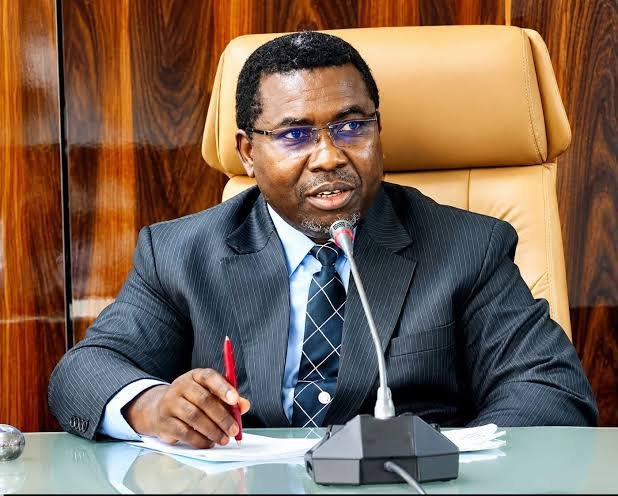

The Joseph Ayo Babalola University (JABU) Alumni Association has condemned the confrontation involving Independent National Electoral Commission (INEC) Chairman, Professor Joash Amupitan, outside Chatham House in London. The incident raises a question beyond the conduct of the protesters: how can Nigerians demand electoral accountability without intimidating the official responsible for the process?
Alumni association objects to the manner of protest
Association president Akinkunmi Akintayo said protesters surrounded Amupitan’s vehicle and hurled insults at him after his November 12 appearance at a discussion on Nigeria’s 2027 elections. He said citizens should seek accountability through lawful, constructive engagement rather than personal intimidation. The statement addresses the manner of the protest, not the electoral complaints that prompted it.
What happened outside Chatham House
Chatham House confirms that Amupitan joined a panel on Nigeria’s 2027 elections on November 12, organised with the Kimpact Development Initiative. INEC’s account says he discussed public confidence, election preparations and the commission’s credibility.
Video-based reporting by TheCable says protesters gathered around the vehicle as it left the venue, shouted for Amupitan to come out and speak, and displayed a placard accusing INEC of election fraud. This supports describing the episode as a heated confrontation. “Harassment”, the alumni association’s description, is a characterisation; available reporting does not establish that Amupitan was physically assaulted.
Also Read: 2027 Elections: INEC Moves to Tackle Deepfakes, Foreign Information Manipulation
Voter-register dispute is not settled
The protest followed scrutiny of the preliminary voters’ register, including claims about duplicate entries, suspicious photographs and registration irregularities. INEC acknowledged problems in the 2025/2026 Continuous Voter Registration exercise. On November 9, it announced that 1,608,660 invalid registrations had been removed, with 873 records of verified deceased persons deleted separately. It also identified 54 officials across 10 states for possible disciplinary action, including prosecution.
At Chatham House, Amupitan acknowledged that controversies surrounding the 2023 elections had left INEC with a trust deficit it had not overcome. The admission underlines the commission’s task: rebuild confidence through verifiable performance and accountability.
INEC must answer with evidence
The clean-up figures show that concerns about the register warranted examination. They do not prove that INEC manipulated it to favour a party or establish personal wrongdoing by Amupitan. The commission says the affected records were reviewed and removed. It must make the process transparent enough for voters, parties and observers to assess whether the clean-up was complete and whether safeguards will prevent a repeat. Clear documentation will help voters test those assurances. Public officials must answer criticism, but demonstrations should not become personal intimidation.
A credible 2027 election will require both peaceful public scrutiny and an electoral commission willing to demonstrate, with evidence, that it deserves public trust.
Back Story: JABU’s connection with Amupitan
Before he was appointed INEC chairman in October 2025, Amupitan served as JABU’s Pro-Chancellor and Chairman of its Governing Council. The alumni association’s website published a congratulatory message on his appointment, describing him as the university’s Pro-Chancellor. This history does not invalidate its position, but it is relevant context when readers assess the association’s defence of a former university officeholder.
Also Read: Why Are Northern-Associated Names Appearing in Abia’s Voter Register? What the Evidence Shows