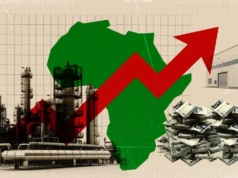
Across major African markets, including Nigeria, Kenya, Egypt, South Africa and Morocco, there is a noticeable shift happening in how venture capital and institutional money are flowing into tech startups. After years of investor caution, portfolio write-downs and slow dealmaking across the continent, a new pattern has emerged in early 2026. Investors are writing new cheques again. But this is not the dramatic rebound that many had hoped for. Instead, it is a deliberate and measured reset that prioritises revenue strength, sustainable business models and tighter risk filters as the sector enters its next phase, according to Launch Base Africa.
Between 2021 and 2022, the African tech ecosystem enjoyed one of its most intense funding cycles. Record rounds, rapid expansion into new sectors and buoyant capital inflows from both global funds and regional players defined that period. But many of those early investments did not yield the strong unit economics or scalable revenue profiles expected. As financial pressures grew from global macroeconomic headwinds and heightened scrutiny from limited partners, investment patterns slowed considerably. For two years, many of Africa’s prominent tech investors focused on portfolio defence, restructuring existing holdings and crossing fingers for exits.
Today, 2026, presents a different picture. Capital is returning, but in a cautious and selective form that signals a move away from the high-velocity funding model of the early decade. Investors are looking first at companies with clear revenue growth, sustainable cost structures and strong traction in their markets. The result is not just a reset of cheque books but a rethinking of sector priorities and investment playbooks.

Table of Contents
How investment shifted after the boom years
Looking back to the peak of venture funding in Africa, many firms entered the scene with expansive visions and bold check sizes. Large funds, both regional and international, aggressively deployed capital into fintech, logistics, e-commerce and consumer platforms. But the speed of funding sometimes outpaced actual business performance in these young companies. When unit economics struggled and follow-on investment slowed, capital markets shifted towards caution.
In the following years after 2022, Africa’s tech funding ecosystem saw a mix of trends that reflected broader economic realities:
- Investors prioritised follow-on support for existing portfolio companies instead of funding new ventures.
- Some companies accepted down rounds or bridge financing just to maintain operations while revenue growth lagged expectations.
- Several startups in logistics, mobility and B2C commerce faced shutdowns or restructurings as capital became scarcer.
- Funds that had grown rapidly during the boom focused instead on internal deal discipline, tightening criteria on what would qualify for new investment.
For a time, the continent’s once hyperactive startup scene seemed to slow, with capital flowing in focused streams and sectors that were seen as less risky or better positioned to produce returns sooner.
This period of consolidation also gave rise to important lessons for founders and investors alike. Quality of revenue, unit economics and sustainable growth became central to valuation discussions. Instead of chasing rapid expansion at all costs, the model shifted towards companies that could demonstrate resilience, profitability pathways and tangible market demand.

The new wave of investors and their approach
In 2026, Africa’s tech space began to attract funding again, but under a pattern that is markedly different from the frenzy that preceded it.
Rather than new funds flooding in from outside, much of the renewed activity appears to come from familiar players who are recalibrating their strategies. These investors are prioritising smaller ticket sizes and careful due diligence, basing decisions on fundamentals rather than hype metrics.
In Nigeria, for example, local venture firms that pulled back during the funding downturn are now cautiously active. These firms focus on businesses that are already generating revenue, have predictable customer behaviour and clear growth pathways. Across East and West Africa, the emphasis is on practical scalability rather than assumptions of exponential growth.
International investors, too, are engaging, but selectively. Global funds that had de-emphasised African rounds in recent years are resurfacing to back category leaders and established companies demonstrating market traction. Their return signifies confidence in mature segments of the ecosystem, even as they sidestep early-stage bets that carry higher risk.
One important trend is that more capital is moving into sectors and companies that have proven revenue models. Investors want to see clear lines from product adoption to recurring income before deploying funds. This shift aligns with global patterns where venture capitalists are more conservative, analysing exit pathways and longevity more thoroughly before backing new ventures.
Another notable change is the renewed interest in infrastructure-linked sectors such as fintech, clean energy and enterprise technology, where revenue streams are typically clearer and risk structures more defined. Sectors like fitness tech and lifestyle platforms that saw earlier hype without revenue traction are no longer top-of-mind for most investors.
The cautious tone is not wholly negative. Investors who return now are likely doing so with greater insights and stronger frameworks for evaluating risk. Their engagement suggests a more mature marketplace where checks are written with long-term viability in mind.
What the broader funding landscape looks like
While the reset means slower deal velocity compared to the boom years, broader data shows that the ecosystem has continued to attract capital overall.
According to recent funding reports, African startups raised billions of dollars in 2025, showing resilience and renewed investor confidence compared to the downturn years. Across the continent, total funding climbed significantly in 2025, signalling a rebound from funding lows of 2023 and 2024. In one estimate by industry trackers, the total amount raised by startups reached over three billion dollars in 2025, a marked increase from the previous year. That figure shows that investment activity is rebounding, but with a different composition of deals and investor behaviour.
In some months, funding bounced back sharply with strong performance in sectors such as fintech and clean energy. January 2025 alone saw almost three hundred million dollars raised, a dramatic surge compared with the previous year’s opening funding period. Equity financing dominated these deals, suggesting that investors are placing long-term bets on companies with clearly defined growth metrics.
Despite this momentum, the startup ecosystem still faces uneven capital distribution. Top rounds and major deals continue to attract the largest shares of funding, leaving smaller and early-stage ventures with fewer opportunities. In December 2025 for example, most investment dollars were secured by the top ten deals, while the rest of the companies raised comparatively modest amounts.
In regional terms, countries like Kenya and South Africa have seen strong inflows, sometimes surpassing Nigeria in total funding raised. Kenya’s ecosystem has especially benefited from clean energy, fintech and mobility deals that combine social impact with solid economics.
These patterns reflect a growing importance of looking beyond headline figures to understand where investment really flows. It is no longer about headline totals alone but where capital is placed, at what stage and with what expectations for returns.
What this reset means for founders and innovators
For African founders, the sentiment is neither pessimistic nor wild with optimism. The new investment reality rewards discipline, revenue focus and strategic thinking. Founders with proven unit economics, repeatable revenue models and clear market demand are most likely to attract the attention of investors. Concepts that hinge on speculative future potential without clear revenue pathways are less attractive in the current climate.
This environment has broader implications for the entire innovation ecosystem:
- Improved financial discipline: Founders are refining projections and unit economics more rigorously to meet investor expectations.
- Stronger market validation: Early traction and validated product-market fit weigh heavily in funding discussions.
- More realistic valuations: Gone are the inflated valuations of hype cycles, replaced by valuations tied to revenue milestones and profitability paths.
- Better investor-founder alignment: With a focus on sustainable growth, both founders and investors are on the same page about long-term value creation.

It is also a time when entrepreneurs who can demonstrate measurable success metrics are valued more than those with only big visions. This has the potential to elevate the quality of businesses that attract funding and to weed out models that depend on continuous external capital without a clear path to revenue.
For the broader African startup ecosystem, this reset points to a maturing phase where capital allocation is increasingly data-driven, strategic and disciplined. While the pace of funding may be slower than the boom years, there is a growing emphasis on building businesses that can survive cycles, create sustainable jobs and contribute to economic growth across the continent.
As 2026 unfolds, the sentiment among investors and founders alike is one of cautious optimism. Capital is returning to where fundamentals are strong, and this measured approach may very well lay the groundwork for a more resilient and long-term sustainable tech ecosystem in Africa.
Join Our Social Media Channels:
WhatsApp: NaijaEyes
Facebook: NaijaEyes
Twitter: NaijaEyes
Instagram: NaijaEyes
TikTok: NaijaEyes