In classrooms and lecture halls across the world, a quiet revolution is underway. Not in textbooks or chalk-dust, but in lines of code. The newest generation of artificial intelligence, known broadly as “agentic AI”, is beginning to reshape how students learn, how teachers teach, and how schools run. This shift promises a move away from AI as a mere helper to AI as an active partner in education.
What exactly is Agentic AI
Agentic AI refers to intelligent systems that do more than respond to prompts. Instead, they act with autonomy, reason through tasks, plan ahead, and adapt as they go. Unlike traditional AI tools, such as chatbots that generate answers only when asked, agentic systems can take the initiative, manage workflows, and pursue objectives with minimal direct human input.
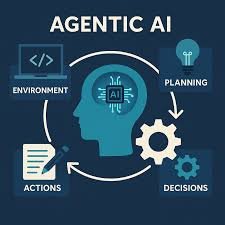
At their core, these systems combine several capabilities: natural language understanding, decision-making, planning, learning from feedback, and long-term memory of past interactions. Over time, they refine their responses and actions, becoming more effective collaborators in complex tasks such as learning and teaching.
In effect, agentic AI is not just a digital tool but more like an assistant, one that can anticipate needs, offer suggestions, and guide actions, without waiting for explicit instructions.
From Content Creation to Co-Teaching: How Education Is Changing
The implications of agentic AI for education are broad and profound.
Smarter, Adaptive Tutoring
Imagine a tutor that doesn’t just answer questions but monitors a student’s progress, senses when they struggle, dynamically adjusts difficulty, and schedules follow-ups, all without a human hovering nearby. Early implementations of agentic AI are already moving toward such autonomous tutoring agents. These systems can track learning patterns, identify gaps, and tailor learning plans in real time.
This kind of dynamic support offers a more personalised learning experience, helping each student learn at their own pace and in their own way — a critical step toward inclusive education.
Curriculum Planning and Management Behind the Scenes
Beyond individual tutoring, agentic AI can help in designing curricula and managing lesson delivery. By analysing past student performance data, teacher feedback, and curriculum standards, these systems can propose optimal lesson sequences, suggest resources, and adapt the plan in response to student needs. Over time, the system learns what works best, refining materials and strategies for future classes.
This reduces the administrative burden on educators and allows them to focus more on human-centred teaching — mentorship, guidance, inspiration, rather than paperwork and logistics.
Administrative Efficiency and Institutional Workflow
Agentic AI’s use is not limited to classrooms. Schools and institutions can deploy these systems to automate administrative tasks: scheduling, communicating with parents, allocating resources, monitoring compliance, and other operational workflows.
This could make school management more efficient, minimise human error, and free up time for educators and administrators to focus on improving educational quality rather than juggling logistics.
Professional Development and Teacher Support
Agentic AI could also become a partner for teachers. By tracking a teacher’s instructional style, certifications, classroom outcomes, and ongoing needs, the AI could recommend tailored professional development resources. It might suggest training modules, educational research, or even peer collaboration opportunities, aligning teacher growth with student outcomes.
In that sense, agentic AI becomes not just a tool for students but a continuous support system for educators as well.
The Promise for Learners: Autonomy, Voice and Growth
One of the most exciting prospects of agentic AI is its potential to nurture real learner autonomy. Rather than passively consuming information, students might actively partner with AI, setting goals, reflecting on progress, exploring ideas, and even engaging in research or creative projects with AI support.
This transforms learning from a one-way transaction to a dialogue. A student working on an essay could get ongoing feedback, not just on grammar but reasoning, structure, and logical gaps. Over semesters, the system could track growth, highlight areas of improvement, and help students build metacognitive skills like self-reflection, planning, and independent thinking.
Such empowerment can help students develop lifelong learning skills, essential in a world where knowledge and demands evolve constantly.
Challenges and Ethical Questions We Must Not Ignore
However, this shift also brings serious responsibilities and potential pitfalls.
Transparency and Accountability
Because these AI agents can make decisions autonomously — about content, scheduling, interventions — it becomes crucial to know how those decisions are made. Do students and guardians understand why certain lessons are prioritised, or why remedial sessions are scheduled? The logic behind AI interventions must be transparent, and the decision-making process explainable.
Otherwise, we risk handing over important educational decisions to black-box systems that neither students nor teachers fully understand.
Equity, Bias, and Fairness
As with any AI — especially in education — there is a danger that not all students will benefit equally. If the training data or the design of the AI agent reflects bias, then recommendations and interventions might favour certain groups over others. Without careful design and oversight, agentic AI could reinforce existing inequalities rather than alleviate them.
Schools and policymakers will need to build frameworks for fairness, ensure inclusive design, and constantly audit these systems to safeguard equity.
Data Governance and Privacy
Agentic AI thrives on data — student performance, behaviour, feedback, even emotional cues. Managing and protecting this data is a massive responsibility. Who owns the data? Who has access? How is consent handled? How long is data stored? These are not trivial questions, especially in contexts with weaker regulatory infrastructure.
Without rigorous data governance, there is a risk of misuse, privacy violations, or unintended disclosures.
Trust, Training, and Implementation Challenges
Finally, introducing AI capable of autonomy requires trust — among educators, students, parents — and time for training and adaptation. Teachers need to understand and trust the system, students must feel safe using it, and institutions must commit to responsible implementation. As with past disruptive educational technologies, change will take time, patience and open-mindedness.
What Agentic Classrooms Could Look Like
If we get the balance right — between innovation and responsibility, between autonomy and human oversight — the future of classrooms could be quite different from what we know today.
In agentic classrooms:
- Every student could have a personalised learning companion that tailors content, pacing, and feedback to their needs.
- Teachers would spend less time grading, scheduling or chasing administrative tasks, and more time guiding, mentoring and inspiring.
- Schools could operate more efficiently, running smoothly behind the scenes while focusing on delivering quality education.
- Education could become more inclusive, adaptive and flexible — accommodating diverse learners, rhythms, and needs without one-size-fits-all constraints.
- Lifelong learning and critical thinking would be nurtured: students would learn not just content, but how to learn, reflect, set goals, adapt, and grow.
But this will require care. Clear policies on data use, strong ethical frameworks, teacher involvement, and transparency must guide deployment. People — not algorithms — must remain the decision-makers.
In Nigeria, and across Africa, this can be especially powerful. With resource constraints, large class sizes, and diverse learning needs, agentic AI could help personalise learning at scale. But it must be approached responsibly, with sensitivity to context — data privacy, infrastructure limitations, and equity must be front and centre.
The adoption of agentic AI in education is not merely about technological progress. It is about reimagining learning — making it more human, more adaptive, more empowering. As we stand at this crossroads, the question is not only can we build smarter AI agents, but can we build wiser educational systems that harness their potential for good.
Join Our Social Media Channels:
WhatsApp: NaijaEyes
Facebook: NaijaEyes
Twitter: NaijaEyes
Instagram: NaijaEyes
TikTok: NaijaEyes