
In a major shift for app developers around the world, Apple has launched Xcode 26.3, a powerful update that radically changes how software is built on its platforms. The new release brings in agentic coding support, making it possible for artificial intelligence agents like Anthropic’s Claude Agent and OpenAI’s Codex to work inside Xcode with far more autonomy than before. This release promises to streamline workflows and help developers turn ideas into finished apps more quickly and intelligently than ever before.
A Bold New Phase for AI in Development
Xcode is Apple’s official software used by developers to create apps for iPhone, iPad, Mac, Apple Watch, Vision Pro and more. Up until now, AI in Xcode has largely assisted with writing and editing code, but Xcode 26.3 takes this further by giving AI agents the power to autonomously navigate projects, make meaningful changes, and solve technical problems without constant human direction. In practical terms, this means developers can describe what they want to build and let the AI break complex tasks into steps, write new code, update settings, and test results all within the Xcode environment.
This step is significant because it extends the role of artificial intelligence from basic suggestion tools into active collaborators in the app-building process. The agents can search through documentation, understand project structures, coordinate across multiple files, and even visually check what they’ve produced using preview tools inside Xcode. These capabilities are designed to speed up development cycles and reduce repetitive manual work that often slows down coding projects.
How Agentic Coding Works in Xcode 26.3
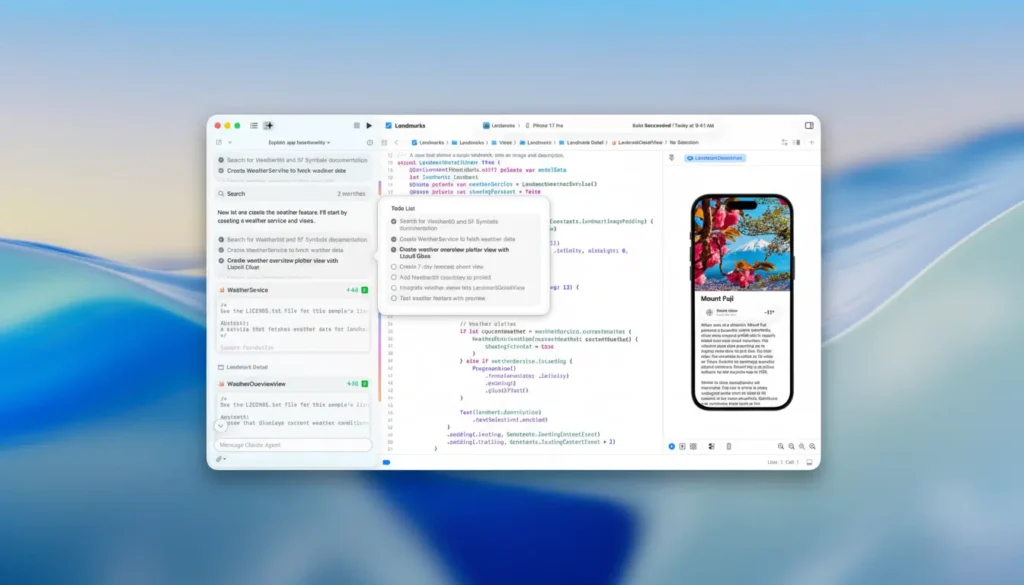
Agentic coding means AI tools can take goals from developers and pursue them with a degree of independence. Traditionally, AI features in coding environments would wait for specific commands and then respond step by step. With Xcode 26.3, developers can describe a high-level intent and let the AI plan, act, and deliver results within the development interface. For example, an AI agent can:
- Search Apple’s developer documentation for relevant guidance
- Review the structure of a project and determine necessary file changes
- Build parts of the app and run tests to check for errors
- Update project settings as needed to fit the intended design
- Capture Xcode previews to verify visual layouts and refine code if there are mismatches
This workflow changes how developers interact with their code. Instead of doing every task manually, they can now focus more on design and innovation, while the AI handles a lot of the heavy lifting.
A key part of this update is support for the Model Context Protocol (MCP), which Apple uses to let external AI systems communicate with Xcode. MCP works as a bridge that connects agents like Claude or Codex to internal tools and documentation, so they can operate more smoothly and efficiently during development.
What This Means for Developers
The implications of Xcode 26.3’s agentic coding are far reaching. Developers working alone or in teams can now leverage these tools to boost productivity and tackle traditionally complex or repetitive tasks with assistance that feels far more collaborative than before. Whether someone is building their first app or working at scale on a large project, they get access to intelligent helpers that can think across multiple files, interpret architectural needs, respond to changing requirements and provide live feedback as code evolves.
Industry observers note that giving AI agents the ability to act within a development environment instead of just offering suggestions could reshape how software is made, even influencing how coding is taught and learned. Newer developers, for instance, may find it easier to learn by watching how an agent breaks down tasks and resolves issues inside their real projects. Experienced developers may gain speed and creativity by offloading routine work and focusing their energy on innovation.
In a statement shared with the press, Susan Prescott, Apple’s Vice President of Worldwide Developer Relations, said the new agentic features are all about empowering developers and supercharging both productivity and creativity in the app-building process.
Release and What Happens Next
At the time of writing, Xcode 26.3 is available as a Release Candidate for members of the Apple Developer Program, meaning developers can download and test the new features right away from Apple’s developer portal. Soon after this phase, Apple plans to roll out the update on the Mac App Store for all users.
To start using agentic coding, developers will have to choose which AI agent they want to work with and sign into their account or provide appropriate API keys. From there, these intelligent agents become part of the development workflow and can interact with the project, often speeding up processes that previously required many manual steps and hours of effort.
This release is part of a broader trend of integrating advanced artificial intelligence into mainstream tools for creative and technical work. Other organisations and platforms are also pushing AI into development environments, but Apple’s move to embed agentic coding inside Xcode marks a significant milestone because of Xcode’s central role in building apps for Apple’s ecosystem.
As adoption grows, developers and companies will be watching closely to see how much these features can reduce work time and increase code quality. Challenges remain, especially around trust, verification and ensuring that autonomous changes align with human intentions. Yet overall, the industry response suggests growing excitement about how this technology can shape the future of software development.
Xcode 26.3 with agentic coding support represents a pivotal advancement in developer tools, bringing intelligent, autonomous coding agents into the heart of app creation. Its arrival opens new possibilities for learners and seasoned professionals alike, potentially changing how apps are developed and how developers interact with their tools each day.
Join Our Social Media Channels:
WhatsApp: NaijaEyes
Facebook: NaijaEyes
Twitter: NaijaEyes
Instagram: NaijaEyes
TikTok: NaijaEyes