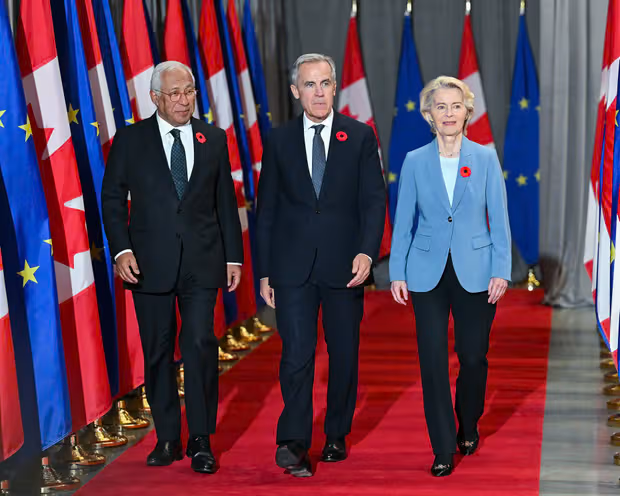

Canada and Europe have launched the Alliance for the Future, a new bloc of like-minded nations designed to serve as a protective umbrella for their populations while hedging against geopolitical volatility.
During a joint press conference in Montreal on Friday, Prime Minister Mark Carney and European Commission President Ursula von der Leyen highlighted the partnership’s potential to deliver unprecedented stability and opportunity, while explicitly inviting additional nations to join the alliance.
“Our societies have been shaken by new storms,” Carney said, referring to the damaging impact of the climate emergency but also the “erosion of democratic norms” and “the weaponization of trade”.
Following he two-day summit, Canada agreed to contribute to a €90 billion support loan for Ukraine as. The leaders stated that future negotiations will yield a more integrated multi-billion-dollar market, reduce trade and travel barriers, and expand bilateral educational opportunities.
A widening trade dispute with the United States has driven Prime Minister Carney to seek new global allies, though Canada’s heavy reliance on American firms—particularly within the defense sector—continues to temper its strategic pivot.
Meanwhile, Elon Musk severely disrupted Ukrainian military and defense operations in mid-October by throttling the connection speeds of both Starlink and Starshield across Ukraine.
Meanwhile, on his part, European Council president Antonio Costa, said earlier that Canada was “by far the most European of the non-European countries”, a sentiment that reflected a belief that despite geography, there was a collective sense of shared values.
Backstory…
The US-Canada trade war escalated when Trump imposed tariffs on Canadian imports, initially announcing a 25 per cent tariff on most Canadian goods and a 10 per cent levy on energy products.
Although exemptions were made for goods complying with the Canada-United States-Mexico Agreement (CUSMA), Washington subsequently introduced additional sector-specific tariffs targeting steel, aluminium, automobiles, lumber and other Canadian exports.
Against this background, closer cooperation between Canada and Europe represents more than a diplomatic partnership. It may also be part of Canada’s broader effort to reduce its vulnerability to American trade policies by securing alternative markets, investment opportunities and supply chains.
Read Also: US-Canada Trade War-US Bans Canadian Dairy, Alcohol and Bikes