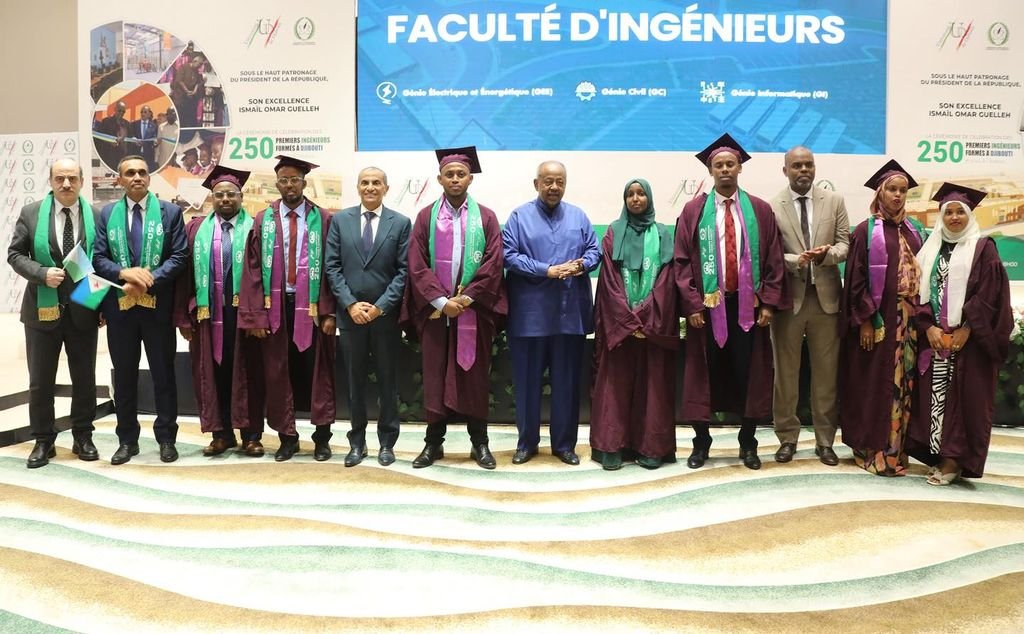
Djibouti’s capital came alive on Friday with a sense of achievement and optimism as 250 young engineers graduated from programmes run entirely within the nation’s education system. The ceremony, attended by senior government officials and dignitaries, honoured the first cohort of homegrown engineers trained to support the Horn of Africa nation’s ambitions for self-sufficiency in technical and scientific fields.
President Ismail Omar Guelleh, speaking to graduates and their families, described the day as historic. He said the ceremony was proof that Djibouti can now equip its own citizens with the high-level skills needed to build, maintain, and expand the country’s infrastructure and industrial capacity. For years, the nation depended heavily on foreign expertise to fill engineering roles. That reliance is now yielding to a new generation of engineers shaped by local classrooms, labs, and professional networks.
Officials highlighted that the achievement reflects long-term investments in technical education, especially in engineering disciplines that had previously been scarce in the country’s universities. This new talent pool is expected to support projects across sectors such as construction, energy, transport, and technology, helping steer Djibouti away from being overly dependent on imported specialists.

Table of Contents
Investing in people to grow the economy
The engineers were trained through a collaborative effort between national higher education institutions, particularly the University of Djibouti, and government initiatives designed to strengthen human capital. The curriculum was tailored to equip students with theory and practical experience in modern engineering practices, preparing them to tackle complex challenges in both the public and private sectors.
Speaking at the event, the Minister of Higher Education and Research, Nabil Mohamed Ahmed, emphasised that building local expertise is central to Djibouti’s broader development goals. He pointed out that the graduation is not just a celebration of academic success but a foundational step towards deeper industrialisation and economic diversification.
Djibouti’s economy has long centred on logistics, port services, and trade. While these sectors will continue to be important, officials believe that expanding technical and engineering capabilities will unlock new areas of growth. Skilled engineers can support infrastructure upgrades, improve local manufacturing capacities, and help advance innovation across sectors. These contributions are seen as crucial for boosting productivity and creating jobs for young people.
Voices from the ceremony
Many of the graduates expressed pride in their achievement and excitement about what lies ahead. Several spoke about the importance of having access to high-quality technical education within their own country, instead of going abroad for study. For them, the opportunity to learn and train at home not only saves costs but also strengthens their connection to the communities they aim to serve.
At the ceremony, President Guelleh urged the new engineers to carry forward the values of diligence, innovation, and service. He encouraged them to see themselves as partners in nation-building, entrusted with responsibilities that go beyond designing structures and systems. He reminded them that their work would have lasting impacts on the quality of life for ordinary citizens as the country grows.
University officials also underscored the importance of industry partnerships in helping graduates transition from education to employment. These collaborations are expected to bridge classroom learning with real-world applications, offering internships, mentorships, and project placements that strengthen engineers’ professional readiness.
A new chapter for Djibouti’s future
The graduation of these 250 engineers arrives at a moment when Djibouti is seeking to shape a future that is less dependent on external expertise and more rooted in local capability. By building the technical workforce needed to drive innovation and manage complex infrastructure, the country is laying the foundation for sustained economic growth.
Experts say graduates like these will play a key role in helping Djibouti seize emerging opportunities. For example, investments in renewable energy, such as wind and solar projects, are becoming increasingly important as Djibouti works to enhance energy security and reduce costs. Skilled engineers are essential to plan, install, and maintain these systems, linking technical know-how with national priorities.
Similarly, the growth of the information and communications technology sector depends on engineering talent that can support innovation, system design, and digital infrastructure development. As countries around the world compete to attract tech investment, Djibouti hopes to position itself as an emerging hub for technology services and digital solutions, backed by homegrown professionals.
In her remarks, the President of the University of Djibouti, Djama Mohamed Hassan, spoke of this graduation as a symbol of national ambition. She said that expanding access to quality engineering education is part of a broader push to nurture talent that will shape the country’s future. Students, she noted, represent the hopes of families, educators, and communities that have invested in their journey.
As Djibouti celebrates this milestone, observers in the region are watching with interest. The country’s commitment to developing a skilled workforce may serve as a model for other nations facing similar challenges in building local expertise. Success in this endeavour could help strengthen economic resilience and reduce dependence on expatriate professionals.
Today’s event in Djibouti is more than just a graduation ceremony. It marks the beginning of a chapter in which the nation’s engineers step forward to shape the built environment, contribute to economic transformation, and inspire the next generation to pursue careers in science, technology, and technical fields.
Join Our Social Media Channels:
WhatsApp: NaijaEyes
Facebook: NaijaEyes
Twitter: NaijaEyes
Instagram: NaijaEyes
TikTok: NaijaEyes