In a stirring two-day virtual summit held between 18–19 November 2025, education union leaders from across Africa convened under the banner of the Education International Africa Regional Committee (EIARC). Their agenda was bold and clear: to press governments to prioritise public education, secure funding, and elevate the status of teachers. Far from mere rhetoric, the meeting was a show of solidarity, a call to action, and a reaffirmation that educators are central to the future of the continent.
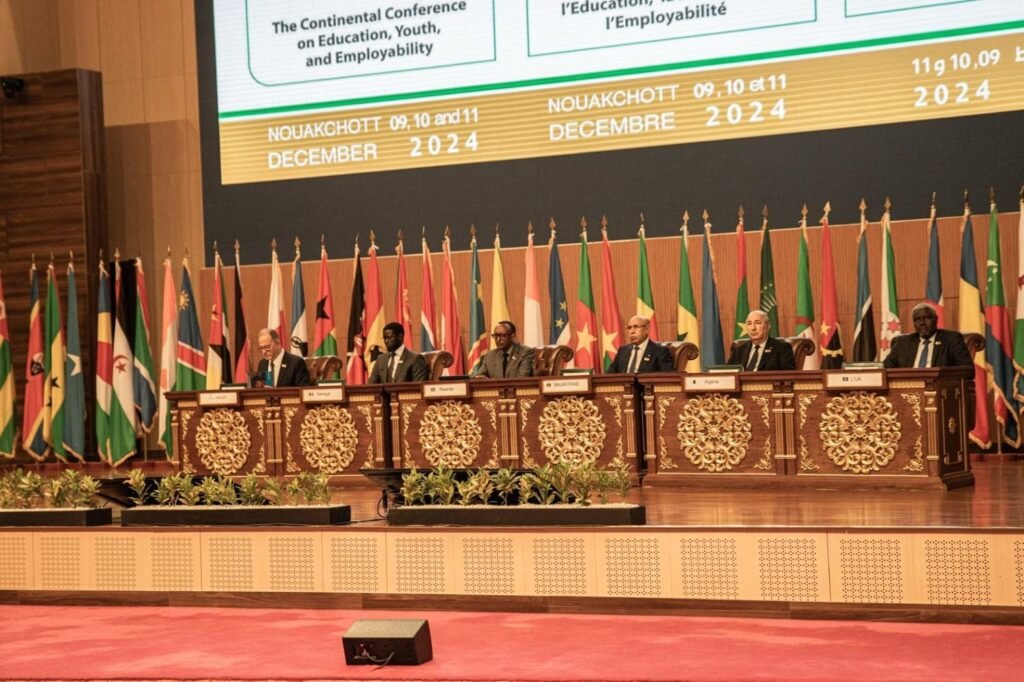
Unions Demand Governments Invest in Education
Mariama Chipkaou, Chairperson of EIARC, opened the meeting by reflecting on a year defined by progress and challenge. She welcomed the African Union’s new Continental Education Strategy for Africa (CESA) 2026–2035, adopted at the AU’s 38th Heads of State Summit. But she stressed that adoption was not enough: implementation must follow, with teachers and unions deeply involved.
Chipkaou went on to highlight the Pan-African Conference on Teacher Education (PACTED) held in Addis Ababa, where EI-led delegates underscored the urgent need for governments to fund education properly, to invest in teachers, and to recognise their contribution.
Beyond words, EIARC organised a learning event around its Go Public! Fund Education campaign, giving union organisations a platform to construct shared strategies. Their goal? To pressure national governments to tackle teacher shortages through long-term investment, rather than short-term fixes, according to Education International.
As Chipkaou put it: it is their duty not only to stand in solidarity with educators under threat, but also to demand that governments “value the teaching profession so that the African continent can enjoy peaceful development and a more just society.”

Turning Pledges into Concrete Action
EI President, Mugwena Maluleke, did not mince his words. He reminded participants that their presence at the meeting was more than symbolic—it was a signal that teachers will not be sidelined. He argued that this year represented a turning point: through the AU’s Decade of Accelerated Action for Education and during PACTED 2025, EI organisations did not simply witness change, they helped to shape it.
For Maluleke, the decade ahead must not be “pasted in a drawer”: it must be backed by real resources and accountability. He drew attention to international benchmarks—the 1966 ILO/UNESCO Recommendation, the UN High-Level Panel’s advice, and the Santiago Consensus—that supply both moral and legal leverage. He issued a rallying cry: “Invest in teachers. Fund public education. Defend peace and rights. Lead the transformation.”
Teachers as Builders of Africa’s Future
David Edwards, General Secretary of Education International, delivered one of the most stirring speeches of the summit, calling educators “architects” and “wisdom workers”. He drove home a powerful point: there’s no substitute for teachers, and governments must stop viewing education as a transactional commodity.
He noted that Sub-Saharan Africa is particularly hard hit by a global teacher shortage — 15 million of the 50 million missing teachers globally are needed in the region. Because of this crisis, Education International’s Go Public! Fund Education campaign is most deeply rooted in Africa, with member unions pushing hard for national strategies around teacher recruitment and retention.
Edwards also warned against relying too heavily on technology. While AI presents exciting new opportunities, the union insisted it must not replace human interaction in the classroom. Education, he argued, is not “content delivery”; it’s a deeply relational process.
He pointed to the upcoming revision of the 1966 and 1997 international recommendations on teachers, which offers an opportunity to make these standards more relevant to today’s realities.
On teacher welfare, Edwards shared that EI recently launched a new Health and Well-being Network (in partnership with the French MGEN) to support educators’ mental and emotional health. He also celebrated the union’s work to rescue nearly 1,900 former child labourers across six African countries—returning them to school in 2024 alone.
On climate change, he noted the teacher profession’s willingness to contribute: educators are mobilising not just for pupils, but for climate justice and a just transition to a greener economy.
Edwards closed with a message of unity: “We stand together,” he said, affirming EI’s commitment to support African educators as they take their rightful place in shaping a better future.
Progress Made, Challenges Ahead
Despite the uphill battle, concrete wins emerged from the summit. Dr Dennis Sinyolo, Director of EI Africa, painted a candid picture of the funding gap: on average, African governments spend only 3.8 per cent of GDP or 14.5 per cent of national budgets on education—well below recommended levels of 6 per cent GDP and 20 per cent of national budgets, respectively
Yet, in the face of that challenge, there have been success stories. One standout example comes from Zimbabwe, where the Zimbabwe Teachers’ Association (ZIMTA) persuaded national legislators to pressure the finance minister — leading to a leap in education budget allocation from 14 per cent to over 20 per cent.
On the advocacy front, EI has strengthened its relationship with the African Union. Through consistent dialogue, evidence-based lobbying, and collective pressure, teacher unions have gained appreciable influence. Sinyolo also flagged an upcoming global meeting in Nairobi on the Safe Schools Declaration, underlining the need to protect teachers in conflict-affected areas.
Another promising sign is institutional growth: union structures are becoming more inclusive, with more youth participation and more women in leadership roles. Some unions are even changing their constitutions to accommodate this shift.
A Bold Vision for Africa’s Teachers and Students
The EIARC meeting ended not just with speeches, but with resolutions. Two major ones stood out:
- A call on the African Union and national governments to fully implement CESA 2026-2035, especially its mandates to professionalise teaching, support educators’ well-being, and include unions in decision-making.
- Unwavering solidarity with union leaders under threat. The resolution strongly condemned violence, harassment, and repression against trade unionists, urging governments to uphold the right to organise and bargain without fear.
Beyond these declarations, there was an unmistakable tone of hope — not a naive hope, but one born from years of struggle, organising, and small victories.
Conclusion
As Education International Africa moves forward, its leaders are clear: talk must be matched with action. This summit was not just a moment, but a turning point — a determination to turn pledges into policies, to turn promises into budgets, and to ensure teachers are not just acknowledged, but truly empowered.
For the millions of students across Africa, the message is powerful: their education matters, and educators are united in fighting for systems that reflect that truth. For governments, the demand is equally clear: invest now — not just in infrastructure, but in people.
This is the heartbeat of a movement. And these education union leaders are leading it.
Join Our Social Media Channels:
WhatsApp: NaijaEyes
Facebook: NaijaEyes
Twitter: NaijaEyes
Instagram: NaijaEyes
TikTok: NaijaEyes
READ THE LATEST EDUCATION NEWS