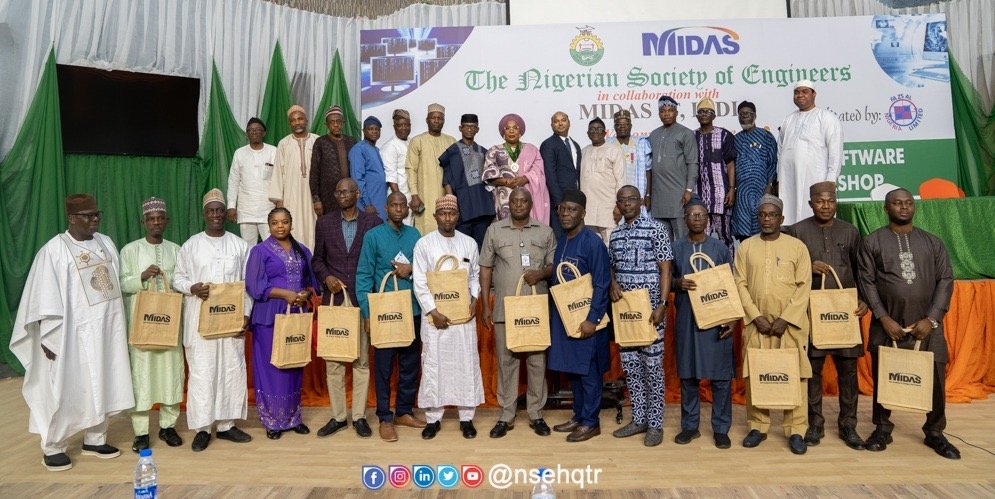
Nigeria’s insecurity challenges need more than policy responses and boots on the ground. In a powerful statement delivered in Abuja on Monday, the Nigerian Society of Engineers (NSE) has urged engineering professionals across the country to champion innovation and technology as strategic tools in the fight against crime, violence and risk. The call comes at a critical moment when communities in different parts of the country struggle with persistent insecurity that affects lives, livelihoods and investor confidence.
At a formal event to inaugurate the 17th National Chairman of the Nigerian Institution of Mechanical Engineers (NIMechB), Dr. Babagana Tella, the President of the NSE, Ali Rabiu, emphasised that insecurity is not a singular problem but a multilayered system that calls for diverse and smart solutions. He specifically challenged engineers to move beyond traditional practice and embrace innovative methodologies that harness data, advanced technology and cross-disciplinary thinking to help stabilise Nigeria’s security landscape.
Nigeria today faces a wide range of security threats. These include armed banditry, communal clashes, kidnappings for ransom, kidnapping of schoolchildren, and rising levels of violent crime. Recent reports and expert analyses show that insecurity does not just strain the nation’s defence architecture; it also disrupts agriculture, education and economic activity across regions. Addressing these layered problems demands tools and insights that conventional responses alone cannot deliver. Expert engineers see this as a moment for the profession to take a frontline role in generating homegrown, technology-powered responses.

A Call for Engineers to Innovate Beyond Theory
In his address, Mr. Rabiu made a case for engineering to be actively repositioned from a peripheral support function into the core of national security planning and execution. “Engineering discipline as a whole is central to industrial growth, infrastructure resilience and national security systems,” he said. “Insecurity should be treated as a complex system requiring multidisciplinary engineering solutions.”
According to the NSE president, the challenges of insecurity cannot be solved with policies alone. He argued that engineers should deploy smart systems such as data analytics, surveillance platforms and locally developed technologies that can help map risk, predict threats and support security agencies. Rabiu also urged greater focus on logistics optimisation and sustainable infrastructure development to strengthen communities and improve resilience.
At the heart of his message was the belief that true innovation must be rooted in logic, structured thinking, modelling and evidence-based decision-making. These, Mr. Rabiu noted, are the core skills that engineers bring to complex problems and the very tools that can help transform Nigeria’s security response. According to him, security solutions should come not only from international imports but from Nigerian minds building systems suited to local realities.

Linking Engineering Solutions to Broader National Goals
The NSE’s advocacy echoes a broader national conversation about the role of science, technology and innovation in tackling Nigeria’s most pressing challenges. Beyond security, government and private sector leaders have highlighted engineering’s key role in addressing food insecurity, infrastructure gaps and economic stagnation. In recent remarks by the Minister of Agriculture and Food Security, for example, there was a call for engineering advice and mechanised solutions to improve food systems, boost productivity and reduce post-harvest losses.
While engineering innovation is widely seen as essential in advancing security solutions, leaders are also urging attention to education and skills development. A growing concern in the sector is the gap between academic training and practical, industry-ready skills among engineering graduates. Reports have highlighted that a majority of young engineers lack hands-on experience with tools, platforms and systems that are critical in real-world practice.
The Nigerian Society of Engineers has already been participating in responses to this skills challenge. In recent months, the organisation partnered in the launch of a national engineering Olympiad designed to inspire students to develop innovations that tackle societal problems and then move those ideas towards commercialisation. This initiative illustrates how engineering excellence and innovation development can be fused to create solutions that extend beyond classroom walls.
What This Means for Nigeria’s Future
The NSE’s renewed focus on leveraging engineering prowess for national security helps underline a shift in how Nigeria thinks about problem-solving. Rather than viewing insecurity solely as a policing or military issue, professional engineers now frame it as a systems problem that requires layered and proactive interventions. According to industry voices, this approach could unlock new pathways to safety that are both targeted and sustainable.
For communities across Nigeria, the promise of engineering-driven solutions is significant. Digital tools that enhance surveillance, data-driven platforms that analyse patterns of violence, and locally developed robotics or sensor systems could all help improve real-time response and risk reduction. At the same time, improved logistics systems can support emergency services, while resilient infrastructure can reduce vulnerability to attacks on critical facilities.
Professionals in the sector see Nigeria at a crossroads. Embracing homegrown innovation could position the country as a leader in creative security responses in Africa. It could also help build an engineering culture that is both commercially viable and substantively impactful. As the NSE calls on its members to rise to the occasion, the broader hope is that engineers will combine technical expertise with entrepreneurial flair to develop solutions that are practical, scalable and adapted to Nigeria’s unique context.
One veteran engineer says the stakes are high and the expectations are clear: “Innovation is not just a buzzword. It is what will help change the narrative of insecurity in our nation. Engineers must be part of that change with ideas that protect life and strengthen our nation.” Comments like this reflect growing ambition within the engineering community to contribute meaningfully to Nigeria’s development.
As Nigeria continues to grapple with insecurity, the NSE’s call for engineering innovation offers a renewed vision of hope. It challenges engineers to look beyond conventional practice, push technological boundaries and apply their skills in service of safety, stability and national progress. For many observers, this perspective represents an important evolution in thinking about national security and the power of innovation.
Join Our Social Media Channels:
WhatsApp: NaijaEyes
Facebook: NaijaEyes
Twitter: NaijaEyes
Instagram: NaijaEyes
TikTok: NaijaEyes