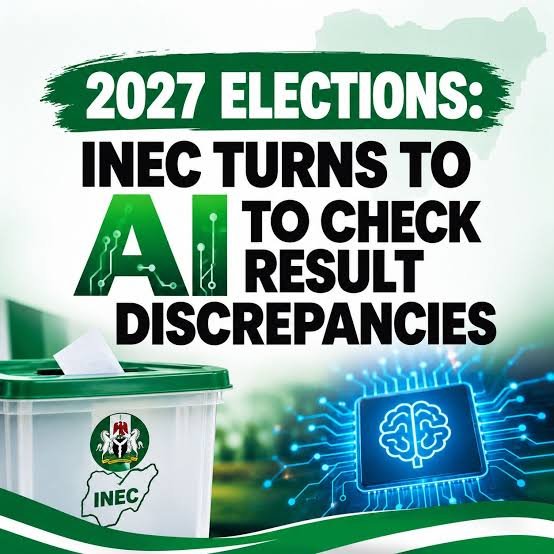

Artificial intelligence is emerging as an important tool in efforts to protect Nigeria’s electoral process ahead of the 2027 general elections, as technology experts call for stronger systems to identify suspicious voter registrations and prevent the spread of election-related misinformation.
The recommendations come amid concerns over questionable photographs discovered in the Independent National Electoral Commission’s (INEC) preliminary Register of Voters and growing evidence that artificial intelligence can be used to manipulate information during elections.
Beyond identifying irregular registrations, experts believe AI could help electoral authorities monitor threats, improve voter education and respond more quickly to misleading information capable of influencing public participation.
AI Could Improve the Accuracy of INEC’s Voters’ Register
Experts have identified biometric verification and automated data analysis as important applications of artificial intelligence in electoral administration.
INEC already uses an Automated Biometric Identification System (ABIS) to identify potential duplicate registrations and other suspicious records requiring investigation.
The commission’s Director of Information and Communication Technology, Dr Lawrence Bayode, explained that the system had identified questionable entries in the preliminary voters’ register, including records containing suspected AI-generated photographs.
A report published by The PUNCH on November 9 quoted Bayode as saying that 268,000 records had been flagged for examination. However, earlier reports by Channels Television and The PUNCH cited 268 records. INEC needs to clarify this significant discrepancy before the figure can be treated as established.
The distinction between detecting suspicious records and confirming electoral fraud is also important. Automated systems can identify unusual patterns, but human officers must investigate the findings before deciding whether a registration is invalid.
Also Read: INEC Introduces AI Tools to Strengthen Election Results Verification Ahead of 2027 Polls
Experts Warn About AI-Generated Election Misinformation
The potential benefits of AI extend beyond voter registration. According to experts who spoke to The PUNCH, the technology could help INEC monitor public complaints, identify emerging security concerns and make electoral information more accessible in Nigerian languages.
Professor of Computer Science and Artificial Intelligence at Babcock University, Oludele Awodele, warned that the same technology could produce convincing fake videos, fabricated audio recordings and impersonations of public officials.
He recommended watermarking, deepfake detection systems and stronger collaboration between INEC and social media platforms to identify misleading election content.
Certified information security professional Precious Olives also advocated coordinated early-warning systems involving electoral authorities, security agencies and civil society organisations.
These measures could become particularly important during campaigns and election periods, when fabricated announcements about polling arrangements, voting dates or security incidents could discourage eligible Nigerians from voting.
Protecting Voters Requires More Than Automated Technology
The Acting Director of the Safeguarding Centre at the University of Lagos, Dr Abiola Akiyode-Afolabi, highlighted another concern: the potential use of AI-generated sexually explicit images and other manipulated content to intimidate women candidates.
She called for safeguards against technology-facilitated violence, particularly targeting women and persons with disabilities.
Her concerns demonstrate why electoral technology policies must address both the integrity of voter information and the safety of political participants.
INEC must also ensure that automated verification does not wrongly remove legitimate voters. Bayode has clarified that genuine photographs enhanced through AI-powered mobile applications should not automatically disqualify their owners.
Transparent investigations, human review and accessible complaint procedures will therefore be essential to maintaining confidence in the system.
Back Story: AI Concerns Ahead of the 2027 Elections
Questions about AI and Nigeria’s electoral integrity intensified after manipulated images circulated during the June 20, 2026 Ekiti governorship election. Fact-checkers identified images presented as evidence of vote-buying and unusually high voter turnout as AI-generated.
The controversy over INEC’s preliminary voters’ register followed in October, after questionable photographs appeared in records published online. The commission subsequently acknowledged irregularities allegedly introduced by some registration officers.
INEC is expected to complete its verification, adjudication and data-cleanup processes before certifying the final Register of Voters on December 15, 2026.
The commission’s challenge is to demonstrate that its technology can identify genuine irregularities without excluding eligible citizens. As Nigeria prepares for 2027, the credibility of its electoral database will depend on effective technology, accountable officials and transparent verification procedures.
Also Read: 2027 Elections: INEC Moves to Tackle Deepfakes, Foreign Information Manipulation