
In Lagos recently, over 900 experts from more than 20 countries converged at the 5th International Conference on Artificial Intelligence and Robotics (ICAIR 2025) held at the University of Lagos (UNILAG). The overarching message: Nigeria—and indeed all of Africa—must urgently adopt and adapt artificial intelligence (AI), robotics and other emerging technologies if the continent is to claim a meaningful role in the global technology landscape.
The event, organised by the Machine Intelligence Research Group (MIRG), bore the theme “Building Sustainable AI-Driven Transformation Infrastructures for African Economies” and staked a claim as Africa’s premier gathering in this space.
During the conference, Dr Victor Odumuyiwa, Chairman of MIRG, emphasised that “Africa’s development trajectory depends on how effectively it harnesses the potential of AI for local impact.” Meanwhile, Prof Phillips Adewole, Dean of the Faculty of Computing and Informatics at UNILAG, urged African nations to build sustainable digital infrastructures suited to local realities rather than simply importing models built for other geographies.

Table of Contents
The Call Is: Build Smart From Within
A recurring theme among the speakers was the need for African-centred innovation rather than off-the-shelf tech from elsewhere. Dr Chika Yinka-Banjo, Head of the Department of Computer Sciences at UNILAG, noted how the department is stepping up its work in AI education and research..
In his keynote address, Dr Bunmi Ajala of the National Centre for AI and Robotics (NCAIR) explained the need for a national framework for “responsible and inclusive artificial intelligence” that reflects Nigeria’s socio-economic realities—calling for ethics, inclusion and transparency to be baked into AI strategies.
For instance, the Lagos State Commissioner for Innovation, Science and Technology, Olatubosun Alake, laid out how Lagos is positioning itself as a hub for AI.
Why This Matters: Opportunities & Imperatives
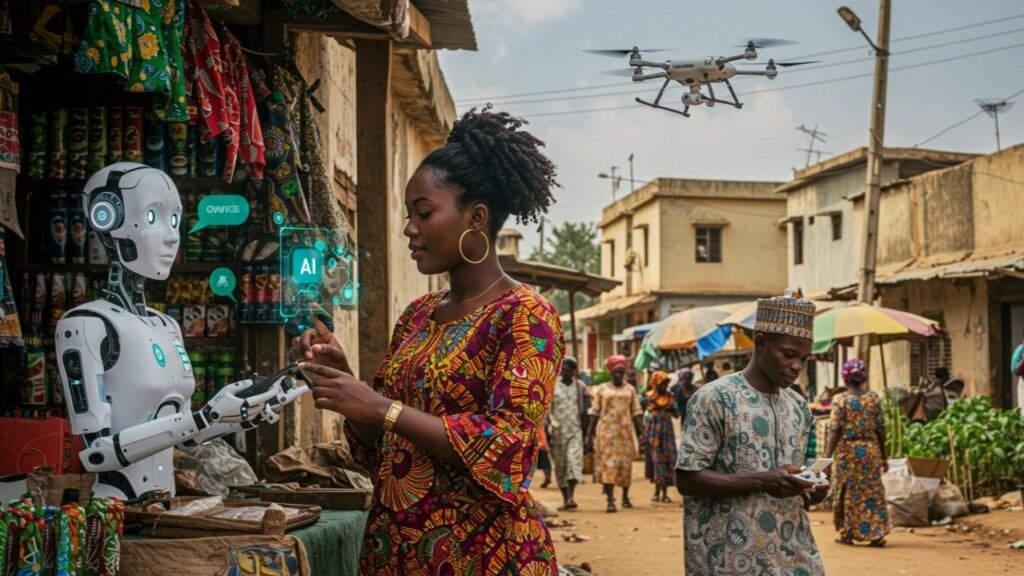
The message resonates for good reason. Africa, and Nigeria in particular, sits at a moment of potential inflection. Technology adoption offers a chance to leapfrog older infrastructure, deliver services more efficiently and open up pathways for youth employment. But without tailored strategies, local capacity and institutional frameworks, the risk is of being left behind—or worse, becoming dependent on external players.
During the conference, Dr Odumuyiwa stressed the importance of collaborative research across countries and continents to bridge the continent’s technological gaps.
Nigeria’s role here is particularly significant. With its large population, youthful workforce and growing digital economy, it is well‐placed to act as a regional leader. The calls made during ICAIR 2025 aren’t mere rhetoric—they’re a practical roadmap. They urge:
- Invest in infrastructure (data centres, reliable power, connectivity)
- Build local skill-sets (engineers, data scientists, robotics technicians)
- Focus on ethical frameworks and inclusivity, to avoid the digital divide widening
- Encourage home-grown innovation, to ensure technologies are adapted for local conditions
Challenges & What Comes Next
Of course, the path ahead is not without hurdles. Nigeria and many other African nations still face systemic issues: intermittent power supply, limited broadband access in rural areas, brain-drain of skilled professionals, and policy frameworks that lag behind fast-moving technological developments.
But conference participants were upbeat that these challenges could be addressed through strategic partnerships. For example, Dr Yinka-Banjo and Prof Adewole urged stronger ties between academe, government and industry—so that research doesn’t stay in the lab, but leads to real-world applications. The conference also served as a networking hub: researchers, policymakers and business leaders mingled, shared insights and explored collaborations across four continents.
For Nigeria in particular, the next steps will likely focus on implementing the frameworks discussed: establishing national AI policies, supporting robotics research and start-ups, integrating AI into public services and ensuring fairness and accountability in these systems.
As the Minister of Communications, Innovation and Digital Economy, Dr Bosun Tijani, observed during the event, technology isn’t just an add-on—it is a vital catalyst for Africa’s digital transformation agenda.

Conclusion
The recent gathering at UNILAG sent a clear signal—Nigeria and its neighbours must seize the moment. The race is not simply about acquiring flashy tech; it’s about building lasting, inclusive, context-aware systems that work for people. For the continent to fully benefit from AI and robotics, the conversation must move from possibility to execution—and from imported models to African solutions. The stage is set; what now matters most is the will, the coordination and the follow-through.
Join Our Social Media Channels:
WhatsApp: NaijaEyes
Facebook: NaijaEyes
Twitter: NaijaEyes
Instagram: NaijaEyes
TikTok: NaijaEyes