The Federal Government has proposed N135.22 billion for “Electoral Adjudication and Post Election Provision” in the 2026 budget, indicating a new multi-billion-naira commitment to handling the duties and disputes that usually follow Nigeria’s elections.
According to sources, on Monday, the clause was found in the House of Representatives Order Paper for March 31, 2026, which included the report on the 2026 Appropriations Bill.
The PUNCH noted that the allotment was recorded under the Service-Wide Votes, a centrally administered fund utilised by the federal government to support commitments unrelated to any particular ministry, department, or agency.
Service-Wide Votes are widely regarded as the government’s contingency or general-purpose fund within the budget.
It has been described as a central provision used to pay for expenses that span several agencies, such as unanticipated costs, national commitments, and liabilities that are difficult to allocate to a single agency.
In certain instances, the fund also covers items that are not fully defined at the time of budget preparation or that need additional approval.
Within this framework, what this means is that the government anticipates continued financial strain from election-related legal issues, settlements, and administrative procedures, as seen by the N135.22 billion provision for post-election concerns.
Further analysis of the appropriation document revealed that the provision sits within the broader Consolidated Revenue Fund charges, reinforcing its classification as a centrally managed obligation rather than a direct allocation to any single agency.
According to the budget plan, the electoral adjudication and post-election line alone contributed for almost 3.65 percent of the overall CRF charges, which came to N3.70 trillion.
The 2026 fiscal proposal included a substantially bigger N1.01 trillion statutory contribution to the Independent National Electoral Commission in addition to this allocation.
Sources also noted that INEC is the largest recipient in this category, accounting for 21 per cent of the total statutory transfers of N4.80tn.
Statutory transfers are compulsory allocations backed by law and the Constitution, paid directly to government institutions like as INEC, the National Assembly, and the National Judicial Council.
READ ALSO: INEC Suspends Voter Revalidation Exercise, Issues Directive to RECs Amid Political Uproar
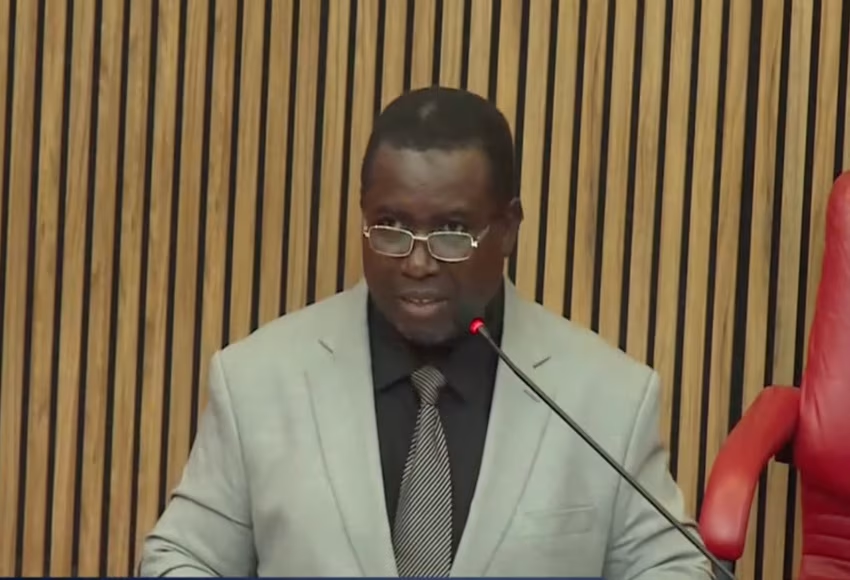
Recall that in February that INEC informed the National Assembly it required N873.78bn to conduct the 2027 general elections. The agency also demanded N171bn to fund its operations in the 2026 fiscal year.
The N873.78bn proposed for the 2027 elections represents a substantial increase over the N313.4bn released by the Federal Government for the 2023 general election.
Meanwhile, sources also observed that the N135.22bn included in the 2026 appropriation bill is a new line item, which was not stated in the proposed 2026 budget.
Parties question allocation
However, opposition parties and civil society organisations have questioned this new allocation.
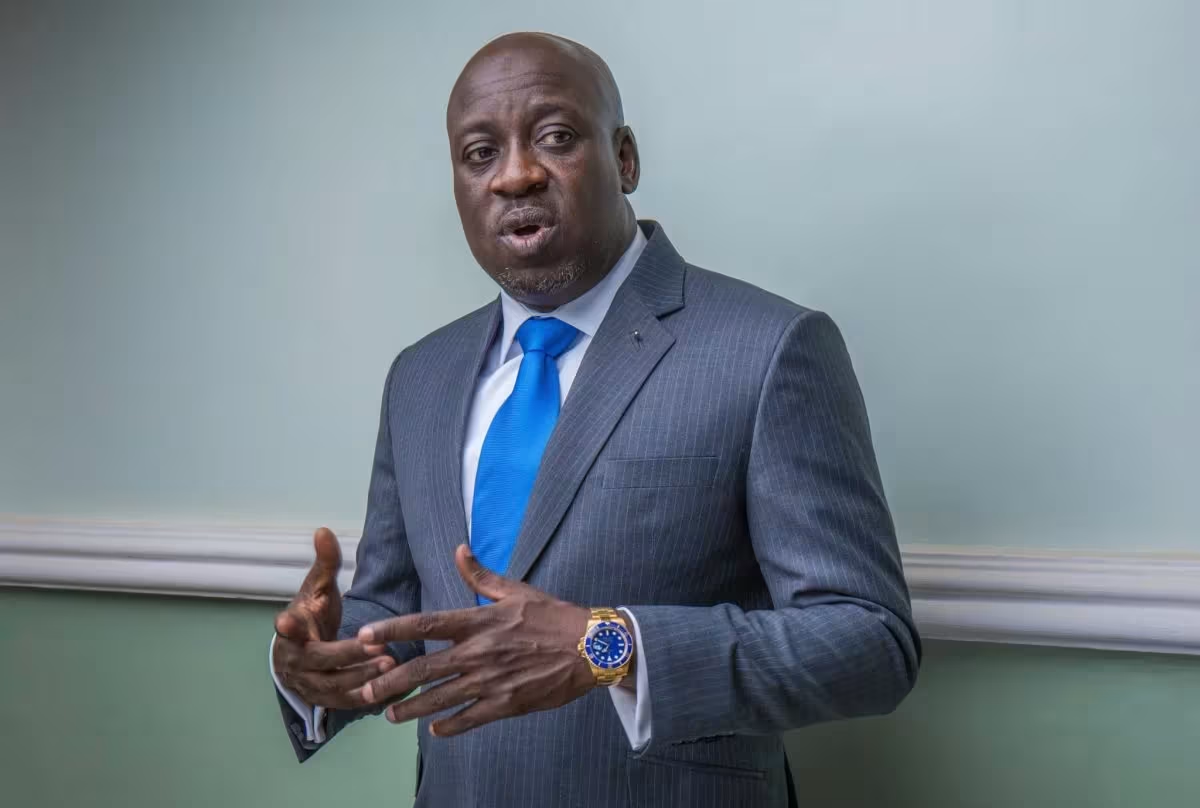
The N135.22 billion provision for post-election legal proceedings has drawn criticism from the People’s Democratic Party and the African Democratic Congress, who have called for increased responsibility in its utilisation and questioned the allocation’s openness and logic.
In an exclusive interview with The PUNCH, the National Publicity Secretaries of the PDP and ADC, Ini Ememobong and Bolaji Abdullahi, voiced concern that the clause implies INEC is anticipating legal disputes, suggesting a lack of readiness to hold free, fair, credible, and acceptable elections in 2027.
According to the PDP National Publicity Secretary, the clause casts doubt on Nigeria’s voting process’s openness. More transparency would “drastically reduce” post-election litigation, he claimed, adding that the allocation implies INEC is foreseeing disagreements.
Noting that “most of the lawyers should be in-house,” he questioned the necessity of substantial legal expenditure and claimed that outside counsel might be swayed by political interests.
Bodies react
Similarly, civil society organisations have also criticised the National Assembly-approved measure, questioning the purpose and ramifications of setting aside such a large amount for expected electoral disputes.
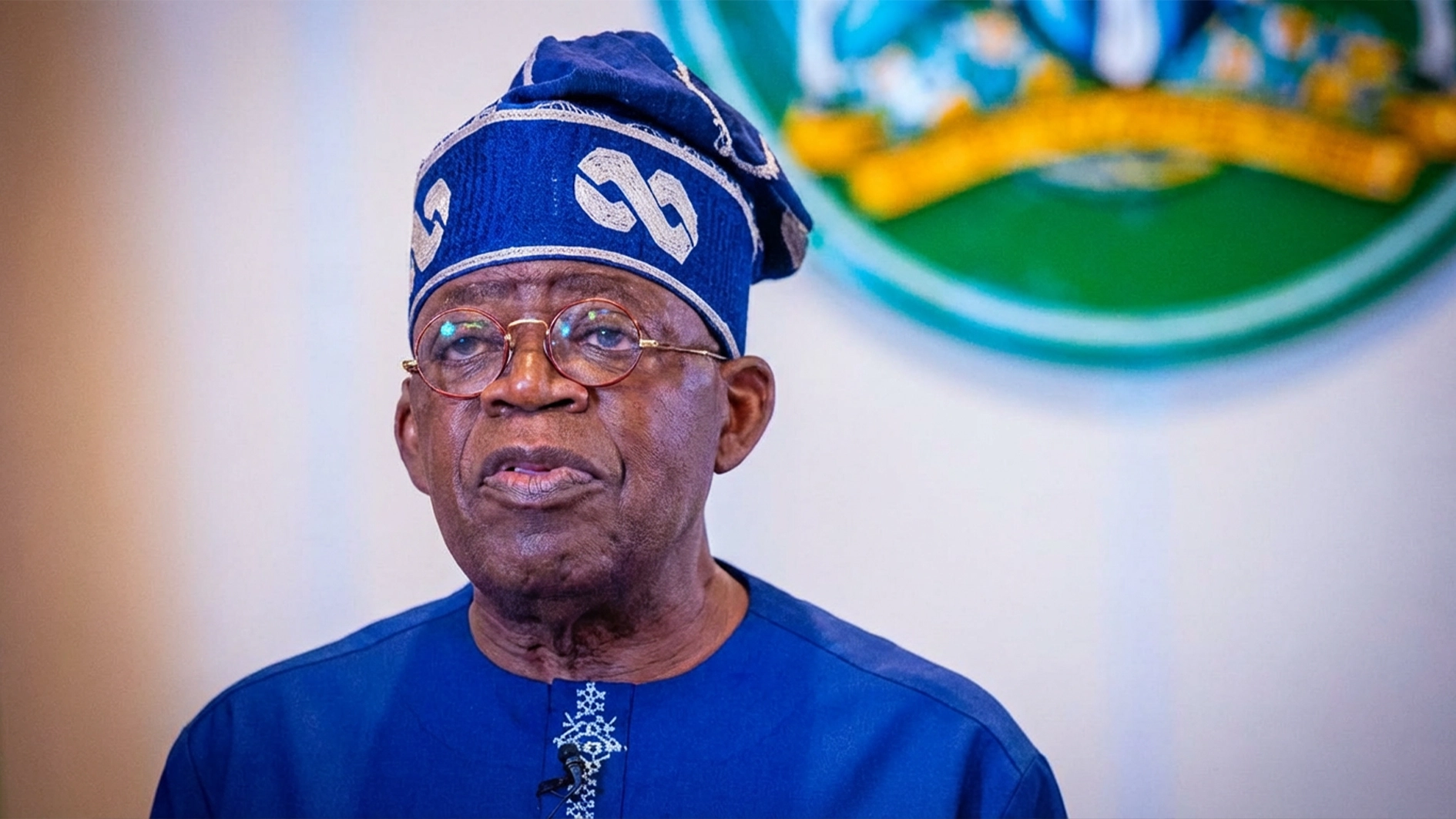
Anthony Ubani, Executive Director of #FixPolitics Africa, has expressed worries about the funding for post-election legal disputes, cautioning that it indicates more serious problems with Nigeria’s democratic system.
Ubani said, “The N135.22bn allocation for post-election legal battles is a troubling signal about the state of our democracy”.
He emphasised that creating a budget as large as the suggested amount raises concerns, while acknowledging that electoral disputes are a part of the post-election period. He maintained that the public’s trust in the democratic process is weakened by the increasing reliance on judges to decide election results.
According to Ubani, the tendency lessens political players’ accountability and promotes manipulation.
He advocated for changes, such as real-time results transmission, to increase electoral confidence.