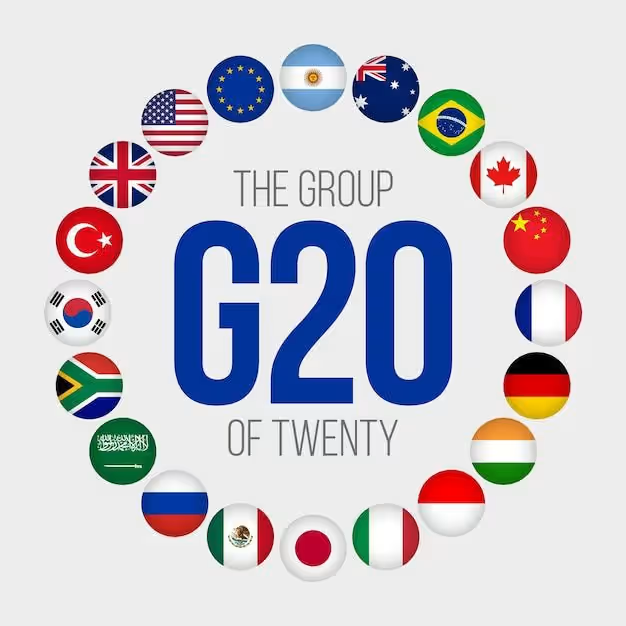
G20 FRAGMENTATION FEARS: US South Africa Rift Threatens Global Economic Bloc
The G20, the world’s foremost forum for international economic cooperation, is now facing an existential threat of fragmentation, driven by rapidly escalating diplomatic tensions between the United States and South Africa. Geopolitical analysts warn that the exclusion of South Africa from the 2026 G20 Summit in favor of Poland signals a potentially irreversible fracture, forcing the world’s largest economies into hardened, rival geopolitical blocs.
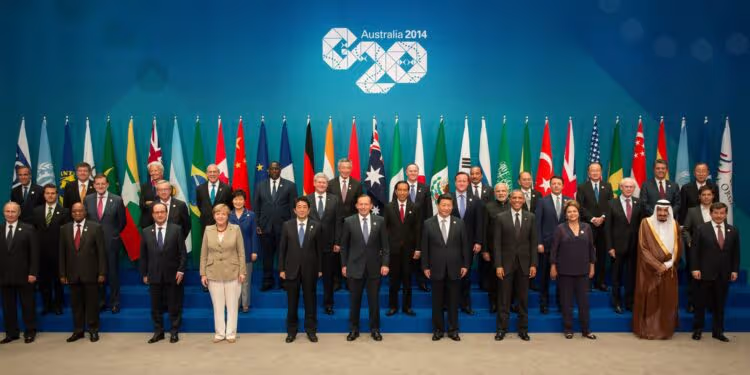
These concerns follow Washington’s controversial decision to exclude South Africa, currently a full member, from the upcoming 2026 summit. This action, coupled with the US boycott of the 2025 G20 Summit held in Pretoria, marks the highest point of friction between the two nations in years and exposes the deep divisions tearing at the fabric of global governance.
The Boiling Point: US Snub and South Africa’s Exclusion
The relationship between the two nations has spiraled downwards following repeated and inflammatory accusations made by US President Donald Trump. He publicly accused South Africa of “genocide against White Afrikaners,” a claim vehemently denied and dismissed by South African President Cyril Ramaphosa during his White House visit in May.
The subsequent US boycott of the 2025 Pretoria Summit was a clear diplomatic statement, underscoring Washington’s displeasure with Pretoria’s nonaligned foreign policy stance. The latest move to exclude South Africa from the 2026 meeting, instead extending an invitation to European ally Poland, cements the growing schism. Pretoria has responded with stoicism, indicating its readiness to sit out the 2026 gatherings without seeking diplomatic intervention from other nations. This quiet acceptance suggests a deeper commitment to its current geopolitical position, regardless of the consequences.
Experts Warn of Imminent G20 Collapse and Bloc Formation
Geopolitical specialists are unequivocal in their assessment of the G20’s future. Speaking on the Nairametrics’ Drinks & Mic podcast, Cheta Nwanze, CEO and Lead Partner at SBM Intelligence, articulated the view that the forum’s cohesion has effectively “collapsed.”
Nwanze predicts a definite split, stating, “The cohesiveness that the G20 used to have, I think is now gone. And the G20 is going to split into various blocs over time, aligning along geopolitics.”
He sees the world rapidly drifting toward an “emerging West versus the rest situation,” where historically nonaligned or neutral smaller countries are being aggressively pressured to choose a side. Nwanze also expressed disappointment that the first G20 summit held on African soil in Pretoria failed to yield any meaningful or concrete outcomes for the continent, leading many to question the actual relevance and utility of the G20 itself.
Reinforcing this view, Arnold Dublin Green, Chief Investment Officer at Cordros Securities, remarked that the Western nations’ silence regarding the US boycott of the African hosted summit was highly revealing. For Dublin Green, this incident represents a broader geopolitical shift, concluding starkly, “It is definitely the West versus BRICS.” He views the US snub as potentially a historical turning point, arguing, “This is probably something we’ll look back on and say, okay, this is when we knew things were exacerbated.”
Double Standards Fueling Global Distrust
A central theme fueling this impending fragmentation is the perceived inconsistency and double standards displayed by global powers on critical international issues. Analysts point to the protracted Russia Ukraine war and the ongoing Israel Palestine conflict as primary examples where deep inconsistencies in the actions and responses of global powers have been exposed.
Cheta Nwanze captured the resulting global distrust with a grim observation: “We’re returning to a world where the strong do what they will and the weak support what they must. And it’s not good for business.” This sentiment highlights a fracturing international order where power politics supersede multilateral cooperation, undermining the very principles the G20 was founded upon—economic stability and inclusive policy coordination.
The US has maintained a consistent hardline approach toward Pretoria, demonstrated previously by expelling South Africa’s ambassador and imposing steep 30% trade tariffs, which South Africa continues to challenge. Such aggressive actions towards a major African economy only serve to solidify the narrative of an emerging West versus the rest, deepening the alignment of countries like South Africa with alternative economic and political structures, such as the expanded BRICS bloc.
The Stakes: Economic Fragmentation and Global Governance
The G20 is a powerful consortium, comprising the world’s largest economies plus the European Union and African Union, collectively representing 85% of global GDP and two thirds of the world’s population. Its failure to maintain cohesion carries severe economic and political risks.
If the G20 splits into rigid blocs, it will dramatically complicate global challenges ranging from climate change and debt management to trade and financial regulation. Economic policy coordination, which is the G20’s primary function, will become impossible, likely leading to parallel, noncooperative tracks dominated by geopolitical rivalries. This potential fragmentation risks reversing decades of progress toward an integrated global economy and reinforces a multipolar world order defined by competition rather than collaboration.
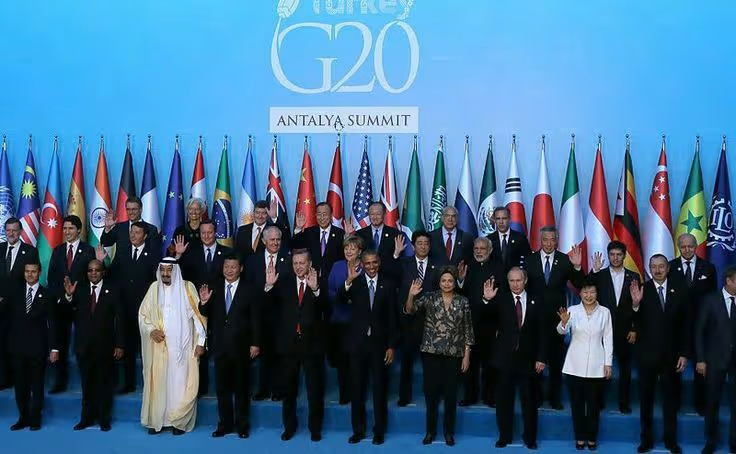
The international community must urgently address the diplomatic rift to preserve the integrity of the G20, or risk rendering the crucial body irrelevant precisely when global challenges demand greater unity.
Join Our Social Media Channels:
WhatsApp: NaijaEyes
Facebook: NaijaEyes
Twitter: NaijaEyes
Instagram: NaijaEyes
TikTok: NaijaEyes