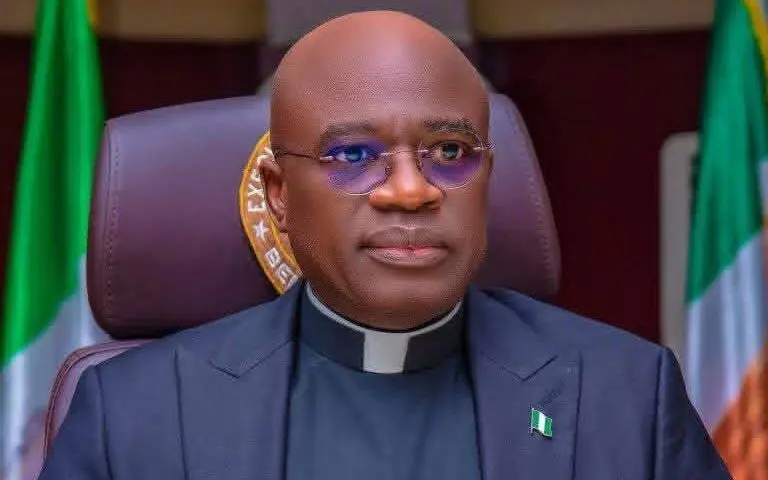
Benue State Governor, Hyacinth Alia, has described the challenges his administration inherited, including failing institutions, a fragile economy, and widespread insecurity across several local government areas.
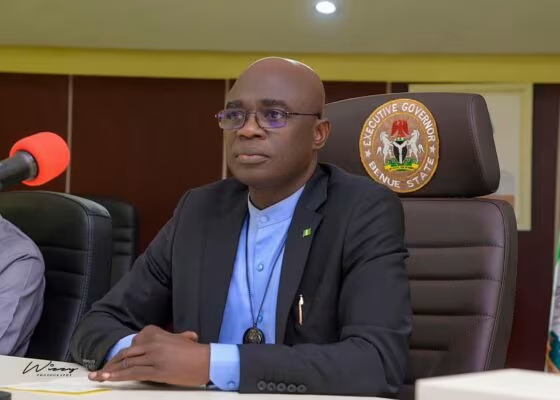
He stated that his government has implemented deliberate measures to restore stability and set the state on a path toward sustainable growth, emphasizing ongoing progress in key sectors.
Alia made these remarks during the 2nd Virtual Town Hall meeting with the Benue diaspora community, held on Sunday and organized by the Benue State Directorate for Diaspora Linkages and Investments under its Director-General, Abraham T. Girgir. The statement was issued by his Chief Press Secretary, Sir Tersoo Kula.
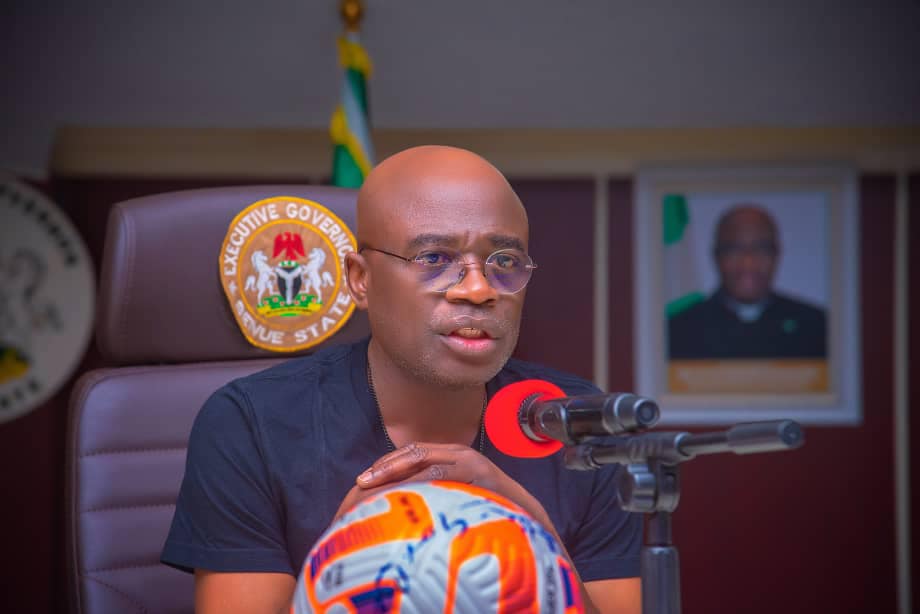
On security, the governor revealed that persistent attacks and killings, which previously affected around 17 local government areas, have now been reduced to a few remaining flashpoints. He attributed the improvement to collaboration with the federal government and security agencies, despite challenges posed by porous borders with neighboring states and international frontiers. He also highlighted the role of technology-driven security strategies in strengthening these efforts.
Regarding internally displaced persons (IDPs), Alia noted that over 600 individuals were displaced at the peak of the crisis in December 2025. He added that many are gradually returning to their communities, with the government facilitating safe and complete resettlement.
He acknowledged support from the First Lady, Oluremi Tinubu, as well as institutions such as UBA, the DSS, and the Nasarawa State Government, noting that interventions have totaled ₦1.27 billion.
In education, Alia revealed that over 22 percent of the 2026 budget is earmarked for revitalization, particularly targeting primary and secondary schools long affected by neglect. He also highlighted ongoing reforms in the healthcare sector to address years of decline.
On the economic front, the governor outlined efforts to revive industries like Taraku Mills while maintaining Benue’s leading position in soybean production. He also noted the operation of processing facilities, including juice, bread, water, and beverage factories, aimed at boosting local manufacturing and retaining economic value within the state.
Concerning infrastructure, Alia provided updates on completed and ongoing road projects across Benue, including township roads in Makurdi and Gboko, as well as inter-local government networks to improve connectivity. He added that the state is collaborating with the federal government on major projects, including the Wurukum overhead bridge.
The governor also shared plans to enhance civil servants’ welfare through a federal housing initiative and the development of a “Renewed Hope Estate” in Makurdi to attract investors and diaspora involvement.
Responding to contributions from participants such as Mwuese Vershima, Dr Emmanuel Ejembi, Dr Aver Yakubu, and Rev. Ralph Okworie, Alia acknowledged the complexities of governance and public expectations, especially as the 2027 elections approach.
He likened rebuilding the state to healing “an old wound,” emphasizing that progress is gradual. Alia reaffirmed his openness to new ideas and continuous learning, urging the diaspora to remain actively engaged in the development of Benue State.
Join Our Social Media Channels:
WhatsApp: NaijaEyes
Facebook: NaijaEyes
Twitter: NaijaEyes
Instagram: NaijaEyes
TikTok: NaijaEyes
Related posts:
- PDP convention: Makinde shocking moves destroy and bury PDP – Group
- ADC blasts attack on PDP headquarters, warns democracy is under threat
- NIDCOM confirms anxious Nigerians in Qatar, UAE and Iran seek urgent evacuation details amid rising tensions
- State Police: New IG Sets Up Crucial Panel to Draft Solid Security Framework