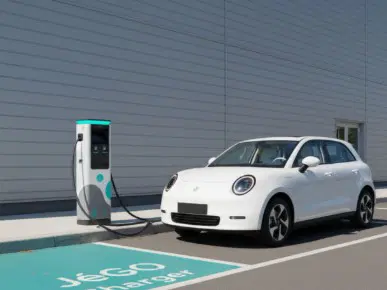
JéGO Technologies Inc. has unveiled its much-anticipated “Zero Carbon” electric vehicle (EV) in Nigeria, signalling a major stride in the country’s transition to clean, intelligent and locally-relevant transport. The launch took place at the 5th International Conference on Artificial Intelligence and Robotics (ICAIR) at the University of Lagos, where the firm’s CEO, Frederick Akpoghene, stressed that this isn’t just another EV—it’s been purpose-built for the realities of Nigerian roads.
This vehicle represents more than just a new car; it embodies JéGO’s mission to merge advanced mobility with sustainability. The company believes that intelligent EVs, engineered for African conditions, can fundamentally shift how Nigerians travel, work, and respond to climate challenges.

Built for Real Nigeria: Endurance, Durability, and Intelligence
One of the most compelling parts of the JéGO Zero Carbon’s debut was a 505-kilometre endurance journey undertaken on a single charge. The trip began in Ajah (Lagos), wound through Ikoyi and rural parts of Osun State, and then returned to Ajah — all done without stopping to recharge.
The terrain wasn’t gentle: muddy slopes after rain, unpaved roads, and tight, pothole-filled corners tested the vehicle’s mettle. Yet the Zero Carbon handled it smoothly, thanks in no small part to its 360° surround-view cameras, hill-assist features, strong traction control, and anti-skid systems.
Inside, the experience is both practical and surprisingly homely. The cabin features a built-in mini-fridge (with room for up to four bottles), turning the car into a kind of mobile office during long drives. Drivers praised the quiet ride, stable handling, and cooling system that remained effective even under difficult conditions.
Breaking Barriers: Policing, Community & Local Impact
What added a historic touch to this launch was the choice of driver for the endurance test — a serving Nigerian Police officer, known as Officer Ebenezer. He drove the entire 505 km trip, from Lagos to Osun and back, without supervision or escort. His flawless handling reinforced JéGO’s message: this EV isn’t just for private citizens — it has real potential for institutional use, including security patrols, community policing, and rapid response operations.
JéGO also deliberately brought the Zero Carbon to ordinary Nigerians. The test drive passed through JéGO’s partner’s “Net Zero Village” in Osun State, where local engineers, climate activists, youth innovators, and government officials were invited to experience the car first-hand.
For many, this was more than a demonstration — it felt like a promise. As JéGO’s CEO Akpoghene put it: the EV is for “everyday Nigerians – young founders, businesswomen and men, government workers, first responders… even the police.”
Officials from Osun State, impressed by the car’s long-range journey, its rugged performance, and the fact that it made the return trip without recharging, openly talked about using the Zero Carbon for state-level logistics, inter-agency duties, and local policing projects.
Scaling Locally: From Assembly to Clean-Energy Factory
JéGO’s ambitions go beyond introducing a single EV. Following the successful demonstration, the company confirmed plans to establish its own clean-energy and EV factory in Nigeria.
Already, several Nigerian states are in discussions, offering land, industrial incentives, tax support, and workforce collaboration. The planned facility will handle local EV assembly, semi-assembled (SKD/CKD) production, battery manufacturing, diagnostics, and servicing.
This plant is not just about cars; it’s about job creation across engineering, manufacturing, and logistics — and even exporting to other West African markets.
According to Akpoghene, the final choice of location for the factory will hinge on infrastructure, reliable energy, logistics corridors, and strong governmental partnerships.
On the vehicle technology side, the Zero Carbon is lean but smart: it offers a 505 km driving range, uses a sophisticated Battery Management System, and has regenerative braking. Advanced safety is baked in via radar sensors, 360° cameras, anti-skid control, and hill-assist.
To further ease adoption, JéGO supports flexible financing: lease-to-own plans, staff / driver purchase programs, and even models tailored for SMEs and agencies.
Charging is also designed with flexibility in mind. The car supports:
- Home charging
- Public charging stations
- Solar-based charging using JéGO PowerPods
- Fast charging (where available)
The PowerPods are particularly interesting: they’re modular, clean-energy units that can provide off-grid charging, enabling households, businesses, or even security agencies to charge without relying on Nigeria’s often-unpredictable grid.

Why This Matters for Nigeria
- Environmental impact: The Zero Carbon helps reduce reliance on fossil fuels, pushing Nigeria closer to cleaner mobility.
- Local innovation: Building the EV and its energy infrastructure locally could spur a new industrial ecosystem.
- Institutional adoption: With police and state governments showing interest, EVs may start being used for public services, not just private transport.
- Accessibility: Through financing and lease plans, more Nigerians — not just elites — may realistically access EVs.
- Energy independence: Solar-powered charging (via PowerPods) gives a way to charge without depending fully on the national grid.
Challenges to Watch
- Charging infrastructure still remains a hurdle in many parts of Nigeria. While PowerPods help, scalable public charging networks are crucial.
- Cost: The vehicle’s price (considering import costs, customs etc.) could limit uptake if not offset with local manufacturing.
- Policy environment: For the factory to thrive, consistent government support (incentives, infrastructure) will be essential.
- Maintenance & servicing: As EVs become more common, a skilled workforce to service them will be critical.
Conclusion
JéGO Technologies’ launch of the Zero Carbon EV marks a powerful moment in Nigeria’s electric mobility journey. By designing a smart, rugged, and range-capable EV specifically for Nigerian conditions — and coupling it with clean-energy solutions and a local assembly plan — JéGO is not just selling a car. It’s building a mobility ecosystem.
The presence of a police officer behind the wheel during the endurance ride highlights a bold message: this technology is ready for real, national-scale challenges. With the prospect of a homegrown factory, JéGO is not just importing change — it’s manufacturing it on Nigerian soil.
If executed well, this could be a turning point: more EVs on the road, more clean-energy infrastructure, and a stronger, more self-reliant Nigerian mobility sector.
Join Our Social Media Channels:
WhatsApp: NaijaEyes
Facebook: NaijaEyes
Twitter: NaijaEyes
Instagram: NaijaEyes
TikTok: NaijaEyes
READ THE LATEST EDUCATION NEWS