Nigeria’s education system stands at a turning point. For decades, textbooks have been the backbone of classroom learning, especially in public schools where resources are already stretched. Now, with the rise of artificial intelligence, a bold question is emerging across policy circles, classrooms, and tech hubs alike: what if AI tutors replaced traditional textbooks entirely?
It is not just a futuristic idea. Early experiments within Nigeria already show that AI can act as a powerful learning companion. But replacing textbooks completely would not simply modernise education. It would fundamentally reshape how students learn, how teachers teach, and how knowledge itself is delivered.
Table of Contents
The promise of AI tutors in Nigerian classrooms
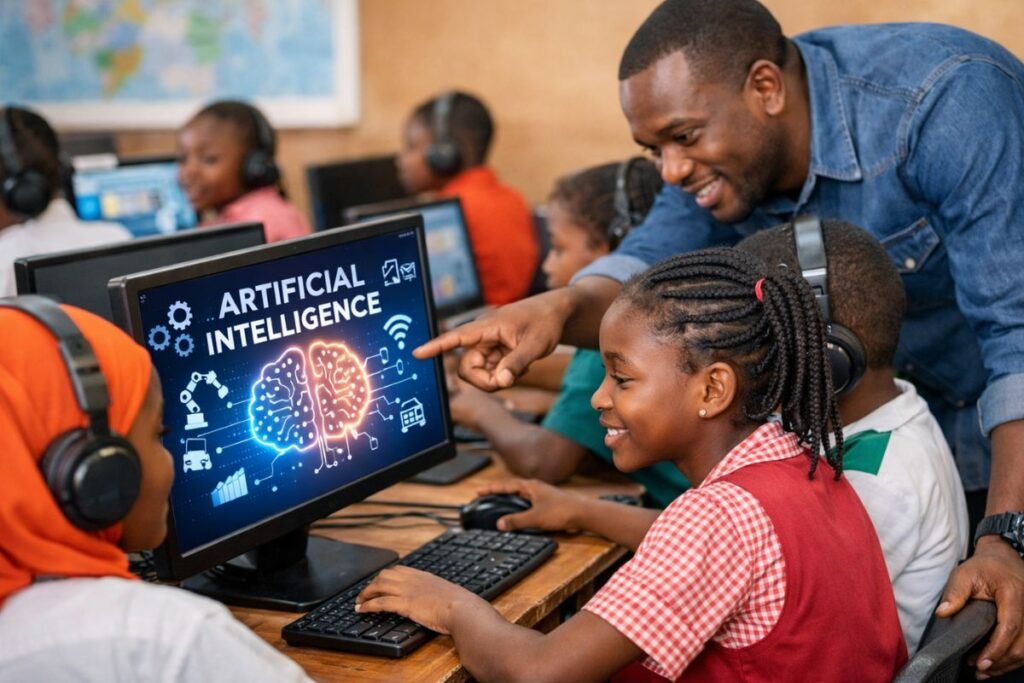
The strongest argument for AI tutors is simple. They can personalise learning at a scale textbooks never could. In many Nigerian public schools, a single teacher may handle dozens of students, sometimes up to 70 or more in one class. In such conditions, textbooks become one-size-fits-all tools, leaving struggling students behind and fast learners unchallenged.
AI changes that equation. It can adapt explanations to each student’s level, offer instant feedback, and repeat lessons without frustration. A recent study in Edo State demonstrated just how powerful this can be. Students who used AI tools in structured sessions achieved learning gains equivalent to roughly one and a half years of schooling in just six weeks.
This is not just impressive. It signals a potential breakthrough for a system long plagued by uneven learning outcomes.
Beyond academics, AI tutors can also provide continuous assessment. Instead of waiting for end-of-term exams, students can receive real-time insights into their strengths and weaknesses. This could help reduce exam anxiety and improve long-term retention.
There is also the question of access. In rural communities where qualified teachers are scarce, AI tutors could serve as a consistent educational support system. With the right infrastructure, even offline-compatible tools could deliver structured lessons aligned with the Nigerian curriculum.
If textbooks represent static knowledge, AI represents living knowledge, constantly updated, interactive, and responsive.
The risks of removing textbooks entirely
Despite its promise, replacing textbooks with AI tutors carries serious risks, especially in Nigeria’s current reality.
The most immediate concern is infrastructure. AI depends on electricity, internet access, and digital devices. Yet, only a fraction of Nigerian public schools have reliable power or connectivity. Without addressing this gap, a full transition to AI could exclude millions of students overnight.
There is also the issue of over-reliance. Evidence suggests that while AI can enhance learning, it can also weaken critical thinking if not properly guided. Students may begin to depend on AI for answers rather than engaging deeply with problems.
Textbooks, for all their limitations, encourage a certain level of independent reading and reflection. Removing them entirely risks replacing one problem with another.
Data privacy is another concern. AI systems often collect large amounts of user data, including learning patterns and personal information. In a country where data protection frameworks are still evolving, this raises questions about how student information would be stored, used, and protected.
Perhaps the most overlooked risk is cultural relevance. Many AI systems are trained on foreign curricula and contexts. Without proper localisation, students may receive explanations that do not align with Nigerian realities, examples, or even examination standards like WAEC and NECO.
Replacing textbooks is not just about technology. It is about trust, context, and control over knowledge.

What happens to teachers and classroom dynamics
One of the biggest fears surrounding AI in education is the idea that it could replace teachers. In reality, the situation is more complex.
Research and field experience suggest that AI works best when combined with human guidance. In the Edo State programme, teachers played an active role in guiding students, structuring lessons, and ensuring that AI interactions remained meaningful.
If textbooks were replaced by AI, teachers would not disappear. Instead, their roles would shift. They would become facilitators, mentors, and learning coaches rather than primary sources of information.
This shift could be positive. Teachers could spend less time dictating notes and more time supporting individual students, managing classroom dynamics, and building critical thinking skills.
However, there is a danger of de-skilling. If AI is used primarily as a cost-cutting tool, teachers could be reduced to supervisors of technology rather than professionals with expertise. This would undermine the very foundation of quality education.
Classroom interaction could also change dramatically. Traditional learning encourages discussion, group work, and shared experiences. AI-driven learning, if not carefully designed, could become isolated and screen-focused.
The human element of education, motivation, empathy, and mentorship cannot be coded into an algorithm.
A likely future: hybrid learning, not full replacement
The most realistic outcome is not a complete replacement of textbooks, but a hybrid system where AI and traditional resources coexist.
Textbooks still serve important functions. They are accessible, reliable, and independent of infrastructure. They provide a structured reference that students can revisit without needing devices or internet access.
AI, on the other hand, brings flexibility, personalisation, and interactivity.
When combined, the two can create a more balanced system. A student might use a textbook to understand core concepts, then turn to an AI tutor for practice, clarification, and deeper exploration.
For policymakers, the challenge is not choosing between textbooks and AI. It is designing a system where both complement each other effectively.
Investment will be critical. This includes not only devices and connectivity but also teacher training, curriculum alignment, and local content development.
If implemented thoughtfully, AI could help close Nigeria’s education gap. If rushed or poorly planned, it could widen existing inequalities between urban and rural schools, and between public and private institutions.
Conclusion
Replacing textbooks with AI tutors in Nigerian public schools is not just a technological upgrade. It is a structural transformation with far-reaching consequences.
The potential benefits are undeniable. Personalised learning, improved outcomes, and expanded access could redefine education for millions of students.
But the risks are equally real. Infrastructure gaps, over-reliance, data privacy concerns, and the possible erosion of the teacher’s role cannot be ignored.
The future of education in Nigeria will likely not be powered by AI alone. It will be shaped by how well the country balances innovation with inclusion, technology with humanity, and ambition with careful planning.
AI may not replace textbooks overnight. But it is already rewriting the story of how Nigerian students learn.
Join Our Social Media Channels:
WhatsApp: NaijaEyes
Facebook: NaijaEyes
Twitter: NaijaEyes
Instagram: NaijaEyes
TikTok: NaijaEyes
READ THE LATEST EDUCATION NEWS