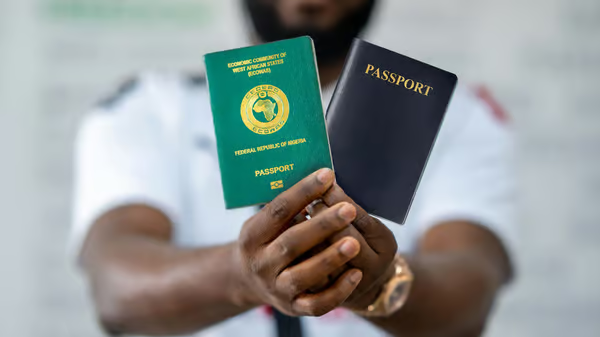
In fresh global data released in January 2026, the strength of the Nigerian passport has recorded a notable rise, moving to 89th place out of 199 countries in the Henley Passport Index. This annual ranking, widely respected by governments and international travellers alike, measures the number of destinations a passport holder can visit either visa‑free or with visa‑on‑arrival and other simplified entry arrangements. Nigerian entrants now hold a visa‑free score of 44, reflecting modest but significant progress in international travel access.
The Henley Passport Index draws on exclusive data from the International Air Transport Association (IATA) and the global citizenship advisory firm Henley & Partners to evaluate travel freedom across nationalities. The jump to 89th in 2026 marks an improvement from 94th at the close of 2025 and sits alongside a similar position held in mid‑2025.
Table of Contents
What This Ranking Means for Nigerians
For Nigerian travellers, this shift means a slightly smoother pathway to nearly four dozen countries without the often lengthy requirement of securing a visa before departure. Visa‑free access, or entry with a simple visa on arrival or electronic travel authorisation, reduces both cost and uncertainty, and can make spontaneous travel more realistic for Nigerians visiting nations in Africa, the Caribbean, Asia and beyond.
Despite the climb, Nigeria’s passport remains in the lower half of the global ranking, underscoring ongoing challenges in expanding international mobility. Within the African continent, the Nigerian travel document ranks below many peers, positioned above only a handful of nations such as the Democratic Republic of Congo, Ethiopia, South Sudan, Sudan, Libya and Eritrea. On the continent’s mobility ladder, Nigeria is currently the seventh least powerful passport.
Travel requirements continue to be restrictive in key parts of the world. Europe, North America and sections of Asia maintain stringent visa processes for Nigerian citizens, demanding extensive documentation, processing fees and waiting periods. These hurdles persist even as the passport’s overall ranking edges upward year on year.

Global Context and Regional Comparison
The 2026 Henley Passport Index presents a study in contrasts between countries with broad global access and those with limited travel reach. At the top of the scale, nations such as Singapore, Japan and several European states maintain visa‑free or visa‑on‑arrival entry to well over 180 destinations worldwide. These passports are prized for the freedom they afford citizens, supporting business travel, education abroad and personal mobility without bureaucratic barriers.
Within Africa, Seychelles continues to hold the strongest passport, with access to a far broader set of destinations, while Mauritius and South Africa also outperform Nigeria by a comfortable margin. Notable progress by Ghana, ranked around 69th globally with access to more visa‑free destinations, highlights how some African countries are leveraging diplomacy and mobility agreements to strengthen travel freedom.
Experts say that passport power is often shaped by diplomatic relations, economic partnerships and reciprocal visa policies between countries. A stronger passport can translate into wider opportunities for business, education and cultural exchange, while a weaker one often means extra cost and complexity for would‑be travellers.
Trends and What Comes Next
The year‑on‑year shifts in the Henley Passport Index illustrate an uneven global mobility landscape. Nigeria’s ranking of 89th reflects not just its own gains but comparative movement from other countries. Some nations have steadily improved access through proactive visa agreements and travel‑friendly policies, while others have tightened controls, particularly in response to global security and migration concerns.
Nigeria’s position earlier in 2025 reached 88th, its highest in recent years, before a slight fluctuation pushed it back to 94th and now up again to 89th. This volatility underscores both the challenges and potential in shaping travel policy and diplomatic engagement that could enhance passport strength in the coming years.
Ongoing discussions among officials, travel industry observers and the diplomatic corps suggest that Nigeria may continue to pursue agreements that broaden its citizens’ mobility. Improving Nigeria’s global travel standing could involve increased bilateral negotiations, regional cooperation frameworks and modernisation of travel systems. These strategies often take time but are seen as key steps to enhancing Nigeria’s passport ranking over the long term.
For now, the 2026 ranking offers a welcome piece of good news for millions of Nigerian travellers and their families abroad. The move to 89th position in the global index is a reminder that, even amid global competition for mobility, Nigeria can claim incremental progress and set the stage for continued improvements in the freedom with which its citizens explore the world.
Join Our Social Media Channels:
WhatsApp: NaijaEyes
Facebook: NaijaEyes
Twitter: NaijaEyes
Instagram: NaijaEyes
TikTok: NaijaEyes