NNPC, Heirs Energies Seal Flare Gas Deals: Converting OML 17 Waste to Power Generation
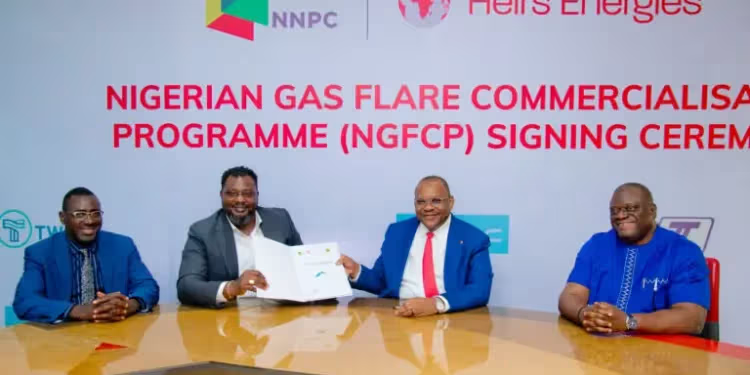
The Nigerian National Petroleum Corporation (NNPC) and Heirs Energies have taken a crucial step in advancing Nigeria’s energy transition goals by signing Gas Flare Commercialization Agreements. The agreement, which took place in Lagos on Tuesday, December 9, 2025, moves the joint venture’s efforts on Oil Mining Lease (OML) 17 from regulatory planning to tangible commercial execution.
The core objective is clear: to capture previously wasted flare gas volumes from OML 17 and deploy them for economically and socially productive uses, primarily aimed at significantly boosting Nigeria’s power generation capacity.
The Strategic Path: From Flare to Value
This initiative is a centerpiece of Nigeria’s commitment to environmental stewardship and is structured under the Nigerian Gas Flare Commercialization Programme (NGFCP) and approved Non-NGFCP frameworks.
Engr. Seyi Omotowa, Chief Upstream Investment Officer of NUIMS, representing NNPC Limited, emphasized that flare gas commercialisation is not mere regulatory compliance. He stressed that it is a strategic pathway to enhancing energy availability, fostering gas based industrialisation, and reinforcing Nigeria’s position as a responsible energy producer.
Capturing and Deploying Flare Gas
The gas volumes captured from OML 17 will be routed for several high impact domestic applications:
Power Generation: Directly feeding gas to power plants to boost the national grid.
Industrial Applications: Supplying industries to support local manufacturing and growth.
Production of LPG & CNG: Converting gas into cooking gas (LPG) and Compressed Natural Gas (CNG) for vehicles, aiding cleaner energy use.
The Nigerian Upstream Petroleum Regulatory Commission (NUPRC), represented by Mr. Ojo Olalekan Ezekiel, affirmed its commitment, noting that the initiative aligns with national energy and emissions-reduction goals under the Petroleum Industry Act (PIA).
Key Partnerships and Enhanced Gas Deliverability
The successful execution of these agreements hinged on bringing together key players for the entire value chain. The collaboration involves NNPC, Heirs Energies, and several private sector offtakers who will process and deploy the captured gas.
The Offtakers:
The five approved flare gas offtakers who will now move to full project implementation include:
AUT Gas
Twems Energies
GPID (Gas & Power Infrastructure Development Ltd.)
PCCD
AGTC (Africa Gas & Transport Company Ltd.)
Heirs Energies’ CEO, Osa Igiehon, highlighted the company’s gas led strategy, asserting that “Gas sits at the heart of Nigeria’s development journey”. The signing moves the project closer to full scale implementation, promising significant economic, environmental, and social benefits for Nigeria.
OML 17: The Engine Room of Gas-to-Power
The foundational success enabling these agreements is the impressive performance of OML 17 under the indigenous operatorship of Heirs Energies. Since taking over the joint venture in 2021, Heirs Energies has executed brownfield excellence interventions, positioning gas as a core value stream.
Landmark Gas Production Leap
A key intervention in 2025 was the rigless recompletion of a non-associated gas well, an industry first for Nigeria. This low-cost, high-impact solution effectively:
Doubled the JV’s gas output to a peak of 135 million standard cubic feet perday (MMscf/d).
Increased the supply of gas to the national grid to 45 MMscf/d.
This surge in gas supply has already had a transformative impact on power generation in the Eastern Domestic Gas Market.

Impact on Power Plants:
| Power Plant | Previous Output (Average) | Current Output (Peak) | Percentage Increase (approx.) |
| TransAfam Power Plant | ~50 MW | Over 180 MW (Peaks of 200 MW) | Quadrupled (300%+) |
| Combined Power Plants (TransAfam, FIPL, Geometric Power) | ~100 MW | Over 350 MW | 250%+ |
This increase provides stable energy for hundreds of thousands of homes and businesses, reinforcing Nigeria’s commitment to the Decade of Gas initiative. The successful elimination of routine flaring at OML 17 serves as a model for technology driven and responsible hydrocarbon asset management across the country.
Would you like more details on the Nigerian Gas Flare Commercialization Programme (NGFCP) structure or the specific technology used in the rigless well recompletion?
Join Our Social Media Channels:
WhatsApp: NaijaEyes
Facebook: NaijaEyes
Twitter: NaijaEyes
Instagram: NaijaEyes
TikTok: NaijaEyes