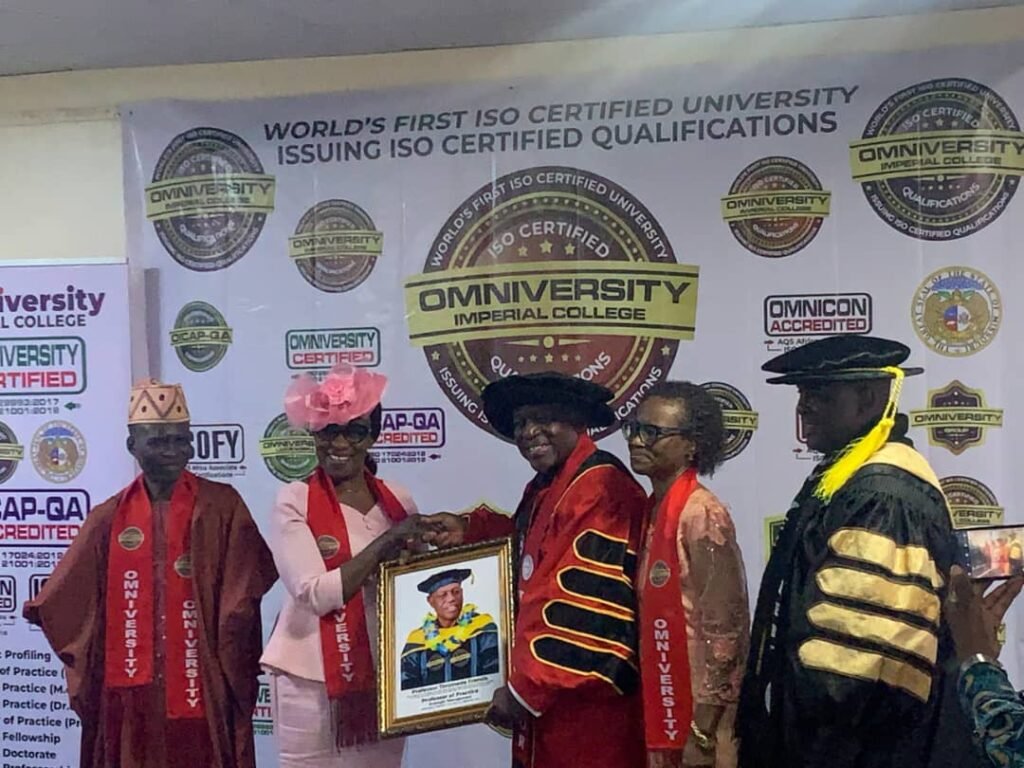
In a landmark moment for Nigeria’s education and professional landscape, Omniversity Imperial College has taken a bold step in recognising excellence beyond conventional academic pathways. The institution recently conferred a range of practice-based academic honours on distinguished individuals whose professional achievements and real-world impact resonate far beyond theory and textbooks. This event marks a growing shift towards valuing hands-on expertise and competence in the nation’s evolving educational discourse.

Omniversity is Bridging Knowledge and Real-World Practice
At the heart of the celebration was the conferment of honorary fellowships, practice-based titles, and advanced academic distinctions on outstanding professionals from various fields. The conferment event assembled practitioners whose careers showcase deep expertise and significant contributions to their sectors, challenging the traditional emphasis on classroom-only credentials.
This push recognises individuals not just for academic attainment but for demonstrable competence gained through years of professional experience. By doing so, Omniversity Imperial College is advocating for an educational ethos that values real-world problem-solving and tangible impact. Observers say this approach aligns with global movements that prioritise competency-based evaluation alongside traditional degrees.
Professors of Practice and Doctors of Practice were among the honours bestowed during the conferment ceremony. These titles honour experienced professionals with deep portfolios of achievement, signalling that practical mastery is as worthy of formal recognition as scholarly research.
A New Narrative for Educational Advancement
The event, which echoed themes discussed at the 2025 African Education Roundtable and Qualifications Conferment, served as both an awards ceremony and a platform for discussions about the future of learning in Nigeria. The overarching theme highlighted the value of accreditation of prior experiential learning and the role of skill recognition in driving educational and economic progress.
Proponents of this model argue that traditional educational frameworks, which focus primarily on theoretical knowledge, often overlook the depth of experience professionals gain over the years in the field. By incorporating practice-based qualifications into formal recognition systems, institutions like Omniversity are pushing for a more inclusive and dynamic understanding of what it means to be educated and skilled.
This initiative also reflects broader global trends that emphasise competency and skills as central to workforce readiness and economic development. In an era where industries evolve rapidly, recognising diverse forms of expertise could help countries like Nigeria unlock new avenues for innovation, productivity, and leadership.
Highlighting Achievers Who Inspire
Among those honoured were seasoned professionals whose careers span leadership, innovation, and impactful contributions to society. While detailed lists of awardees were not published in the initial report, other media outlets covering similar events show that recipients included veterans in strategic management, cybersecurity, forensic sciences, and business leadership. Their achievements demonstrate how professional practice can generate profound societal value.
Professors of Practice, for instance, represent individuals who have spent decades shaping their fields through pioneering work, mentorship, and measurable results. Doctors of Practice are recognised for specialised competencies in cutting-edge domains that blend technical mastery with creative application. These titles provide public affirmation of practitioners whose work has influenced industries, communities, and national growth.
The recognition also spotlighted professionals whose contributions have helped bridge gaps between academia and industry, inspiring younger generations to see the value of lifelong learning, adaptability, and innovation.
Omniversity is Shaping the Future of Qualifications in Nigeria
The ceremony and the conversations that accompanied it speak to a broader ambition: to expand how society values different forms of knowledge and experience. Educational reform advocates believe that recognising competence gained outside formal classrooms can help address skills gaps and better prepare graduates for real-world challenges.
This approach does not seek to undermine traditional university degrees but to complement them with pathways that validate practical achievement. By integrating frameworks such as accreditation of prior experiential learning and competency-based evaluation, institutions can create more flexible and relevant qualification systems for diverse learners
In addition, partnerships between educational innovators and professional bodies are emerging as a way to standardise practice-based recognition, ensuring that credentials awarded reflect rigorous assessment and international benchmarks. Such collaborations could strengthen Nigeria’s position in the global knowledge economy and encourage professionals to pursue lifelong learning without constraining their career paths.
The impact of these initiatives is already being felt. Thought leaders and stakeholders say that bridging experiential expertise with formal recognition boosts morale among seasoned professionals and signals to young talent that excellence comes in many forms, both inside and outside lecture halls.
Looking Ahead
As Nigeria continues to navigate its development goals, the recognition of practice-based academic achievement could play a crucial role in shaping a workforce equipped for the challenges of the 21st century. By honouring individuals whose careers embody dedication, innovation, and high-impact contributions, Omniversity Imperial College has not only celebrated excellence but also championed a broader vision for the future of education.
In the unfolding narrative of educational evolution, the message is clear: knowledge is more than theory. Real-world mastery matters, and when it is recognised and celebrated, it can inspire a generation to redefine success on their own terms.
As other institutions and policymakers watch closely, the hope among reform advocates is that such initiatives will ripple across the sector, inviting a richer, more inclusive understanding of what it means to be learned in Nigeria and beyond.
Join Our Social Media Channels:
WhatsApp: NaijaEyes
Facebook: NaijaEyes
Twitter: NaijaEyes
Instagram: NaijaEyes
TikTok: NaijaEyes
READ THE LATEST EDUCATION NEWS