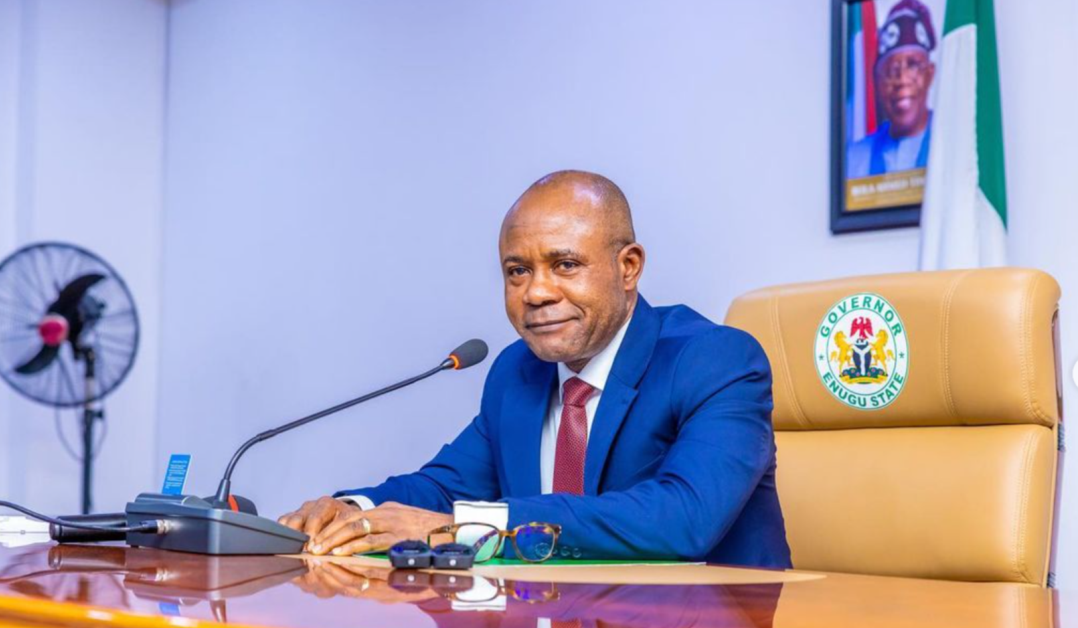

Governor Peter Mbah has advocated financial autonomy and robust investment in modern security infrastructure for proposed state police services, saying any legal framework establishing the system should strike a balance between national oversight and local operational capacity.
Mbah stated this on Thursday while speaking at a town hall meeting themed, “Building a National Consensus for State Police and National Security,” organised by Arise News in Abuja.
The Enugu governor stressed that the framework for state policing should uphold national standards and support while granting states the financial independence and decision-making authority needed to address their unique security challenges effectively.
He added that prioritising security through adequate funding and investment in technology would equip state police services with the tools and resources required to deliver effective security outcomes at the subnational level.
“The importance of funding the state police system effectively cannot be overemphasised. And having a State Police Service Commission that has a first-line charge on the Consolidated Revenue Fund is in order.
“Many other institutions in the states – the judiciary and the legislature – have the first-line charge. The key thing is providing enough funding to be able to sustain the state policing system,” he said.
Sharing the Enugu State experience on the importance of prioritising security, he recalled that at the inception of his administration in 2023, the state was under siege, with nightlife gone, some areas even in the state capital barricaded, Mondays gone, while many students lost an entire academic year, as they could not sit important final-year examinations due to the illegal sit-at-home orders.
“If the Enugu experience is anything to go by, we came into office recognising that we had made commitments to eradicate poverty, to grow the economy exponentially, to make Enugu State the preferred destination for business, living, and investment.
“We immediately recognised that if we didn’t address the security challenges, we could not achieve those objectives. Therefore, we had to invest hugely in technology, in building a Safe City Surveillance System with CCTV cameras that are AI-enabled, as well as having both static and mobile cameras. All these come with huge costs.
“But the human element is also important, which is essentially why we had to set up the Distress Response Squad (DRS). As a governor, you want immediate action because matters of security are measured in minutes. You must be in a position where you are able to act swiftly.
“So, you must build the capability to first nip crime in the bud. But where there has been a breach, you must have the capacity to act swiftly. And if the Enugu experience is anything to go by, that essentially is what we did that enabled us to drive down violent crime by over 90 per cent.
“Therefore, when you talk about funding, you can see that the states are already carrying quite a huge burden in terms of funding, because you are investing in technology.
“We also ensured that there is a unified communication system between the agencies. Our Command and Control Centre houses all the security agencies in the state – the police, the army, and the Department of State Services. They all have a channel of communication,” he stated.
Governor Mbah also called for a constitutional provision that guarantees state police while preserving the details for an Act of the National Assembly to allow for amendments in the future without going through the rigours of constitutional amendment.
“So, in amending the Constitution, we must, by all means, make sure that it is not verbose. There should be a provision that allows us to reform the system in future, if needed, when we have tried it,” he said.
Mbah also stressed the need to focus on operational authority for state police rather than on watering down the powers of governors, who would be in office for a maximum of eight years only.
“By the way, there is this idea that governors are likely to abuse state police and that we should, therefore, do as much as we can to water down their powers.
“Nobody is a governor forever. We are also going to one day leave that office and become regular citizens.
“We just want to be sure that there is enough operational authority given to the governors so that you do not give someone a performance target without providing him or her with the control needed to achieve the required outcome,” he concluded.
BACKKSTORY:
The debate over the creation of state police has gained renewed momentum amid worsening insecurity across Nigeria, including banditry, kidnapping, terrorism, communal clashes and attacks on rural communities. Governors, traditional rulers and security experts have repeatedly argued that the current centrally controlled policing system is overstretched and unable to respond effectively to local security challenges.
For years, the Nigeria Governors’ Forum and several stakeholders have advocated constitutional amendments to allow states to establish and manage their own police services. Supporters of the proposal argue that state police would improve intelligence gathering, enable quicker responses to security threats and strengthen community policing because officers would have a better understanding of local languages, cultures and terrain.
However, the proposal has also attracted criticism from those who fear state police could be abused by governors to intimidate political opponents or interfere in elections. To address these concerns, proponents have called for strong constitutional safeguards, clear oversight mechanisms and sustainable funding arrangements to ensure professionalism, accountability and operational independence.
Governor Peter Mbah‘s latest remarks add to the growing national conversation, as he argues that any state policing framework should guarantee financial autonomy, investment in modern technology and a balance between national standards and local decision-making to ensure the system functions effectively if eventually established.