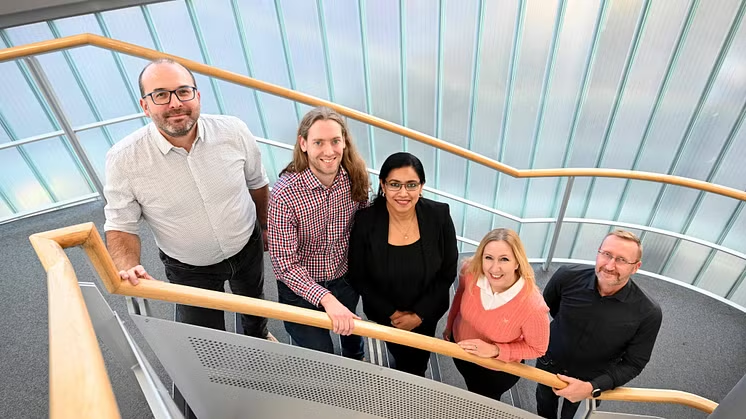
The space innovation landscape in the United Kingdom has taken a confident stride forward with the North East Space Communications Accelerator (NESCA) awarding its first round of innovation funding to seven pioneering space communications and technology projects. This milestone marks a key moment in the ongoing effort to transform leading research into real-world technologies with global impact. The funding injection, just over £340,000, is expected to spark significant advances across space monitoring, communications resilience, and satellite operations.
NESCA is part of a broader strategy to position the UK’s northern region as a hub of space technology excellence. The initiative was launched six months ago with investment from the Engineering and Physical Sciences Research Council (EPSRC), supported by an annual budget within a larger £2.5 million programme designed to run over four years. Partnerships between universities, civic organisations, and private industry lie at the heart of this drive, aimed at delivering innovations that bridge academic ideas and commercial realities.
Table of Contents
A Diverse Set of Projects Receiving Backing
The first NESCA funding round featured seven projects selected for their potential to advance space communications, safety and technology. Among those supported are initiatives with applications ranging from tracking space debris to building resilient satellite communications systems that can endure harsh conditions in orbit.
Three projects are being led by researchers at Northumbria University, highlighting that institution’s central role in the NESCA consortium. One of these, SkyScan, makes use of techniques similar to those used in astronomy, adapting them to capture clearer images of satellites and space debris. The goal is to improve the monitoring of objects in Earth’s orbit, reducing the risk of collision and enabling safer operations for commercial and scientific satellites.
Another Northumbria project focuses on developing broadband photodetector technology that can resist the extreme temperatures and radiation challenges of space. This work holds promise for ensuring continuous connectivity in critical missions where commercial off-the-shelf components would fail.
The funded projects also include advanced research from other partner universities. Newcastle University is working on a Quantum Light Source for Ultra-Secure Satellite Links, a project expected to bolster communications security through quantum encryption techniques. Durham University is progressing a prototype optical system designed to support low-latency communications, potentially opening new pathways for real-time data transfer in space operations. Additional work involves geopolitical analysis within the space domain, recognising that space technology does not exist in a vacuum but is shaped by international and regulatory dynamics.

NESCA’s Mission and Strategic Value
NESCA’s mission goes beyond awarding innovation grants. It seeks to bridge the gap between research excellence and commercial application, fostering collaborations that result in viable products, services, and policy frameworks. By facilitating partnerships across academia, industry, and the public sector, the initiative is strengthening the North East of England’s space sector, creating opportunities for high-skilled employment and supporting economic growth.
The broader programme is organised around three strategic pillars. The first is innovation funding, providing financial support to translate research results into prototypes and commercial ventures. The second pillar focuses on place-based activities, boosting the region’s profile in national and international space communities and developing infrastructure and policies that favour sustained growth. The third pillar emphasises skills and talent development, equipping a new generation of engineers, scientists, and space technologists with the tools to excel in an expanding industry.
Professor Vincent Barrioz, NESCA project lead and a key figure in shaping the accelerator’s direction, has expressed enthusiasm about the range and quality of proposals that were supported. According to him, these projects not only showcase cutting-edge research talent but also illustrate strong engagement with industry partners, setting clear pathways for future innovation and commercial uptake.
What This Means for the UK Space Sector
NESCA’s latest funding round is part of a larger UK commitment to fostering regional strengths in space research and innovation. It is one of seven Place-Based Impact Acceleration Account (PBIAA) projects supported by EPSRC, aimed at invigorating innovation clusters across the country. Collectively, these projects share about £22 million of investment, dedicated to stimulating local economies and building long-term technological leadership.
By centring its activities in the North East, NESCA is leveraging existing strengths across universities and industry partners, while attracting interest from organisations beyond the region. Importantly, the inclusion of early career researchers among project leads signals an emphasis on nurturing new talent and ensuring that the next generation of technical leaders is prepared to tackle future challenges.
The innovation focus also reflects broader global trends in space communications. As satellite constellations proliferate and Earth observation expands, issues such as space traffic management and inter-satellite connectivity have become critical. Projects like SkyScan are directly responsive to these needs, enhancing the ability to monitor objects in orbit and reduce potential collisions that could disrupt operations or create hazardous debris fields.
Looking Ahead: Continued Support and Future Rounds
This initial round of funding represents a significant step, but it is only the beginning. NESCA has announced that further funding rounds will be held over the course of the programme, with the next call already open and scheduled to close in early 2026. Researchers and innovators from partner institutions and beyond are encouraged to apply, particularly where collaborations with industry partners can be demonstrated.
The accelerator’s approach aligns with a growing recognition that space technologies must be developed in collaboration with commercial partners and public stakeholders to achieve meaningful impact. By offering financial support, fostering regional ecosystems, and promoting skills development, NESCA is contributing not just to scientific discovery but to practical solutions with commercial and societal outcomes.
For innovators in the space sector, these developments signal a fertile period of opportunity. With continued backing from EPSRC and significant buy-in from universities and industry alike, the UK’s North East is poised to play a leading role in converging research excellence with real-world application. Future projects funded through NESCA could lead to breakthroughs in communications resilience, space sustainability, and even international collaboration on orbital infrastructure.
By bringing together bright minds, strategic funding, and clear commercial pathways, this initiative is helping transform academic ingenuity into technologies that define the future of space. NESCA’s first funding cycle may be complete, but its impact is only beginning to unfold.
Join Our Social Media Channels:
WhatsApp: NaijaEyes
Facebook: NaijaEyes
Twitter: NaijaEyes
Instagram: NaijaEyes
TikTok: NaijaEyes