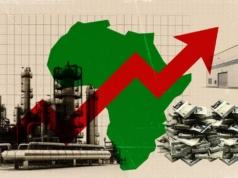
Artificial intelligence (AI) promises to reshape economies, transform societies, and redefine the future of work. But in a powerful new warning, the United Nations and its leading experts are saying that without strong human‑centred governance, the rapid rollout of AI could make inequality between and within countries even worse. This is not a distant theory, but an urgent global challenge demanding coordinated policy action from capitals in Abuja and Accra to Washington DC and Geneva.
The UN’s message is clear: AI’s transformative potential must be harnessed responsibly so that the technology uplifts people rather than entrenching existing divides. The stakes are high for millions of young Nigerians, Africans across the continent, and workers everywhere who see both opportunity and risk in an AI‑enabled world.
Table of Contents
The Rising Power of AI and the Risks It Brings
AI has rapidly moved from experimental labs to classrooms, hospitals, farms, and workplaces around the world. Its ability to analyse data, automate tasks, and enhance services is already evident in how businesses operate and how public services are delivered. But the United Nations warns that this momentum can turn into a global problem if governance fails to keep pace.
At its core, the concern is inequality. Developed nations with advanced digital infrastructure, deep pools of technical talent, and vast research resources are positioned to benefit the most from AI. In contrast, many low‑income nations are struggling with basic broadband access, teacher shortages, and limited digital skills. Without meaningful intervention, the gap between rich and poor nations may widen instead of narrowing.
This dynamic has been described in UN circles as a potential “next great divergence,” where the world could see inequality grow faster than at any time since the industrial revolution. Countries with strong AI ecosystems — including investment, regulation, and education — will surge ahead economically, while others risk being left further behind.
At a United Nations press briefing in Geneva, officials explained how the problem is both economic and structural. Only a minority of countries lead in AI development, while vast populations lack basic digital tools like spreadsheets or steady internet. These gaps create deep imbalances in who can participate in the AI economy and who cannot.
For example, in parts of the Asia‑Pacific, only a small fraction of the population uses AI tools regularly, and women are significantly less likely than men to own essential devices such as smartphones. These patterns reflect broader global trends that leave entire communities on the margins of the digital revolution.

What the United Nations Wants: Human‑Centred Governance
The United Nations has long stressed that technology must be shaped by human values. This message has been consistent across its agencies, including UNESCO, the International Labour Organisation (ILO), and the UN Development Programme (UNDP). They argue that AI governance should protect human rights, protect jobs, and ensure that the benefits of technology are shared broadly rather than concentrated among the powerful.
UN Secretary‑General António Guterres has been particularly clear that AI systems cannot be left to the black box of algorithms without oversight. He emphasised that human judgement, fairness, and accountability must be at the centre of AI systems — especially in areas that affect fundamental freedoms and livelihoods.
To translate these principles into action, the United Nations has been developing global guidelines for AI governance. These frameworks promote:
- transparency in AI systems so people understand how decisions are made,
- strong data protection laws to guard against misuse,
- mechanisms to prevent algorithmic bias,
- accountability for harmful outcomes, and
- restrictions on technologies that threaten dignity or freedom.
This approach reflects a broader commitment to the Universal Declaration of Human Rights as the foundation for digital policy worldwide. Organisations such as United Nations University have also highlighted that AI should be shaped in line with those values so that people everywhere can benefit from technological progress.
In practical terms, this means that governments and tech leaders must work together to set rules that ensure private companies cannot pursue profit at the expense of human welfare. It also means countries should share technology in ways that help emerging economies build capacity rather than deepen dependency.
Jobs, Education, and the Future of Work
Another core theme in the UN’s warnings is the impact of AI on jobs and education. Around the world, workers are anxious about what the automation of tasks might mean for employment and careers. In a 2025 survey by the World Economic Forum, a large share of employers indicated they plan to restructure jobs because of AI.
Yet international experts, including the ILO, note that AI may not destroy jobs overall but will change the nature of work. Roles that demand complex human skills — creativity, critical thinking, empathy, and ethical judgement — are likely to thrive. Workers will need to upskill continuously throughout their careers if they are to adapt to new demands.
This puts a spotlight on education systems, particularly in regions with high youth populations such as Africa. The UN has pushed for more emphasis on digital literacy and teacher training so that schools are ready for an AI future. UNESCO has warned against replacing educators with machines, emphasising that education is fundamentally a human and cultural experience.
In fact, UNESCO estimates that tens of millions of new teachers will be needed globally by 2030, underscoring that investment in people remains essential even as technology evolves.
Without stronger investment in education and reskilling, developing countries could fall into a low‑skill trap, where their workforces are ill‑prepared for the jobs of tomorrow. This would compound the inequality risks posed by AI adoption and stagnate social progress.
International Cooperation and Shared Frameworks Cited by the United Nations
The United Nations insists that no single government or organisation can handle AI’s risks alone. AI’s reach is global, crossing borders and sectors in ways that make isolated policy responses ineffective. The UN is calling for broad international cooperation to shape standards for AI governance.
This includes global dialogues on ethics and regulation, investment in workforce training, and systems that support equitable access to digital infrastructure. Such cooperation is also meant to encourage technology sharing so that smaller nations have the tools to build their own AI capabilities.
Experts have pointed out that cooperation should take into account regional differences. What works in one country may not be suitable in another due to varying levels of digital readiness, economic structures, and cultural contexts. Tailored strategies are therefore essential to avoid a one‑size‑fits‑all approach.
Many international voices, including leaders such as WTO Director‑General Ngozi Okonjo‑Iweala, have echoed similar themes, emphasising that AI must be used responsibly and shared in ways that foster global prosperity rather than exclusion.
For Nigeria and other African nations, these discussions have real consequences. Africa has one of the world’s youngest populations, which could become a demographic advantage if digital skills and infrastructure are prioritised. But without strong education investment and international partnerships, the continent risks becoming marginalised in the global AI economy.

Conclusion: A Call to Act Now on the United Nations Warning
The United Nations’ warnings about AI are both a caution and a call to action. While the technology holds immense promise to improve lives — such as enhancing healthcare access, supporting agricultural innovation, and enabling new forms of economic growth — its benefits are not guaranteed to be shared equally.
If policymakers, educators, and industry leaders fail to act, the world could see deepened inequality where nations and populations without digital access or strong governance structures are left further behind.
But the opposite is also possible. With coordinated global efforts focused on human rights, inclusive education, and responsible technology governance, AI can become a tool for narrowing gaps rather than widening them.
This future will depend on the choices made today by leaders in government, business, and civil society. In Nigeria and beyond, the race is on to ensure that AI serves everyone fairly, protects human dignity, and fosters shared prosperity.
Join Our Social Media Channels:
WhatsApp: NaijaEyes
Facebook: NaijaEyes
Twitter: NaijaEyes
Instagram: NaijaEyes
TikTok: NaijaEyes
READ THE LATEST EDUCATION NEWS