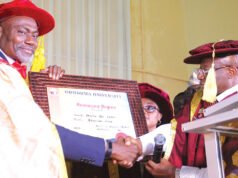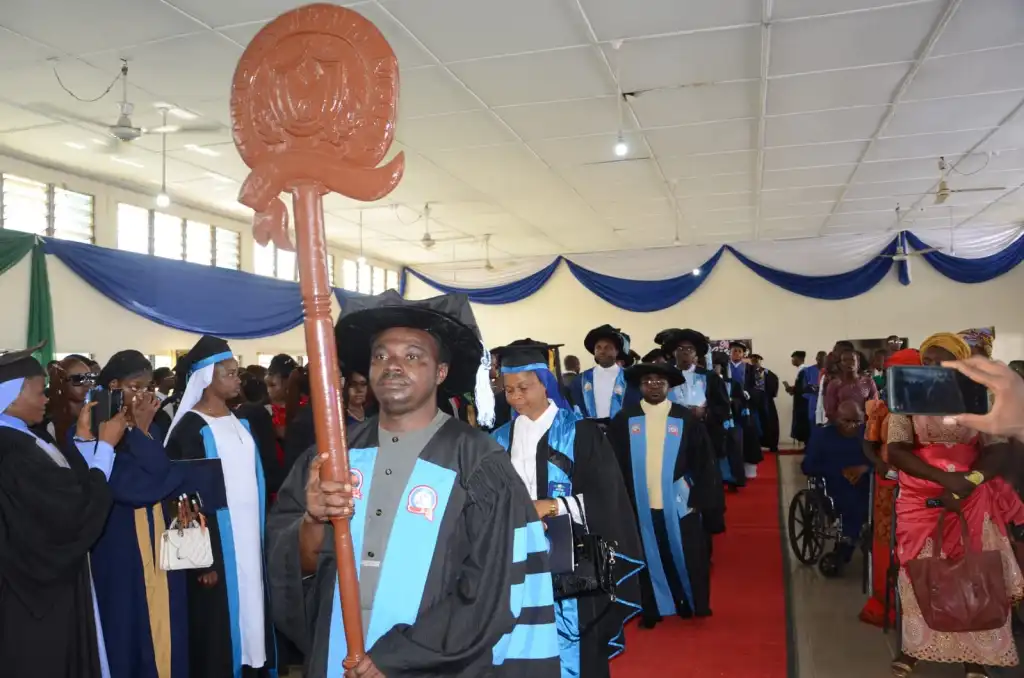
In a compelling address at the 35th Convocation Lecture of Olabisi Onabanjo University (OOU), Ago-Iwoye in Ogun State, a key federal minister asked higher institutions to take a more active role in driving the country’s economic revival and long-term prosperity. The plea comes at a time when Nigeria’s leadership is sharply focused on transforming education into a cornerstone of national development and productivity.
Dr Bosun Tijani, Nigeria’s Minister of Communications, Innovation and Digital Economy, used the convocation platform to challenge universities to rethink their traditional roles and align academic work more closely with the economic priorities of President Bola Ahmed Tinubu’s administration. His remarks were practical, forward-looking and centred on the idea that education should not only produce graduates, but also fuel progress and prosperity in every sector of society.
This editorial examines Dr Tijani’s call, the broader context within Nigeria’s higher education landscape and why this moment matters for the nation’s future.
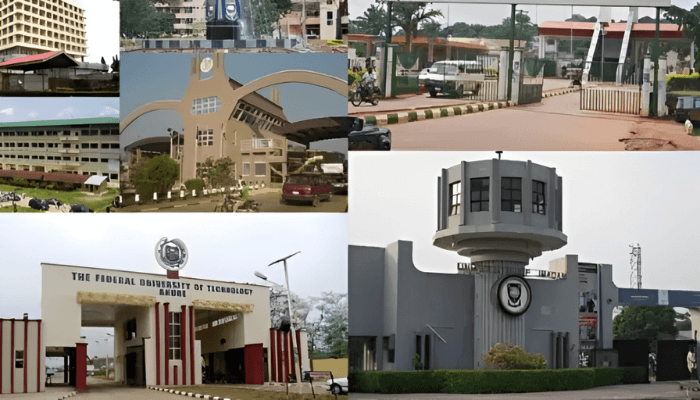
The Heart of the Message
Speaking to graduands, academics and dignitaries, Dr Tijani stressed that the real value of universities lies in their capacity to convert knowledge into tangible solutions that address real societal problems. Academic certificates, he argued, are not sufficient on their own to guarantee national growth. Instead, students must be equipped with skills that translate into real innovation, productivity and economic results.
Highlighting the government’s aspiration to build a “prosperous, trillion-dollar economy that delivers benefits to citizens”, the minister described universities as critical engines of this ambition. He said that classrooms should become “living laboratories”, where theory meets real-world challenges and research responds directly to pressing national needs.
Dr Tijani also presented a symbolic gesture to underscore his message. He donated a digital innovation laboratory to OOU as part of efforts to deepen technology literacy and expand opportunities for students and faculty.
His words were both an encouragement and a directive, reminding graduates that the degrees they receive are instruments for societal impact, not just personal achievement. “Nations do not grow on certificates,” he said, emphasising that skilled, innovative graduates are the true foundation of economic prosperity.
Why This Matters Now
The minister’s appeal comes at a time when the Nigerian government is increasingly asserting that education must be directly connected to economic outcomes. President Tinubu’s Renewed Hope Agenda continues to prioritise sectors that can drive sustainable growth, including digital innovation, technology, agriculture, and entrepreneurship. In this environment, universities are expected not only to educate, but also to partner with industry and government to solve economic challenges.
This shift is visible in other initiatives too. For example, the federal government launched a N50 million grant for student innovators to support viable business models developed by university students, further signalling that education and economic innovation must go hand in hand.
Likewise, government efforts to stabilise macroeconomic conditions and expand access to credit for entrepreneurs reflect a broader push to make Nigeria’s economy more inclusive and dynamic. This includes attempts to improve investor confidence and strengthen sectors such as finance, technology, and energy.
These moves reflect the idea that human capital development and economic strategy are inseparable. Universities, as incubators of talent and research, now sit at the centre of a national effort to improve productivity and global competitiveness.
What Universities Are Being Asked to Do
The minister’s message was clear: universities must go beyond theoretical teaching and embrace a form of scholarship that delivers practical solutions. This includes:
- Focusing research on real economic and social challenges: Universities should align more of their research priorities with national needs, including sectors like agriculture, health, energy and digital technology.
- Deepening partnerships with industry: Linkages between campuses and private or public sector organisations can help ensure that academic work has real–world relevance and impact.
- Building entrepreneurial skills: Graduates should be prepared to launch ventures that create jobs and stimulate local economies, not just compete for scarce positions in an already crowded job market.
- Improving teaching quality: Exceptional teaching that equips students with applied knowledge and critical thinking skills is key to producing graduates who can lead change.
- Infusing campuses with technology and innovation: As seen in the donation of a digital lab at OOU, expanding access to technology tools helps bridge the gap between learning and practical application.
These expectations align with similar calls from other leaders. Leaders at convocation lectures across the country, for instance, have emphasised the roles that universities can play in agro-industrial growth, job creation and rural development through research and innovation.
Balancing Hope and Reality
While the minister’s vision is energising, the challenge facing Nigerian universities is significant. Many institutions grapple with underfunding, infrastructural deficits and brain drain that weakens academic capacity. Students and staff often face disruptions caused by industrial actions and limited resources. These structural issues must be addressed for universities to fully play the role envisioned by policymakers.
Still, there are reasons for optimism. Beyond funding allocations and institutional reforms, successive efforts by the federal government aim to strengthen Nigeria’s education ecosystem. Previous reports show commitments to increasing allocations to education, supporting research commercialisation and promoting innovation across campuses.
Moreover, the national conversation on education reform recognises that quality matters as much as access. More emphasis is being placed on how graduates can contribute to national productivity rather than just on how many students are enrolled.
Graduates at the Centre of Change
For the fresh graduates at OOU, the minister’s address was more than a speech. It was an urgent invitation to step into a role as drivers of national progress. Dr Tijani urged them to think deeply about how they can use their education to make immediate, positive contributions to society.
This perspective differs from the long-held view that earning a degree is the endpoint of academic pursuit. Instead, it places graduates at the beginning of a journey that connects individual aspirations with national development.
For many young Nigerians, this means embracing entrepreneurship, innovation and service to the community rather than simply seeking jobs. It also means viewing education as a tool for change that, when applied with intent and skill, can help resolve long-standing economic challenges.
A Future Built on Knowledge
The minister’s address at OOU goes beyond rhetoric. It captures a vision in which education is fundamentally tied to national well-being. It recognises that graduates are not just products of an education system, but potential architects of a new economic future.
Universities, in this context, are not ivory towers, but engines for economic growth, creativity and social transformation. If this vision takes root across Nigeria’s campuses, it could redefine how the country educates its young people and how it harnesses human capital as a driver of prosperity.
Ultimately, the measure of success will be how well graduates apply their knowledge, how universities build partnerships beyond academia, and how policymakers sustain a long-term environment that supports innovation and productivity. Those are the real tests of whether Nigeria can fulfil its promise of inclusive and prosperous growth.
As the nation watchers progress in the Renewed Hope Agenda, the role of universities and their graduates will be one of the defining narratives of Nigeria’s journey toward a vibrant and resilient economy.
Join Our Social Media Channels:
WhatsApp: NaijaEyes
Facebook: NaijaEyes
Twitter: NaijaEyes
Instagram: NaijaEyes
TikTok: NaijaEyes
READ THE LATEST EDUCATION NEWS