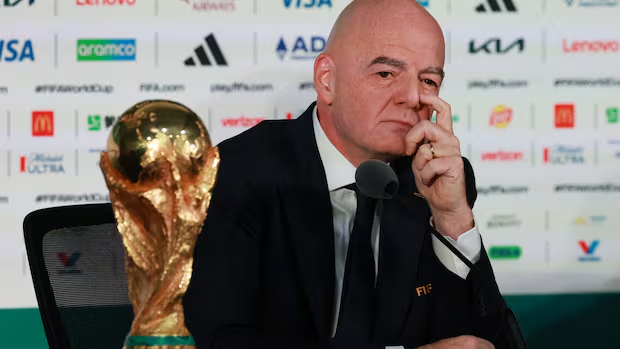

I know a lot of people must have heard about the FIFA Forward Enterprise proposal. It is the proposal through which FIFA wants to sell a minority stake linked to the commercial value of the FIFA World Cup to private investors.
When I first heard about it, I became concerned. It was not because I had not read anything about it. I had seen the proposal online, and I also saw that FIFA President Gianni Infantino gave stakeholders a deadline within which they were expected to consider and respond to the proposal.
Even before I read the position of the Confederation of African Football (CAF), I already had an idea of what their response would be. When I eventually saw it, I was not surprised. In my opinion, I know how we Africans often approach issues like this.
Personally, the proposal worried me because of the little I know about investments, stocks and private equity. One thing I understand is that private investors invest for one reason, and that reason is to make money. Nobody invests in a company unless they believe that company will grow and generate returns. If I put my money into a business, it is because I expect it to increase in value so that I can make a profit. That is simply how investing works.
That is why, when FIFA says it wants to sell part of the commercial value of the FIFA World Cup to private investors, my immediate reaction is that it will eventually affect football itself. It is not just about raising money. It is about what happens after investors come in expecting returns on their investment. I honestly believe that any reasonable person who thinks beyond today should have concerns about that.
Also Read: FIFA Opens Global Vote for Best Goal of 2026 World Cup as Fans Pick Tournament’s Finest Strike
What Selling Part of the World Cup Really Means
Let me explain what I understand Gianni Infantino is trying to do.
Selling part of the FIFA World Cup does not mean selling football itself. Rather, it means selling a stake in the commercial activities that surround the tournament. These include ticket sales, sponsorships, commercial partnerships, licensing and, most importantly, television broadcasting rights.
To explain it simply, imagine that FIFA earns about 100 million dollars from these commercial activities during a World Cup cycle. Instead of waiting to receive that money gradually over several years, private investors may decide to pay perhaps 400 million dollars upfront for a minority stake in those future revenues. In other words, FIFA immediately receives what could have taken several World Cups to earn.
From FIFA’s perspective, that sounds attractive because it receives a huge amount of money at once.
However, from the investors’ perspective, that money is not a gift. They have invested because they expect to recover their money and make even more in return. That is exactly where my concern begins.
Once investors own part of those commercial rights, they will naturally want to maximise revenue from those investments. FIFA would already have received years of future income in advance, but the investors would now expect the World Cup to generate even more money than it currently does.
Why I Was Not Surprised by CAF’s Position
That is why I was not surprised when CAF appeared supportive of the proposal. I expected that response because, in my opinion, many African football administrators tend to focus on immediate financial opportunities without giving enough attention to the long-term consequences.
I also noticed that the Qatar Football Association expressed support for Infantino’s vision. I do not necessarily believe that comes from a bad place. I simply think they see the financial opportunities more than the possible long-term implications for football.
So I do not completely judge them.
However, I was disappointed that Africa appeared willing to support the proposal so quickly. I had already expected that response before their official statement was even released.
CAF indicated that there would be consultations and meetings, but also suggested that they would support any initiative that could raise more money for grassroots football, women’s football and football development.
My question is straightforward.
With all the money FIFA has generated over the years, how much has genuinely transformed grassroots football in Africa? How much has truly been invested in women’s football across the continent? How many talented young African footballers have reached the highest level simply because of their talent alone?
These are important questions.
If the current financial structure has not solved many of these problems, why should we automatically believe that bringing private investors into the commercial side of the World Cup will suddenly solve them?
That is why I remain sceptical.
Also Read: Who are the Top Goal Scorers in the FIFA World Cup History?
The Long-Term Consequences I See
Now let me explain what I believe could happen if this proposal ever becomes reality.
Private investors are not charities. They are businesses whose primary responsibility is to generate profits.
That means there will naturally be pressure to increase the amount of money generated by the FIFA World Cup.
How do you increase revenue?
One possibility is increasing the number of matches. Another is expanding the tournament format. There could be pressure to organise more competitions, create more commercial opportunities and maximise television audiences and sponsorship deals.
Gradually, commercial considerations may begin to influence football decisions.
Another concern is that countries with greater commercial appeal may become even more valuable than smaller football nations because they attract larger television audiences, bigger sponsors and greater commercial returns.
Whether intentionally or unintentionally, there could be pressure for football to favour what generates the most money rather than what is best for the game itself.
That is why I believe this proposal has implications far beyond simply raising money.
It could affect the frequency of matches. It could affect tournament formats. It could affect the football calendar. More importantly, it could introduce investor pressure into decisions that should be made solely in the interest of football.
If investors expect greater returns, there will always be pressure on FIFA to find new ways of increasing revenue.
That is what worries me.
Football is loved across the world because people believe it belongs to everyone. The moment financial returns become the dominant consideration, there is always the risk that the game itself begins to change.
I was therefore not surprised when former Nigeria Football Federation President Amaju Pinnick publicly expressed support for Gianni Infantino even before CAF formally released its position.
Infantino is an experienced football politician. He consults widely before introducing proposals of this magnitude. He understands how to build alliances and secure support before making major announcements.
Yet, despite all those consultations, look at the level of criticism this proposal has generated across the football world.
Pinnick himself once explained that during Infantino’s campaign for the FIFA presidency, Infantino promised financial support if elected, and according to Pinnick, he fulfilled that promise.
To me, that raises important questions.
Is this becoming more about football, or is it becoming more about money?
If the resources FIFA already generates have not transformed African football the way many people hoped, why should selling part of the commercial value of the World Cup be presented as the solution?
Even today, many talented young footballers across Africa still struggle to break through, not because they lack ability, but because opportunities are often influenced by connections. In many cases, talent alone is not enough. You still need to know somebody who knows somebody.
That tells me that Africa’s biggest football challenge is not simply the amount of money available. It is also about governance, accountability and whether the resources that already exist are reaching the people they were intended to benefit.
That is why I believe we should think very carefully before embracing any proposal that introduces private investment into the commercial heart of the FIFA World Cup. Once that door is opened, the game we all love may gradually begin to change in ways that cannot easily be reversed.