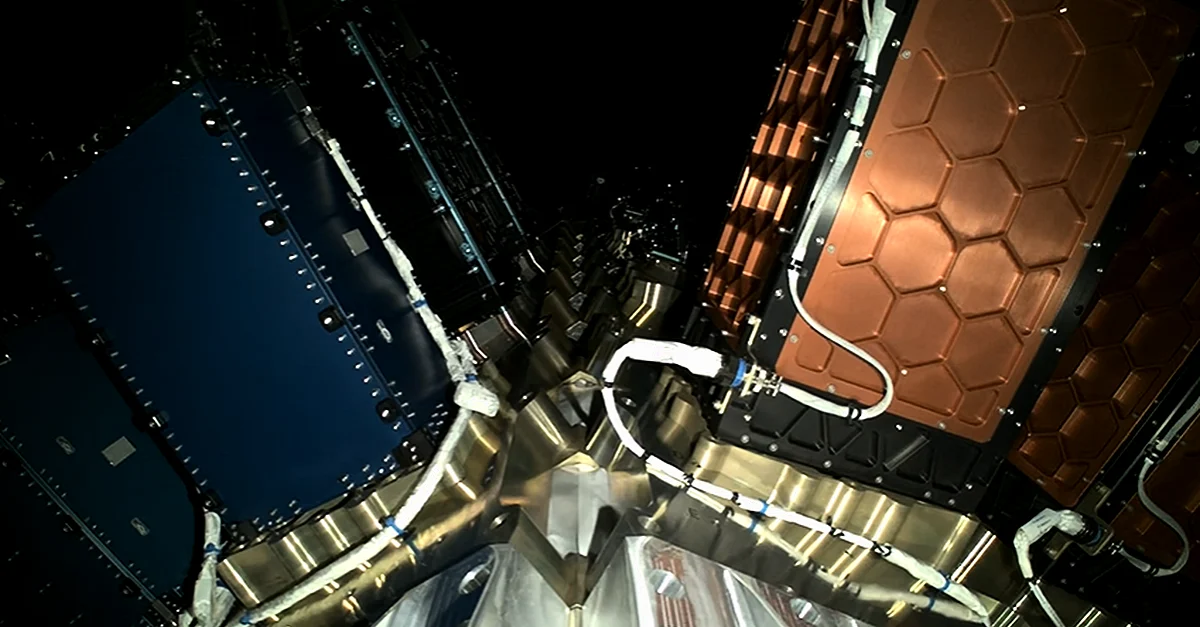
On Friday evening, a major milestone was reached in space research as the first privately‑owned space science satellite named Mauve was lofted into orbit. The launch was conducted by Blue Skies Space, a London‑based space science data company. Mauve rode to space on a Falcon 9 launch from California. The successful deployment marks the first time a commercial satellite dedicated to scientific observation, rather than communication or Earth‑observation, has entered orbit.
Mauve is roughly the size of a microwave and carries instruments, including a specialised microscope. Its mission: to observe stellar flares and exoplanets — cosmic phenomena that cannot be studied properly from Earth. Blue Skies Space has indicated that data from Mauve will be shared with subscribing research institutions, among them universities in Boston and Columbia.

Why Mauve Matters for Astronomy
Ground‑based telescopes have long been limited in what they can observe. When it comes to ultraviolet wavelengths — the very light emitted by many stars and by certain high-energy processes, Earth’s atmosphere absorbs much of it. That means vital data about stellar behaviour, flares, and surrounding exoplanets remain hidden from view. Mauve changes that.
According to Giovanna Tinetti, chief scientist at Blue Skies Space, Mauve will pry open a new window into stellar activity that was previously largely invisible. By capturing ultraviolet light from space, researchers hope to gain a deeper understanding of how stars behave and how their flares might influence the habitability or environment of planets orbiting them.
This has significant implications for astrophysics and the search for life beyond our solar system. Observations from Mauve may help scientists refine models of star-planet interactions, planetary atmospheres under stellar radiation, and potentially help narrow the search for exoplanets that could support life.

Commercial Science: Access to Data for Research Institutions
What sets Mauve apart is not only its scientific mission but its commercial backing. Blue Skies Space plans to distribute Mauve’s data through a subscription model to research institutions. This approach could democratise access to high-quality space science data. Instead of data being monopolised by national space agencies or a few very well-funded observatories, universities and research centres will be able to subscribe and gain access.
This could transform how science is conducted in astronomy and astrophysics. More institutions worldwide—including those that might not have had access to big budgets or national-level collaboration- can now gain access to valuable ultraviolet space data. Over time, this may boost research output, widen participation in space science, and accelerate discoveries.
Blue Skies Space’s CEO, Marcell Tessenyi, said the firm’s ambition is to make space science data as accessible as possible. This marks a significant shift in mindset: from secretive or restricted satellite data to open, subscription-based sharing.
What Next for Space Science from the Private Sector
With Mauve now in orbit and transmitting data, the coming months and years promise to be exciting. Researchers are watching closely for the first datasets on stellar flares and exoplanet behaviour. Insights drawn from Mauve’s observations could reshape our understanding of star‑planet dynamics and guide future missions, whether from governments or private companies.
Moreover, Mauve’s success could inspire other private firms to invest in space science missions. If the public appreciates the value of subscription-based science data, and research institutions sign up in meaningful numbers, a new commercial space science ecosystem could emerge.
For countries outside the traditional space power circle, including those in Africa, this development may open up opportunities. Scientists and institutions in Nigeria and elsewhere could potentially subscribe to satellite data, leverage global space research, and contribute to discoveries. That could strengthen local science capacity, build new collaborations, and inspire a generation of researchers and students.
Finally, as more commercial satellites like Mauve fill the skies, the volume and variety of space science data will increase. That may accelerate breakthroughs in astrophysics, exoplanet research, and our overall understanding of the cosmos.
Join Our Social Media Channels:
WhatsApp: NaijaEyes
Facebook: NaijaEyes
Twitter: NaijaEyes
Instagram: NaijaEyes
TikTok: NaijaEyes