
The Federal Government intends to raise up to N900 billion from its bond sale in January 2026 as part of a major increase in domestic borrowing. The sum is twice as much as the N450 billion it set as a goal in January 2025 due to mounting fiscal constraints and refinancing requirements.
According to offer documents made public by the Debt Management Office, three reopened Federal Government of Nigeria bonds totalling N900 billion would be included in the January 2026 auction. This is a 100% increase in the January offering’s size over the previous year.
The government appeared to take a more cautious approach to borrowing in January 2025 when it offered three bonds in the five-year, seven-year, and ten-year segments.
Join our WhatsApp community
It aimed to generate N200 billion from a new ten-year debt instrument issued in January 2035, N150 billion from a seven-year bond issued in February 2031 with an 18.50 percent coupon, and N100 billion from a five-year bond issued in April 2029 with a 19.30 percent coupon. Even while borrowing rates were still high, the N450 billion offer represented relatively modest funding requirements at the moment.
However, the January 2026 plan indicates a greater dependence on the domestic debt market.
The government intends to raise N300 billion from the reopening of the 18.50 percent FGN February 2031 bond, N400 billion from the reopening of the 19.00 percent FGN February 2034 bond, and N200 billion from the reopening of the 22.60 percent FGN January 2035 bond, according to the offer circular.
In addition to the larger headline, the offer’s structure indicates a change in borrowing tactics. Compared to N200 billion in ten-year paper sold in January 2025, ten-year instruments account for N600 billion, or roughly two-thirds of the whole auction.
This implies a greater inclination towards longer-dated debt, which will probably increase the maturity profile of governmental debts and lower the risks associated with short-term refinancing. The tight monetary conditions and investors’ desire for protection against inflation and interest-rate instability are reflected in the high coupon rates on the 2026 bonds.
The government is now borrowing at a higher cost, as evidenced by the January 2035 bond’s 22.60 percent coupon, which is a significant increase above rates on similar tenors a year ago.
Join our WhatsApp community
The monies will be issued for N1,000 each, with a minimum subscription of N50.001 million, semi-annual interest payments, and bullet repayment at maturity, according to the Debt Management Office. In addition to accumulated interest, winning bidders for reopened bonds will pay prices determined by the yield that clears the auction volume.
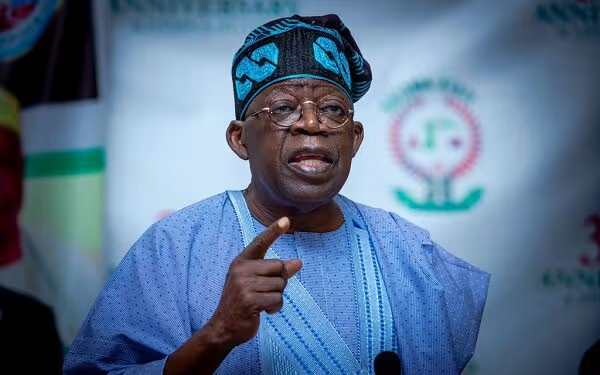
He said this during an interview on Bloomberg Television at the World Economic Forum in Davos, Switzerland, on Tuesday. “The issue now is to focus on revenue, focus on domestic resource mobilisation,” he said. “We’re hoping to rely less on borrowing.”
Additionally, he stated that the government’s top goal is to mobilise its own resources, even though the nation may tap foreign bond markets if needed. Edun highlighted the government’s initiatives to improve budgetary sustainability and increase tax collection in the face of growing pressure from the world economy.
Join Our Social Media Channels: