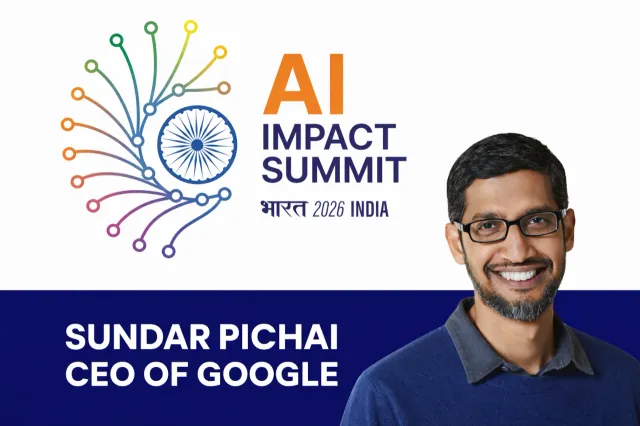
At the AI Impact Summit 2026, one of the biggest global gatherings on artificial intelligence, Google Chief Executive Officer Sundar Pichai offered a clear and compelling vision for how AI can change lives across the world. His message was rooted in optimism yet grounded in realism, reminding leaders and innovators that achieving the benefits of AI will take more than just good technology. It will require courage, responsible action, and teamwork from governments, businesses, and communities.
Pichai’s keynote address was part reflection, part roadmap and part call to action. He opened by talking about how far technology has come and what AI could do to advance human welfare. But he also warned that the benefits are not handed to us on a platter. This is a defining moment for humanity where choices made today will shape the future.
A Personal Journey with Big Implications
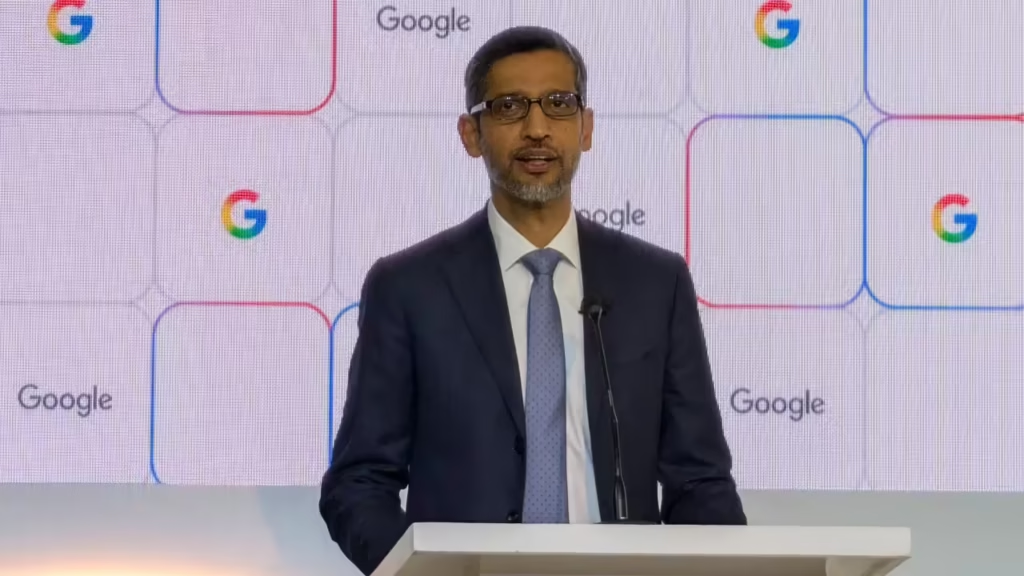
Speaking at Bharat Mandapam in New Delhi, Pichai drew from his own journey to underline how progress often begins with humble beginnings. He recounted memories of travelling by train as a student from Chennai to study at one of India’s prestigious engineering schools, passing through Visakhapatnam, a coastal city that now stands poised to be a global AI centre.
That transformation of Visakhapatnam reflects a broader theme in his speech: technology can unlock opportunities in places that once lacked access but now stand ready to leap forward. In Visakhapatnam, Google is building a full-stack AI hub under its multi-billion dollar investment plan. That hub will be more than just a computing powerhouse. It will be a gateway for skills, jobs, innovation, and international partnerships.
“The pace of change around me today reminds me of the endless possibilities when people dream big,” Pichai said, noting that no technology had ever inspired him more than artificial intelligence. He described AI as the biggest platform shift of our lifetimes, with the power to transform economies and solve long-standing human challenges.
Bold Innovation with Real World Impact
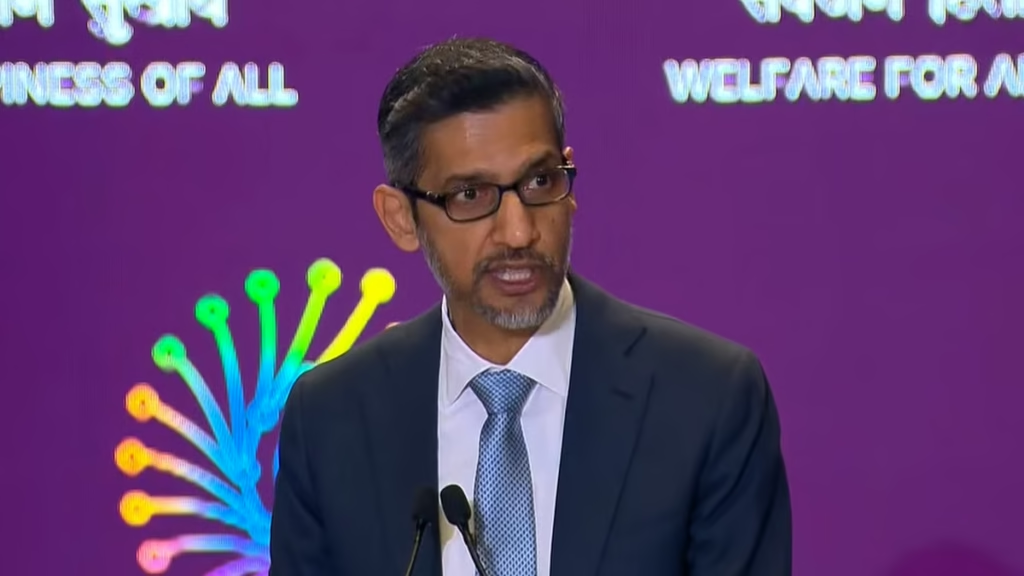
For Pichai, bold innovation isn’t just a corporate slogan. It is about asking hard questions and stepping into areas with the potential to change the world. He pointed to breakthroughs in science made possible by AI, such as the AlphaFold project by Google’s DeepMind unit, which helped decode protein structures and turbo-charged research in fields like drug discovery. The results have ripple effects for millions of people working on illnesses like malaria and antibiotic resistance.
The summit message also included how AI is being used in agriculture and healthcare. In India, Google’s AI-powered weather forecasts were sent to millions of farmers to help them anticipate monsoon variations and protect their livelihoods. Meanwhile, other partnerships are creating tools that help diagnose health challenges where resources are scarce.
Pichai also highlighted work in linguistic inclusion, especially in Africa, where Google is supporting research and open-source tools for more than twenty languages. This is important because language barriers often limit access to education, information, and economic opportunities in many regions.
These examples were part of a larger theme: that AI should be a tool for solving tough problems in health, education, economic opportunity, and public services. But getting there will require more than technology alone.
Responsibility at the Heart of Progress
Pichai’s speech balanced excitement with caution. He stressed that while AI has tremendous potential, it also carries risk. One of his key points was the urgent need to prevent the digital divide from turning into an AI divide where only wealthy or well-connected nations benefit, leaving others behind.
To avoid that, he said, it is essential to invest in infrastructure such as computing power, connectivity, and subsea cables that link countries into the global digital economy. The aim is to ensure access to high-speed networks that can support powerful AI systems for education, business, and government services.
He also spoke about the future of work. As machines take on more tasks, the job landscape will shift. Pichai cited the creation of entirely new professions — such as digital content creators — as evidence that change can bring opportunity, not just disruption. To prepare for this shift, Google has invested in programs that train millions in digital skills and launched an AI Professional Certificate that will help individuals adapt to new digital careers across industries.
Yet beyond infrastructure and skills, Pichai made it clear that trust and governance are just as important. “Trust is the bedrock of adoption,” he said, noting that tools to verify information and fight misinformation help build confidence in what people read and share online.
Global Collaboration for Lasting Impact
Perhaps the most powerful part of Pichai’s message was his insistence that no single group can shape the future of AI alone. He repeatedly invited governments, tech companies, and civil society to work together if the benefits of this technology were to reach billions of people.
Governments, according to Pichai, must play a dual role. They should not only regulate to protect citizens and set standards for safety but also lead in adopting AI to improve public services such as healthcare, education, and infrastructure. This means creating clear rules of the road that encourage innovation while safeguarding rights and equality.
His message echoed what experts around the summit have been discussing — that responsible AI requires shared goals and shared responsibility. These conversations identify common ground where nations can collaborate on AI that benefits all sectors of society.
Pichai’s remarks also recognised innovators in other parts of the world. He pointed out examples where local governments use satellite imagery for electrification planning and bus-mounted AI systems to monitor and repair road conditions. These may seem like small advances but they represent significant progress when combined with global cooperation.
A Moment of Possibility and Purpose
As the summit continued, it was clear that Pichai’s speech was not just about Google or its projects. It was about a larger narrative on how humanity chooses to use one of the most powerful technologies ever created.
Many delegates left the hall talking about how AI might solve pressing challenges like climate change, disease control, and education access. But others also spoke about the need for caution around inequality, ethics, and the role of humans in the governance of such powerful systems.
In a time where the impact of AI is already visible everywhere — from smartphones to business tools — Pichai’s message served as both a reality check and a source of inspiration. He reminded the world that while technology can open new doors, its benefits will only be realised if people choose to use it wisely and inclusively.
For countries like India and many nations in Africa, South America, and beyond, AI offers a chance to skip over old limitations and build forward with new tools. But that opportunity will be meaningful only if leaders, innovators, and whole societies commit to ensuring fairness, access, and ethical use of this technology.
The AI Impact Summit 2026 may go down in history as one of the moments when the world paused to reflect on what comes next. And in that reflection, voices like Sundar Pichai’s remind us that technology is most powerful when guided by human values and collective purpose.
Join Our Social Media Channels:
WhatsApp: NaijaEyes
Facebook: NaijaEyes
Twitter: NaijaEyes
Instagram: NaijaEyes
TikTok: NaijaEyes