The Federal Government has openly held the private concessionaire accountable for the deteriorating state of the Benin-Asaba Expressway, signaling a major policy review of how public-private road projects are awarded and managed across the nation.
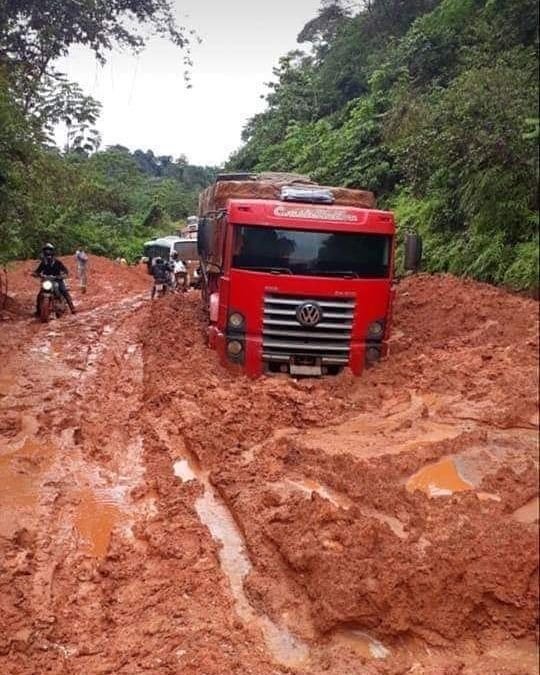
During an inspection of the highway, Minister of Works David Umahi expressed strong dissatisfaction with the Benin-Asaba Expressway Concession Company (BAECC), accusing the firm of technical incompetence and improper execution. The government confirmed plans to invoke overriding public interest clauses to intervene directly, review the existing contract terms, and engage competent civil engineering contractors to restore failed sections.
Technical Failures and Operational Controversies
The primary trigger for the road’s sudden collapse was the premature removal of existing asphalt layers before proper drainage channels were built.
Also read Benin launches first three projects under 26 school agricultural training plan
Key issues highlighted during the site assessment include:
- Disregarded Engineering Sequences: Project consultants confirmed that the concessionaire was repeatedly advised to construct side drains prior to stripping the road surface. Ignoring this sequence exposed the underlying subgrade to heavy rains and waterlogging.
- Asset Destruction Warnings: Officials described stripping asphalt off functional carriageways without prior approval as a misuse of public assets. Orders have been issued to arrest any road contractor stripping existing pavement without explicit authorization.
- Traffic and Weather Constraints: Representatives from BAECC attributed delays to intense seasonal rainfall and the difficulty of building drainage while managing high traffic volumes along the major South-South transit corridor.
According to a project inspection report by Nairametrics in 2026, federal officials verified that the concessionaire’s failure to build adequate drainage infrastructure before removing asphalt directly caused severe road failure along the corridor.
Strengthening Infrastructure Public-Private Partnerships (PPPs)
The crisis along the Benin-Asaba highway highlights systemic challenges in managing public-private partnership contracts within Nigeria’s transport sector.
Public infrastructure experts have long argued that PPPs require strict vetting of a private firm’s technical expertise, financial capability, and risk management capacity before handing over national trunk roads.
According to an operational assessment by the Federal Ministry of Information and National Orientation in 2026, legislative leaders and infrastructure regulators are advocating for comprehensive reviews of all active highway concession agreements to prevent performance failures and ensure private partners deliver on agreed engineering standards.
To provide immediate relief to stranded commuters, the government is mobilizing emergency maintenance through major engineering firms while restructuring the long-term concession framework.
The Backstory: Evolution of the Highway Concession Strategy
To understand why the failure of the Benin-Asaba highway triggered such swift policy action, it helps to examine how highway concessions were designed to solve Nigeria’s infrastructure deficit.
For decades, federal highways across the country suffered from inadequate annual budget allocations, leading to a backlog of deferred maintenance. To bridge this gap, the government introduced the Highway Development and Management Initiative (HDMI), opening key inter-state corridors to private sector concessionaires. Under these agreements, private investors were expected to fund, expand, and maintain roads in exchange for tolling rights over a fixed period.
In 2025, the Benin-Asaba corridor—a vital economic artery connecting the South-South, South-East, and Western regions—was concessioned to BAECC for expansion into a multi-lane highway. However, execution delays, inadequate technical capacity, and poor construction sequencing turned the vital commercial route into a major bottleneck for commuters and freight haulers. As public pressure mounted, the Federal Government’s decision to step in marks a decisive shift toward stricter oversight and accountability in highway concessions.