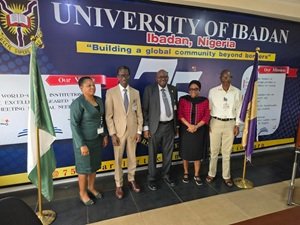

A University of Ibadan academic has called for an urgent digital transformation of Nigeria’s academic knowledge system, saying the country must move beyond traditional libraries and build a stronger digital ecosystem that makes research easier to discover, access and share.
Dr Alice A. Bamigbola, Acting Head of the Department of School Library and Media Technology at the University of Ibadan, made the call while delivering the 20th Faculty of Education Lecture at the university.
The lecture, titled “From Shelves to Servers: Digital Libraries and the Future of Academic Knowledge in Nigeria,” focused on how technology is changing academic libraries and the way knowledge is created, preserved and accessed.
Bamigbola argued that the future of Nigerian scholarship depends increasingly on the country’s ability to move from physical storage of academic materials to reliable digital systems. Tribune Online reported that she proposed an eight-point agenda to accelerate this transformation.
Her recommendations include expanding broadband access and digital literacy, establishing stronger national standards for institutional repositories and open access, and increasing government funding for research and digital knowledge infrastructure.
Also Read: University of Ibadan Announces 100% Online Postgraduate Programmes for 2026
Digital Libraries Need More Than Technology
For Bamigbola, digitising academic knowledge is not simply a matter of scanning books and uploading research papers online. It requires an ecosystem capable of preserving scholarly work while ensuring that researchers and members of the public can actually find and use it.
She called for reliable electricity, improved internet connectivity and secure servers to support digital academic infrastructure. She also recommended mandatory deposition of scholarly works so that important research produced by Nigerian academics is systematically preserved in institutional repositories.
This is particularly important for Nigerian universities, where valuable research can remain difficult to discover beyond the institution where it was produced.
Bamigbola also wants academic libraries repositioned as digital knowledge hubs rather than being viewed primarily as physical spaces containing books.
According to a report by NUESA Press UI, she noted that librarians are increasingly involved in institutional repositories, digital archiving and helping academics navigate complex information environments.
The shift means librarians themselves must acquire new competencies in areas such as repository management, copyright literacy, artificial intelligence, research data management and digital preservation.

AI Is Changing How Academic Knowledge Is Managed
Artificial intelligence is also becoming part of this transformation.
Bamigbola highlighted the growing role of AI in academic knowledge management, particularly in automated indexing, metadata generation, classification and intelligent tagging.
The development could help Nigerian institutions organise large volumes of academic information more efficiently. It also presents an opportunity to improve the visibility of Nigerian research by making scholarly materials easier for search systems, researchers and other knowledge users to discover.
However, the lecturer’s position was not that technology should replace librarians or traditional libraries.
Instead, she argued for a new relationship between people, technology and knowledge. Physical libraries, she stressed, remain important for heritage, preservation and cultural memory, even as digital platforms become increasingly necessary for extending the reach of scholarship.
In an account of the lecture, NUESA Press UI reported that Bamigbola also raised concerns about academics’ participation in institutional repositories, noting that some scholars may be reluctant to deposit their works when such contributions are not adequately recognised in promotion and reward systems.
Back Story: Building a National Knowledge Ecosystem
The call comes against the background of a rapidly changing global academic environment, where digital repositories, online databases and AI-powered tools are reshaping how research is produced and consumed.
Bamigbola believes Nigeria needs a national knowledge ecosystem in which research is not merely produced and stored, but also made visible, searchable, accessible, citable, reusable and globally connected.
Achieving that goal, she said, would require collaboration between government, universities, libraries, researchers, technology providers and other stakeholders.
She also called for stronger incentives for open and responsible scholarship, alongside continued investment in the people responsible for managing digital academic resources.
The University of Ibadan has itself been engaging with the wider question of digital transformation. The university’s Faculty of Education hosted the lecture on August 11, 2026, at its Large Lecture Theatre, with the discussion placing digital libraries, academic access and the changing role of librarians at the centre of attention. University of Ibadan’s faculty profile identifies Bamigbola as a researcher whose area of specialisation includes digital libraries.
The bigger issue is therefore not whether Nigerian universities should embrace digital libraries, but how quickly and effectively they can build the infrastructure and human capacity required to make them work.
For Nigeria’s academic community, moving from shelves to servers could ultimately mean more than modernising libraries. It could determine whether years of research remain difficult to find or become part of a connected body of Nigerian knowledge capable of reaching students, researchers, policymakers and audiences around the world.