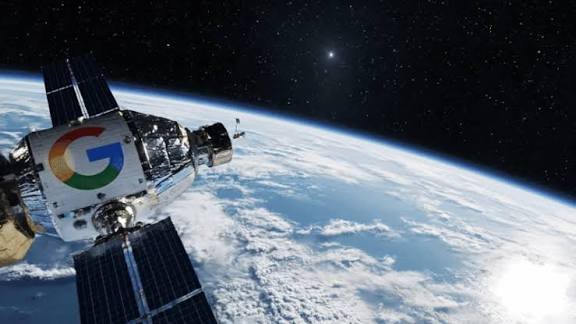

Google has taken another step towards changing how artificial intelligence infrastructure operates after successfully running an AI model aboard a satellite in space and transmitting its first complete response back to Earth.
The development marks an important milestone in the company’s Project Suncatcher, an ambitious research initiative exploring whether large-scale artificial intelligence data centres could eventually operate in orbit around the Earth.
According to a report by TechCrunch published on October 30, 2026, Google’s experimental satellite has successfully powered its onboard Tensor Processing Units (TPUs), run an AI model and communicated its response to engineers on the ground.
For its first interaction, engineers sent a prompt asking the satellite to generate a haiku, a short Japanese-style poem, about its experience in space. The onboard Gemma 4 AI model responded with a poem describing the Earth below and the surrounding environment.
Although the exercise was relatively simple, it demonstrated that Google’s AI hardware could perform computing tasks in orbit and successfully communicate the results to Earth.
The satellite carries four Google Tensor Processing Units, specialised computer chips designed to handle demanding artificial intelligence workloads. However, its available power means that engineers can operate only one of the four chips at a time, for approximately 20 minutes.
Google is now preparing to investigate how reliably the processors perform under the extreme conditions of space, particularly radiation exposure and temperature variations.
The company believes that successfully addressing these challenges could eventually make space a viable location for some of the world’s growing AI computing infrastructure.
Also Read: Experts Push Satellite Technology, AI to Strengthen Nigeria’s Fight Against Insecurity
Why Google Wants to Move AI Data Centres into Space
The increasing demand for artificial intelligence has created a major challenge for technology companies, particularly the enormous amount of electricity required to operate modern data centres.
AI systems depend on powerful processors that consume significant energy when training models, processing information and responding to user requests. As companies expand their AI services, they must also find ways to secure sufficient electricity, cooling systems and physical infrastructure.
Google’s proposed solution is to investigate whether some of these computing facilities could operate beyond Earth’s atmosphere.
Through Project Suncatcher, the company wants to take advantage of the near-constant sunlight available in certain low Earth orbits. According to Google’s explanation of the project, satellites in suitable orbits could potentially generate up to eight times more solar energy than comparable solar installations on Earth.
This could provide a substantial energy advantage for future space-based computing systems.
Another potential benefit is reducing pressure on electricity infrastructure on Earth. Data centres require enormous amounts of power, and their expansion has raised concerns about electricity availability, water consumption and the environmental consequences of supporting increasingly demanding AI technologies.
However, Google’s proposal is still experimental. The company has not demonstrated that a fully operational, large-scale AI data centre in space is commercially practical.
The Challenges Google Must Overcome
Despite the potential benefits, operating powerful computer processors in space presents engineering difficulties that are considerably different from those encountered in conventional data centres.
One major concern is radiation. Unlike equipment on Earth, satellites operate beyond much of the protection provided by the planet’s atmosphere and magnetic environment. High-energy particles from the Sun and cosmic rays can interfere with electronic components and corrupt computer memory.
Such errors are sometimes called bit flips, where a computer’s stored information changes unexpectedly because of radiation exposure.
Another challenge is cooling. Conventional data centres use fans, air conditioning and water-based systems to prevent computer processors from overheating. However, space is a vacuum, meaning there is no surrounding air through which heat can be removed using ordinary cooling methods.
Google is therefore testing heat pipes and radiators to transfer excess heat away from its processors.
Communication is another important consideration. Future satellites will need to exchange large volumes of information quickly enough to function as interconnected computing facilities. Google plans to investigate high-speed laser communication between satellites to support this arrangement.
The company expects to test this technology using two additional satellites in 2027.
Back Story: Google’s Project Suncatcher and the Future of Computing
Google announced Project Suncatcher in 2025 as a long-term research effort to explore the possibility of building machine-learning infrastructure in space.
The first experimental satellite was developed in partnership with Planet Labs and launched aboard a SpaceX Falcon 9 rocket in October 2026.
Google is not alone in exploring orbital computing. Other technology companies and startups, including SpaceX and Starcloud, have also expressed interest in using satellites to support future AI infrastructure.
However, significant questions remain about launch costs, hardware reliability, cooling systems, satellite maintenance and the environmental implications of placing thousands of additional spacecraft in orbit.
A US Government Accountability Office assessment of space-based data centres published in April 2026 also identified power generation, heat management and the potential difficulty of managing increasing satellite numbers as major obstacles.
For now, Google’s successful first AI response from orbit represents an experimental achievement rather than the arrival of commercial space data centres. Nevertheless, the project provides an opportunity to understand whether future computing infrastructure could extend beyond the limits of Earth’s resources.
Also Read: Can Africa Build Its Own AI Infrastructure Instead of Depending on Foreign Data Centres?