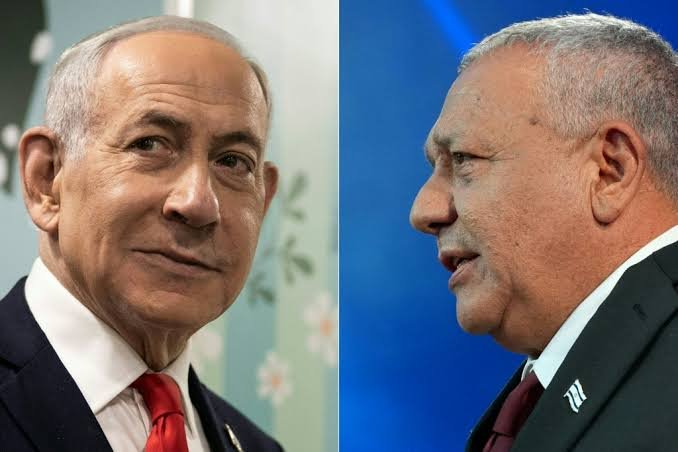

On Saturday, Israeli Acting Prime Minister Benjamin Netanyahu cautioned his political rival, Gadi Eisenkot, against forming an unstable coalition government.
Renewing his push for a national unity government, Netanyahu urged Israel’s two primary political blocs to enter talks “without preconditions” and “put aside all conflicts and boycotts.”
“Gadi, instead of trying to form a shaky and dangerous government… let us do what is called for,” he advocated in a speech.
He anchored his appeal on the threat posed by Iran, asserting that Tehran “seeks to destroy Israel” and is working to revive its nuclear program.
The interim prime minister asserted that Iran would not hesitate to deploy nuclear weapons against Israel, arguing that Tehran “did not hesitate to massacre many thousands of its own people.”
Netanyahu maintained that only a broad unity government could permanently neutralize the Iranian threat, contending that “a narrow government” or one that “relies on supporters of terrorism” would fall short of achieving that objective.
In response, Eisenkot accused Netanyahu of continuing to “foment division and stokes tensions as if there were no tomorrow,” despite knowing he had lost the election.
Dismissing the rhetoric by stating that “these techniques don’t work on me,” the Yashar party leader questioned why his rival was publicly calling for negotiations when talks were already underway.
Responding, Eisenkot stated that Netanyahu is fully aware of the “clear majority against him among the Israeli public and in the Knesset,” pledging that a new and better government will be established.
Backstory…
Recall that political dispute comes following Israel’s October 27 general election which produced a hung parliament, leaving neither Prime Minister Benjamin Netanyahu’s bloc nor the opposition with the 61 seats required to form a majority government.
Although Netanyahu’s Likud emerged as the largest individual party, his wider religious-nationalist alliance secured only 53 seats in the 120-member Knesset, while the opposition bloc led by former military chief Gadi Eisenkot secured 48 seats.
Reuters+1
Following consultations with political parties, President Isaac Herzog on November 8 formally tasked Eisenkot with forming a new government after 67 lawmakers recommended him for the role, compared with 46 who backed Netanyahu. Eisenkot was given 28 days, with a possible 14-day extension, to negotiate a coalition.
Read Also: Netanyahu, Rival Fail to Secure Majority as Israel Election Produces Deadlock