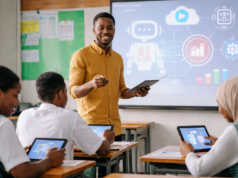
A growing concern is emerging across classrooms in Nigeria and beyond as artificial intelligence tools become more deeply embedded in everyday learning. Education experts are now raising alarms that while AI has undeniable benefits, its overuse could quietly erode one of the most important skills students are meant to develop: the ability to think critically.
This warning was strongly echoed by a Nigerian-American expert, who cautioned that students are increasingly leaning on AI tools not just as aids, but as substitutes for genuine thinking. The development, she explained, risks creating a generation that can produce answers quickly but struggles to understand, analyse, or question the information in front of them.
Her concerns come at a time when AI-powered tools are widely accessible to students, from essay generators to homework assistants, fundamentally reshaping how learning happens both inside and outside the classroom.

The Silent Shift From Learning to Dependency
What makes this issue particularly troubling is how subtle the shift has been. Students are not necessarily abandoning learning altogether. Instead, many are outsourcing the most mentally demanding parts of it.
Recent studies show that students with access to AI tools often rely on them for higher-order tasks such as analysis, writing, and problem-solving. This trend, sometimes described as “cognitive offloading,” means that learners are gradually handing over the intellectual effort that education is designed to build.
The Nigerian-American expert highlighted that when students consistently depend on AI to generate ideas, structure arguments, or even complete assignments, they risk weakening their natural reasoning abilities. Over time, this can lead to reduced originality and a diminished capacity to engage deeply with complex topics.
Research also supports this concern. Findings indicate that excessive reliance on AI tools can foster dependency behaviours and reduce students’ ability to independently evaluate information. In simpler terms, students may begin to trust AI outputs without questioning their accuracy or bias.
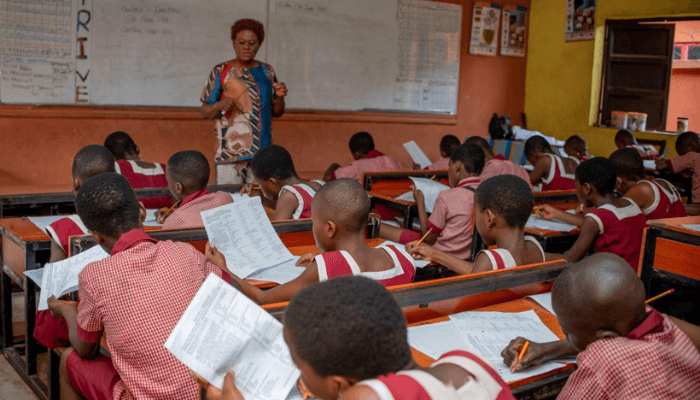
Nigerian Classrooms at a Critical Crossroads
In Nigeria, the situation carries additional urgency. The education system is already grappling with challenges such as limited resources, uneven access to quality teaching, and gaps in digital literacy. The rapid adoption of AI tools introduces both an opportunity and a risk.
On one hand, AI can help bridge learning gaps by providing instant explanations, personalised feedback, and access to global knowledge. On the other hand, without proper guidance, it can deepen existing problems by encouraging shortcuts over understanding.
Scholars studying AI use among Nigerian learners have observed that some students accept AI-generated content without proper scrutiny, leading to inaccurate knowledge and poor application of information. This is particularly concerning in a context where critical thinking is already a skill that educators are striving to strengthen.
There is also the issue of academic integrity. As AI tools become more sophisticated, they can generate essays and assignments that appear original but may not reflect the student’s actual understanding. Experts warn that this could undermine the credibility of assessments and qualifications if not properly addressed.
Why Critical Thinking Still Matters More Than Ever
At its core, education is not just about getting the right answers. It is about understanding how to arrive at those answers, questioning assumptions, and developing the ability to solve new problems independently.
Critical thinking enables students to evaluate information, identify bias, and make informed decisions. In a world increasingly flooded with data and automated outputs, this skill is more important than ever.
However, when AI tools handle the heavy lifting, students may skip the process entirely. Studies have shown that when the final product can be generated without effort, the learning process itself is weakened.
The Nigerian-American expert stressed that this is not an argument against AI, but rather a call for balance. AI should enhance learning, not replace the intellectual effort that makes learning meaningful.

Finding the Right Balance in an AI-Driven Era
The challenge now facing educators, policymakers, and parents is how to integrate AI into education without allowing it to undermine core learning outcomes.
Experts suggest that the solution lies in teaching students how to use AI responsibly rather than restricting it entirely. This includes developing AI literacy, encouraging critical evaluation of AI-generated content, and designing assignments that require independent thinking.
Some education researchers have proposed rethinking assessment methods altogether. Instead of focusing solely on final answers, schools can emphasise the reasoning process, asking students to explain how they arrived at their conclusions and to critique AI-generated responses.
There is also a need for teacher training. Educators must be equipped not only to use AI tools themselves but to guide students in using them effectively. Without this support, the technology risks becoming a shortcut rather than a learning aid.
Ultimately, the goal is to ensure that students remain active participants in their education. AI can provide support, but it should never replace the curiosity, effort, and critical engagement that define true learning.
As the Nigerian-American expert concluded, the future of education will depend not on how much AI students use, but on how well they can think for themselves while using it.
Join Our Social Media Channels:
WhatsApp: NaijaEyes
Facebook: NaijaEyes
Twitter: NaijaEyes
Instagram: NaijaEyes
TikTok: NaijaEyes