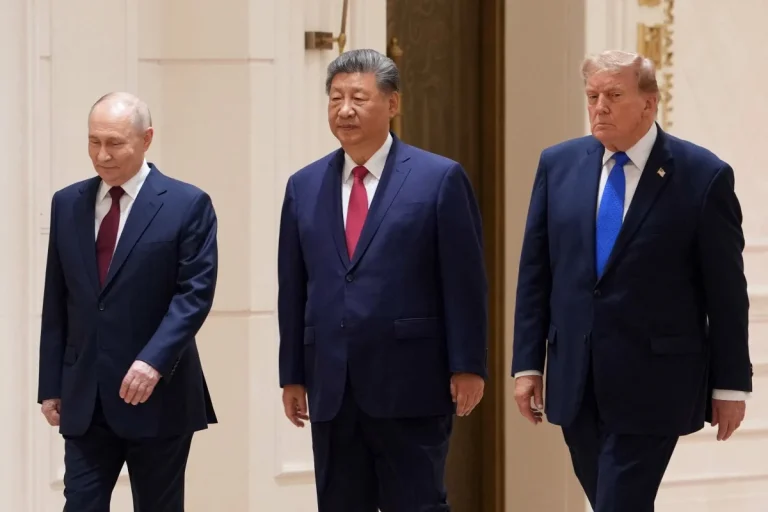

Following a rare trilateral summit, China, the US, and Russia issued a joint “peace declaration” on Thursday, nearly five years into the war in Ukraine and as President Donald Trump remains entangled in conflict in Iran.
After convening in China, Xi Jinping, Trump, and Vladimir Putin released a statement outlining their shared intent to boost the production and supply of refined petroleum products, uphold diplomatic immunity, and reform the United Nations.
“The three heads of state engaged in an in-depth exchange of views on the current international situation and committed themselves to upholding strategic stability and international security,” said the statement published by Chinese state media and the Kremlin, but not yet by the White House.
The three-way talks unfolded against a backdrop of turmoil in the Middle East triggered by Trump’s strikes on Iran, Russia’s protracted offensive in Ukraine, and an increasingly assertive China working to expand its influence across East Asia.
“Our countries have many converging interests when it comes to resolving regional conflicts, including, of course, the conflict in Ukraine,” Putin said at the start of the meeting, adding they had a “shared responsibility for maintaining international peace and security”.
Gathered around a spacious, dark circular table with a pink floral arrangement at its center, the three leaders launched their discussions with pressing matters such as nuclear weapons and the ongoing conflict in Ukraine.
The private session at Shenzhen’s Kylin Villa wrapped up after an hour and twenty minutes.
Reflecting on the summit, Putin stated that the three had opened a fresh “page in the history of diplomacy,” while Trump asserted they were “creating history.”
Backstory…
The summit came amid growing global tensions, particularly over the Russia-Ukraine war, the conflict involving Iran, and rising nuclear security concerns.
Relations between Washington, Beijing and Moscow have also been strained by trade disputes, Western sanctions against Russia and disagreements over global influence.
A major concern was the weakening of nuclear arms control after the last US-Russia nuclear weapons treaty expired in February 2026.
Washington had pushed for China to join future negotiations, although Beijing had previously resisted, arguing that its nuclear arsenal was considerably smaller.
Read Also: UN Says It Is Ready to Support Denuclearisation Deal Among China, US, Russia