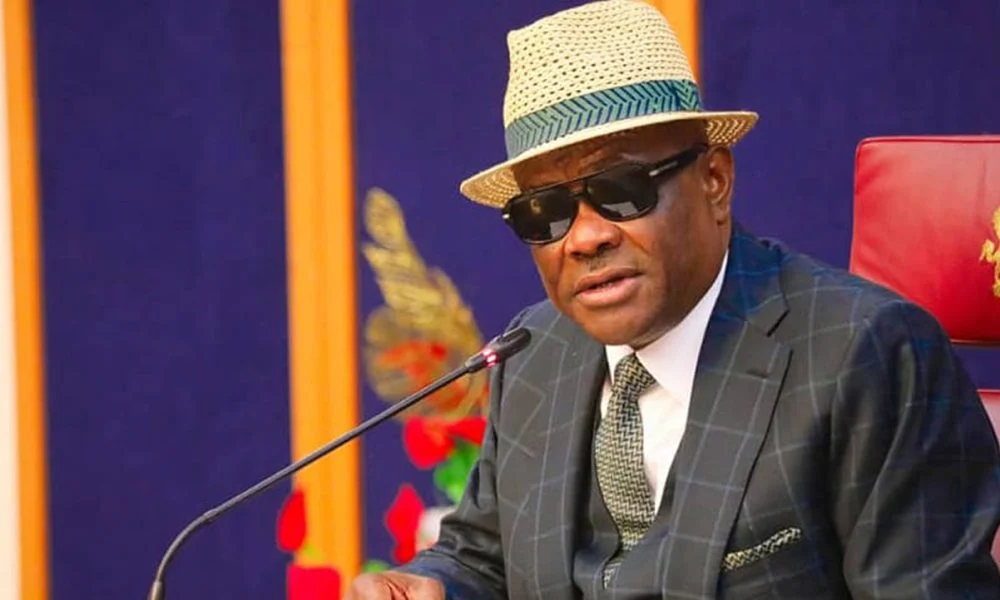

Nigeria’s political landscape is witnessing an unusual arrangement ahead of the 2027 general elections, with Minister of the Federal Capital Territory (FCT), Nyesom Wike, emerging as one of the most influential figures in President Bola Tinubu’s re-election campaign despite belonging to the opposition Peoples Democratic Party (PDP).
From establishing a political coalition to mobilising support for Tinubu’s second-term ambition and taking charge of campaign structures in Abuja and Rivers State, Wike appears to be playing a role that extends far beyond the traditional boundaries of party affiliation.
His latest political move came on Monday, November 16, when he inaugurated the 466-member All Progressives Congress (APC) presidential campaign council in the FCT, alongside the Rainbow Coalition.
The development has raised questions about the extent of Wike’s influence within the ruling party and the apparent willingness of APC leaders to allow a politician from another party to occupy such a prominent position in its electoral mobilisation.
Wike’s Influence Within the APC Despite Remaining in PDP
One of the most striking aspects of Wike’s growing political influence is that he has not formally defected to the APC.
The former Rivers State governor remains an active member of the PDP, the same opposition party that is expected to challenge Tinubu’s re-election bid in 2027.
However, his political activities have increasingly aligned with the ruling party’s interests, particularly his open declaration of support for Tinubu’s second term.
In September 2026, Wike announced that he would take charge of Tinubu’s campaign machinery in both Rivers State and the FCT, insisting that he had the political structure and support base required to deliver the two territories for the President.
He maintained that he did not need to be a member of the APC or occupy a position in its national campaign council to mobilise support for Tinubu.
His influence became even more significant in October when the APC included him in its expanded presidential campaign council, appointing him as campaign coordinator for Rivers State and the FCT.
The decision stood out because Wike was not the only politician from outside the APC brought into the campaign structure. Osun State Governor Ademola Adeleke, a member of the Accord Party, and Anambra State Governor Chukwuma Soludo of the All Progressives Grand Alliance (APGA) were also appointed coordinators for their respective states.
Also Recommended: Wike Promises N10m to Council That Secures Ward for Tinubu
Inaugurating an APC Campaign Council Without Being an APC Member
Wike’s November 16 inauguration of the APC presidential campaign council in the FCT has further brought the unusual political arrangement into focus.
At the event, the minister inaugurated a 466-member campaign council tasked with mobilising support for Tinubu and APC candidates in the nation’s capital.
He also directed the campaign team to ensure that opposition parties, particularly the African Democratic Congress (ADC) and the Nigeria Democratic Congress (NDC), do not secure up to 25 per cent of the presidential votes in the FCT.
His involvement raises a fundamental political question: how has a serving member of an opposition party become such a central figure in organising the ruling party’s campaign activities?
While political alliances across party lines are not unusual, Wike’s position appears particularly significant because he is not merely endorsing the President. He is actively assembling campaign structures, coordinating political mobilisation and setting electoral targets for APC candidates.
The arrangement also raises questions about the authority and influence of the party’s own leadership structures, particularly the roles traditionally occupied by APC chieftains and elected officials.
The Rainbow Coalition: Wike’s Political Structure for Tinubu
Beyond his activities within the APC campaign council, Wike has established the Rainbow Coalition, a political alliance designed to bring politicians from different parties together in support of Tinubu’s re-election.
The coalition, which has attracted members of the PDP, APC, Labour Party and other political groups, has become an important part of Wike’s political strategy ahead of the 2027 elections.
Wike has repeatedly defended the arrangement, arguing that political differences should not prevent individuals who support Tinubu from working together.
However, the coalition has not been without controversy. Its activities have reportedly generated disagreements with some APC governors, particularly members of the Progressive Governors’ Forum, who have expressed concerns about its influence and the possibility that it could undermine the ruling party’s own structures.
Despite these concerns, Wike has maintained that the Rainbow Coalition is not going away, positioning it as a platform through which politicians outside the APC can contribute to Tinubu’s electoral campaign.
Read Also: Aliyu Audu – Wike in PDP but destroying APC in Rivers, FCT with Tinubu’s support
How Wike Is Shaping Political Decisions in Rivers State
Perhaps the clearest indication of Wike’s political influence is the situation in Rivers State, where the minister continues to play a major role in determining the direction of the state’s political alliances.
Despite no longer being governor, Wike has remained a central figure in Rivers politics, particularly following the prolonged political dispute between him and his successor, Governor Siminalayi Fubara.
The political crisis, which involved disagreements over control of the state legislature, party structures and the machinery of government, eventually saw the two political camps move towards reconciliation with the intervention of President Tinubu.
In October, the coalition unveiled its preferred candidates for various elective positions in Rivers State, including Kingsley Chinda, the APC’s governorship candidate, and Major Jack as his running mate.
The Rivers State Governor, Fubara on his part has also publicly pledged his support for the coalition, describing Wike as its leader and calling on members to put aside previous disagreements.
Read Also: 2027- ‘Rivers Has No Choice but to Support Tinubu’ — FCT Minister Wike